Bitto Cheese vs Caciocavallo Cheese
Bitto Cheese
Caciocavallo Cheese
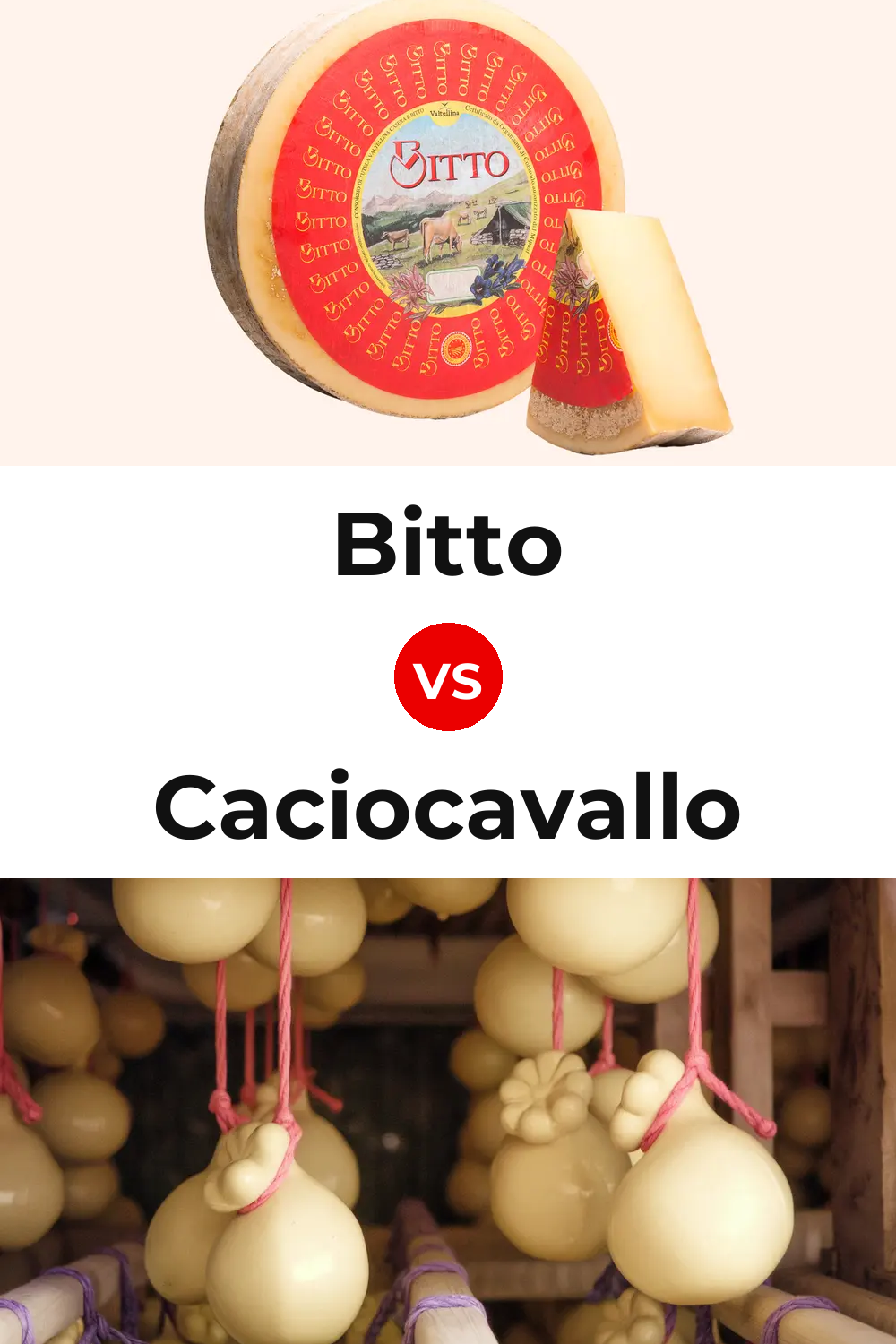
Bitto Cheese is a cow and goat-milk cheese from Italy, while Caciocavallo Cheese is firm to semihard, chewy to crumbly and made from cow milk, originating in Italy.
What Is Bitto Cheese?
Bitto is a historic cheese from the Valtellina valley in Lombardy, Italy. It is made from a mix of cow's and goat’s milk, giving it a unique, rich flavor. Aged Bitto can mature for up to 10 years, during which it develops a granular texture and deep, complex flavors ranging from fruity to nutty.
What Is Caciocavallo Cheese?
Caciocavallo is a traditional Italian cheese made primarily from cow's milk, although some versions use sheep's milk. It has a distinctive teardrop shape and a smooth, golden rind. This semi-hard cheese is aged for two to six months and has a mild, slightly tangy flavor that becomes more pronounced with age.
What's the Difference Between Bitto Cheese and Caciocavallo Cheese?
- Milk type: Bitto Cheese (Cow's milk primarily, with non-mandatory addition of raw goat’s milk up to 10%), Caciocavallo Cheese (cow's milk)
- Aging: Bitto Cheese (Minimum of 70 days), Caciocavallo Cheese (2 to 12 months, up to 5 years)
Side-by-Side Comparison
| Bitto Cheese | Caciocavallo Cheese | |
|---|---|---|
| Country of Origin | Italy | Italy |
| Specific Origin | Province Of Sondrio, Lombardy, Including Neighboring Upland Pastures Of Lecco And Bergamo | Apennine Mountain Range |
| Milk Type | Cow's milk primarily, with non-mandatory addition of raw goat’s milk up to 10% | Cow's milk |
| Milk Treatment | Raw | — |
| Texture | — | Firm to semihard, chewy to crumbly |
| Rind | — | Smooth, thickens with age |
| Aging | Minimum of 70 days | 2 to 12 months, up to 5 years |
| Taste | — | Slightly sweet to sharp, piquant, complex |
Taste Comparison: Does Bitto Cheese Taste Like Caciocavallo Cheese?
Their flavor profiles are distinct. More specifically, Bitto Cheese shows cooked at 118–126°f, finely cut curd, matured for a minimum of 70 days, while Caciocavallo Cheese leans toward sweet when young; intensifies and becomes piquant and complex with age, dotted with small crystals. Aging plays into this as well. Bitto Cheese at minimum of 70 days develops a different profile than Caciocavallo Cheese at 2 to 12 months, up to 5 years.
Can You Substitute Bitto Cheese for Caciocavallo Cheese?
Bitto Cheese can stand in for Caciocavallo Cheese in many dishes, but the switch will shift the overall character of the recipe.
Which Is Better, Bitto Cheese or Caciocavallo Cheese?
There's no single winner. It depends on your recipe and the profile you want.
Which is your favorite?
One click, anonymous. See what others chose.
Frequently Asked Questions
Is Bitto Cheese the same as Caciocavallo Cheese?
No, they're distinct cheeses. Bitto Cheese is made from cow and goat milk; Caciocavallo Cheese uses cow. Aging also differs: Bitto Cheese is typically aged minimum of 70 days, Caciocavallo Cheese 2 to 12 months, up to 5 years.
Is Bitto Cheese similar to Caciocavallo Cheese?
Not closely. They use different milk bases and have distinct profiles.
Can I substitute Bitto Cheese for Caciocavallo Cheese?
You can, but expect a shift in richness and milk character.
Does Bitto Cheese taste like Caciocavallo Cheese?
They have distinct flavor profiles. The taste row in the table above is the best direct comparison.
What is Bitto Cheese made of?
Bitto Cheese is made from cow and goat milk (raw), using calf rennet. It's typically aged minimum of 70 days. It originates in Italy.
What is Caciocavallo Cheese made of?
Caciocavallo Cheese is made from cow milk. It's typically aged 2 to 12 months, up to 5 years. It originates in Italy.
Which should I choose, Bitto Cheese or Caciocavallo Cheese?
It depends on the dish. The table above is the fastest way to decide based on your recipe.