
Liliputas 
Liliputas is a small semi-hard cheese made by hand at the Belvederis dairy in Lithuania's Jurbarkas district since 1958. It ripens for 30 days in village cellars, where a local fungus gives it a fresh lactic taste.
Find Liliputas Cheese
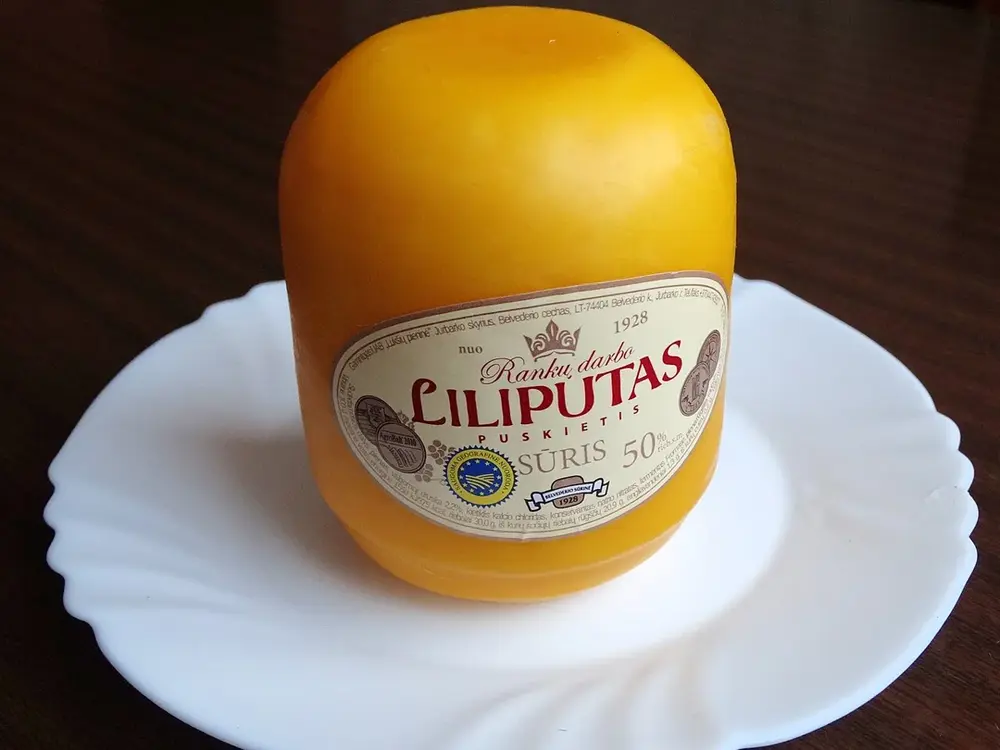
Vilensija, CC BY-SA 3.0, via Wikimedia Commons
Key Facts
| Country of Origin | Lithuania |
| Specific Origin | Belvederis |
| Protection | PGI (2011) |
| Milk Type | Cow's milk |
| Milk Treatment | Pasteurized |
| Fat Content | 50% |
| Rind | Waxed |
| Texture | Semi-hard |
| Flavor | Milky |
| Aroma | Fresh, lactic |
| Colors | Yellow |
| Forms | Cylinders with rounded edges, 7.5 to 13 cm high, 7 to 8.5 cm across, 0.4 to 0.7 kg |
| Age | 30 days |
What is Liliputas Cheese?
The dairy at Belvederis was set up in 1928 on the grounds of the manor house, inside an agricultural school. Milk was warmed in a vat over a wood fire, the separator was hand cranked, and the moulds were wooden. Ice cut from the Nemunas cooled the cellars. Until 1958 the dairy made round semi-hard cheeses of 2.5 to 3 kg, then it began making small 0.4 to 0.7 kg ones and named them Liliputas. Jonas Jarušaitis was the first master to learn the method. Eight tonnes ripened in the first year; forty years later output had reached 130 tonnes.
In March 2015 the European Commission entered Liliputas in the register of protected geographical indications, the seventh Lithuanian food to be listed. The name comes from the cheese's small size and carries no geographical sense of its own, but in Lithuania it is tied to Belvederis village, because the taste depends on Penicillium pallidum Smith, a microscopic fungus that lives in the cellars there. Attempts to carry the fungus to other plants, and even abroad, failed.
The work is manual. The curd is cut and laid into cylindrical moulds by hand, wrapped in damp napkins, turned, washed, wiped and waxed, and each head is picked up more than fifty times during production. Self-pressing runs 20 to 25 minutes, pressing another 1.5 to 2 hours, then the cheeses spend two days in brine. They ripen on cellar shelves at 10 to 14 °C and 93 to 94 percent humidity, where the fungus covers them until they start to look like silkworm cocoons. They are turned every five days, washed clean after 15, and finished at 30 days, when the coating is washed off again and a layer of wax goes on. Compared with automated dairies, the cheese costs twice as much to make.
A head is a cylinder with rounded edges, 7.5 to 13 cm tall and 7 to 8.5 cm across, weighing 0.4 to 0.7 kg, with 50 percent fat in dry matter. The wax coat is there to keep the product fresh, and the rind formed during pressing keeps the fungus out of the paste. The taste is mild, the body even, and the lactic freshness comes from the cellar fungus.
Liliputas is eaten as a snack and used to season dishes. It keeps at 0 to 6 °C in air no damper than 85 percent relative humidity, and is sold by weight, by the piece, and as 0.3 kg souvenir heads packed one to a branded box. It has taken a gold medal at the Agra-76 show, gold as Lithuanian Product of the Year 2002, and bronze at World Food Moscow 2005.
How Does Liliputas Cheese Compare?
The most relevant cheeses to compare Liliputas against.


