Tilsit Cheese vs Traditional Ayrshire Dunlop Cheese
Tilsit Cheese
Traditional Ayrshire Dunlop Cheese
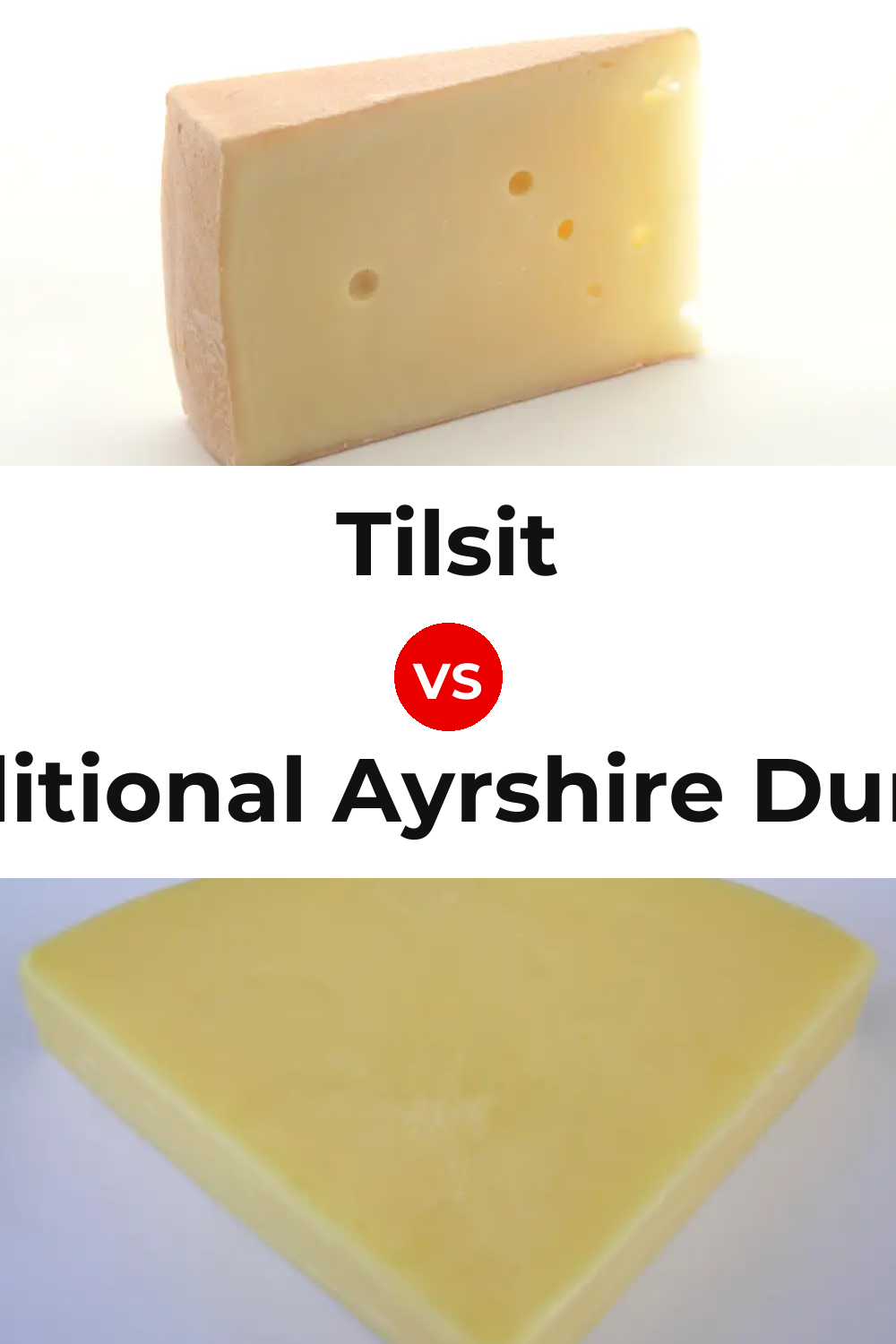
Tilsit Cheese is a semi-hard cow-milk cheese from Germany, while Traditional Ayrshire Dunlop Cheese is hard and made from cow milk.
What Is Tilsit Cheese?
Tilsiter, or Tilsit, is a semi-hard cheese originally made by Prussian-Swiss immigrants in the town of Tilsit. Made from cow's milk, it has a pungent aroma and a strong, slightly fruity and nutty flavor. The texture is firm yet creamy with irregular holes. It’s used in sandwiches, on cheese platters, or melted in cooking.
What Is Traditional Ayrshire Dunlop Cheese?
Traditional Ayrshire Dunlop is a hard cheese made in the parish of Dunlop, Scotland, using milk from Ayrshire cows. It has a natural pale yellow color and a smooth, close surface that feels moist when cut. The cheese develops a mild, nutty flavor when young, becoming creamier and more pronounced as it matures. It has a thin golden rind and a firm body that becomes drier with age. Ayrshire cows' milk, known for its smaller fat globules, helps retain moisture in the curd, contributing to the cheese's characteristic smooth texture. The cheese is traditionally cloth-bound and matured for a minimum of 6 months, with popular aging periods between 10 and 12 months. It is made using open vats, hand-cut curds, and a scalding process to develop its distinctive rind. Traditional Ayrshire Dunlop continues to be produced using the same artisan techniques established over 300 years ago.
What's the Difference Between Tilsit Cheese and Traditional Ayrshire Dunlop Cheese?
- Milk treatment: Tilsit Cheese (Raw and pasteurized), Traditional Ayrshire Dunlop Cheese (Raw or pasteurized)
- Texture: Tilsit Cheese (Semi-Hard), Traditional Ayrshire Dunlop Cheese (Hard)
- Rind: Tilsit Cheese (Washed-rind/ Dry rind), Traditional Ayrshire Dunlop Cheese (Hard, thin, golden, slightly mottled, cloth-bound)
- Aging: Tilsit Cheese (3 months / Variable), Traditional Ayrshire Dunlop Cheese (6 to 18 months (mild: 6–10 months, mature: 10–12 months, extra mature: 12–18 months))
- Taste: Tilsit Cheese (Pungent, balanced), Traditional Ayrshire Dunlop Cheese (Mild and nutty when young, develops creamier, stronger nutty flavors with age)
Side-by-Side Comparison
| Tilsit Cheese | Traditional Ayrshire Dunlop Cheese | |
|---|---|---|
| Country of Origin | Germany | — |
| Specific Origin | Northern Germany/Baltic And Northern Switzerland | Dunlop, East Ayrshire |
| Milk Type | Cow’s milk | Cow |
| Milk Treatment | Raw and pasteurized | Raw or pasteurized |
| Texture | Semi-Hard | Hard |
| Rind | Washed-rind/ Dry rind | Hard, thin, golden, slightly mottled, cloth-bound |
| Aging | 3 months / Variable | 6 to 18 months (mild: 6–10 months, mature: 10–12 months, extra mature: 12–18 months) |
| Taste | Pungent, balanced | Mild and nutty when young, develops creamier, stronger nutty flavors with age |
Taste Comparison: Does Tilsit Cheese Taste Like Traditional Ayrshire Dunlop Cheese?
Tilsit Cheese reads as pungent, balanced, while Traditional Ayrshire Dunlop Cheese brings mild and nutty when young, develops creamier, stronger nutty flavors with age character. More specifically, Tilsit Cheese shows northern: pungent aroma, sweet; swiss: strong, sweetness, while Traditional Ayrshire Dunlop Cheese leans toward subtle, rich, creamy, slightly sweet and nutty. Aging plays into this as well. Tilsit Cheese at 3 months / variable develops a different profile than Traditional Ayrshire Dunlop Cheese at 6 to 18 months (mild: 6–10 months, mature: 10–12 months, extra mature: 12–18 months).
Can You Substitute Tilsit Cheese for Traditional Ayrshire Dunlop Cheese?
In most recipes, Tilsit Cheese and Traditional Ayrshire Dunlop Cheese can be swapped with reasonable results. Both are cow-milk cheeses, so the base character carries over. Expect semi-hard bite and body where the recipe calls for hard. Flavor-wise, Tilsit Cheese reads as pungent, balanced while Traditional Ayrshire Dunlop Cheese brings mild and nutty when young, develops creamier, stronger nutty flavors with age notes.
Which Is Better, Tilsit Cheese or Traditional Ayrshire Dunlop Cheese?
There's no single winner. It depends on your recipe and the profile you want. If you want a semi-hard cheese, go with Tilsit Cheese. For a hard profile, Traditional Ayrshire Dunlop Cheese is the better fit. Flavor-wise, Tilsit Cheese suits recipes that want pungent, balanced notes, while Traditional Ayrshire Dunlop Cheese fits dishes calling for mild and nutty when young, develops creamier, stronger nutty flavors with age.
Which is your favorite?
One click, anonymous. See what others chose.
Frequently Asked Questions
Is Tilsit Cheese the same as Traditional Ayrshire Dunlop Cheese?
No, they're distinct cheeses. Aging also differs: Tilsit Cheese is typically aged 3 months / variable, Traditional Ayrshire Dunlop Cheese 6 to 18 months (mild: 6–10 months, mature: 10–12 months, extra mature: 12–18 months).
Is Tilsit Cheese similar to Traditional Ayrshire Dunlop Cheese?
Somewhat. They share a cow-milk base but diverge in texture and flavor.
Can I substitute Tilsit Cheese for Traditional Ayrshire Dunlop Cheese?
You can, but expect a shift in bite and mouthfeel.
Does Tilsit Cheese taste like Traditional Ayrshire Dunlop Cheese?
Tilsit Cheese reads as pungent, balanced, while Traditional Ayrshire Dunlop Cheese is mild and nutty when young, develops creamier, stronger nutty flavors with age.
What is Tilsit Cheese made of?
Tilsit Cheese is made from cow milk (raw and pasteurized), using traditional rennet. It's typically aged 3 months / variable. It originates in Germany.
What is Traditional Ayrshire Dunlop Cheese made of?
Traditional Ayrshire Dunlop Cheese is made from cow milk (raw or pasteurized). It's typically aged 6 to 18 months (mild: 6–10 months, mature: 10–12 months, extra mature: 12–18 months).
Which should I choose, Tilsit Cheese or Traditional Ayrshire Dunlop Cheese?
It depends on the dish. The texture difference is the biggest practical tell. Tilsit Cheese is semi-hard, while Traditional Ayrshire Dunlop Cheese is hard.