Tilsit
Tilsit, also spelled Tilsiter, is a pale yellow semihard smear-ripened cow's milk cheese created in the mid-19th century by Prussian-Swiss settlers in the East Prussian town of Tilsit. It is medium firm with irregular holes, and often flavoured with caraway seed.
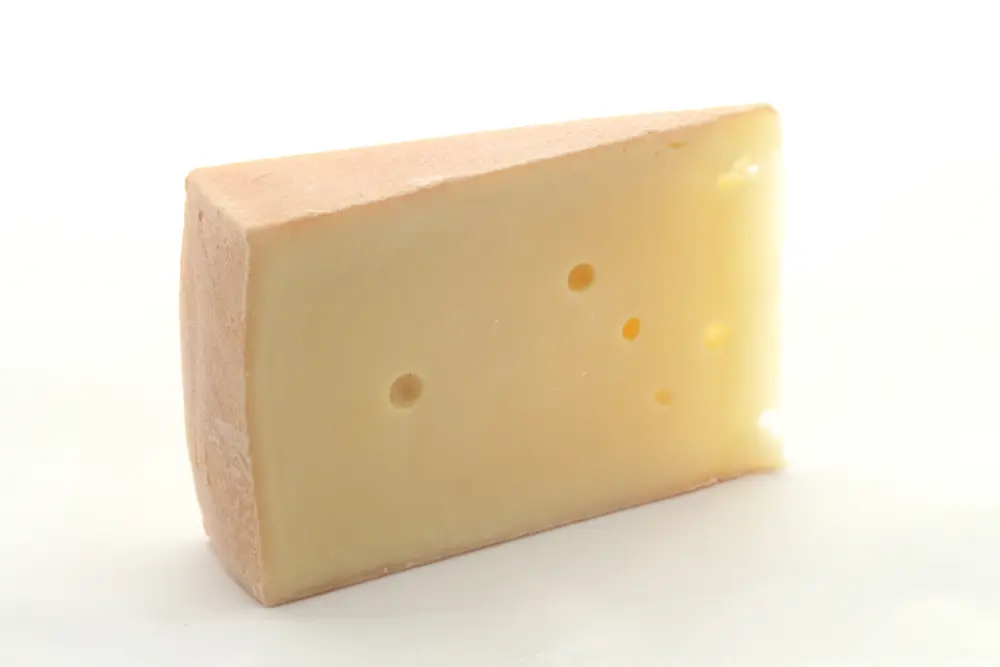
Guy Waterval, CC BY-SA 4.0, via Wikimedia Commons
Key Facts
| Country of Origin | Germany |
| Specific Origin | Northern Germany/Baltic and northern Switzerland |
| Milk Type | Cow’s milk |
| Milk Treatment | Raw and pasteurized |
| Fat Content | 30 to 60% milk fat |
| Rind | Washed-rind/ Dry rind |
| Texture | Semi-Hard |
| Flavor | Pungent, balanced |
| Aroma | Pungent, complex |
| Colors | Yellowish |
| Forms | Rectangular / Round pressed wheels |
| Age | 3 months / Variable |
| Rennet Type | Traditional |
| Alternative Spellings | Tilsiter |
| Also Known As | Holsteiner Tilsiter, Rahm-Tilsiter |
What is Tilsit Cheese?
Tilsit, or Tilsiter, goes back to the middle of the 19th century, when Prussian-Swiss settlers from the Emmental valley, the Westphal family, began making cheese in the East Prussian town of Tilsit on the Neman River. They named the cheese after the town. The original cheese plant buildings still stand there, in what is now Sovetsk, Russia.
The settlers could not get the same ingredients they had used at home, and in the humid climate the cheese was colonized by different moulds, yeasts and bacteria. The result was more intense and fuller flavoured than the cheese they had set out to copy. After World War II, when Tilsit and the rest of northern East Prussia became the Soviet Kaliningrad Oblast, Tilsiter-style cheeses were produced in Switzerland and Germany.
Commercial Tilsiter is made from pasteurized cow's milk and ranges from 30 to 60 percent milk fat. It is smear-ripened, and after the main part of production the cheese rests for another two months. Swiss Tilsiter comes in three main versions: a mild green label from pasteurised milk, a more strongly flavoured red label from fresh unpasteurized milk, and the yellow label Rahm-Tilsiter, made from pasteurized milk with added cream.
The paste is pale yellow and medium firm, cut through with irregular holes or cracks, under a dark yellow rind. Caraway seed and peppercorns are common additions.
This is a common table cheese that also holds up in cooking. It can be cubed into salads, melted into sauces, served on potatoes, baked in flans, or laid on a burger, and it goes well with hearty brown and rye breads and dark beers. Production spread to Switzerland in 1893 and to Germany in 1920, where it carries the protected brand name Holsteiner Tilsiter, and the cheese is now also made in Austria, Finland, Estonia, Latvia, Lithuania, Poland, Romania, Russia and Ukraine.
How Does Tilsit Cheese Compare?
The most relevant cheeses to compare Tilsit against.


