
Brunost Cheese vs Parmesan Cheese
Brunost Cheese
Parmesan Cheese
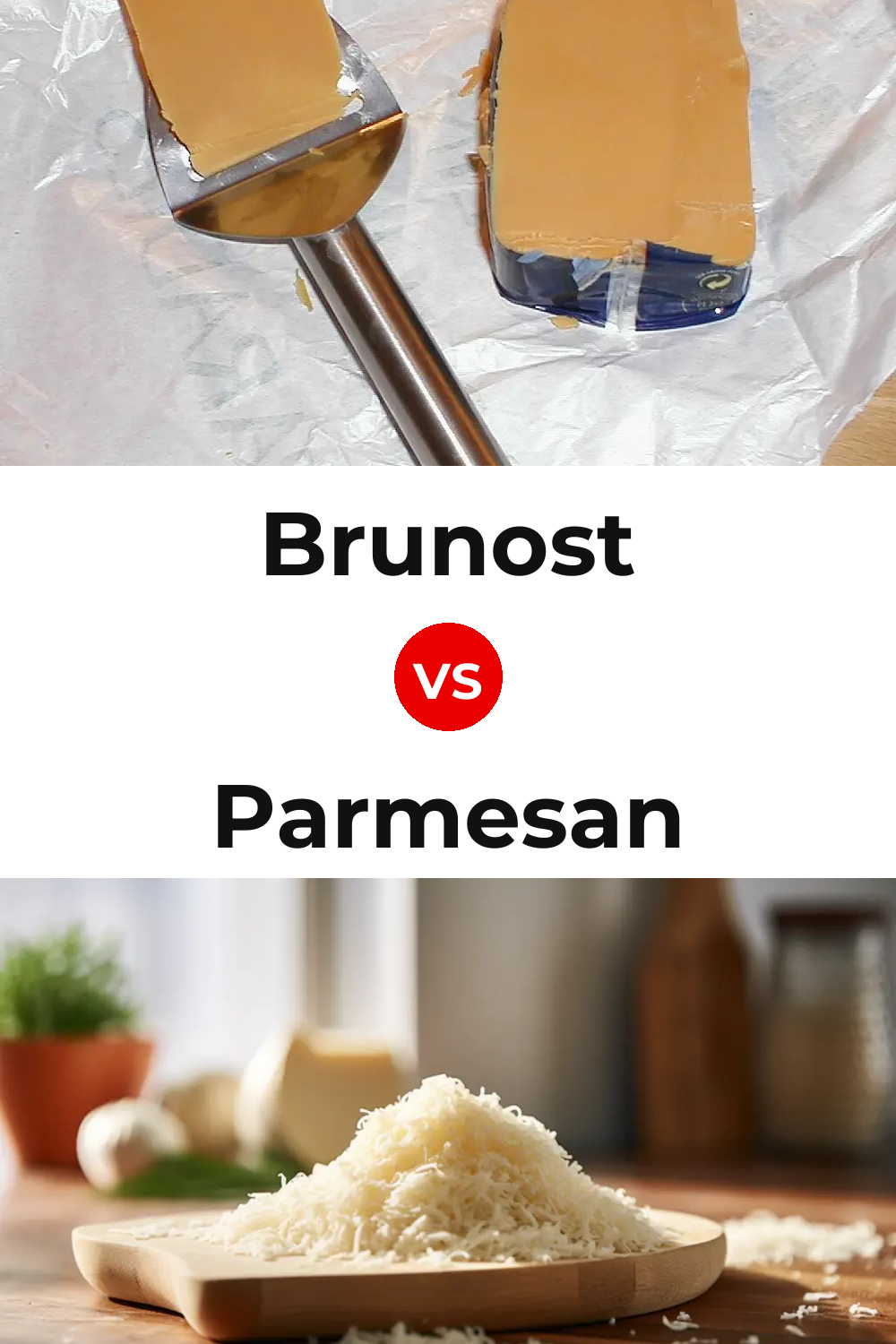
Brunost Cheese is a semi-soft, whey cow and goat-milk cheese from Denmark, Finland, Germany, Iceland, Norway and Sweden, while Parmesan Cheese is hard, artisan and made from cow milk, originating in Italy.
What Is Brunost Cheese?
Brunost is a Norwegian whey product made by boiling whey with milk and cream until the milk sugars caramelize. It is brown, sweet and firm enough to slice, and it is eaten like cheese on sandwiches, crispbread and waffles.
What Is Parmesan Cheese?
Parmesan, or Parmigiano Reggiano, is a hard granular cow's milk cheese from northern Italy, aged at least 12 months. It is known for its sharp, salty, savory taste, which comes from an unusually high level of glutamate.
What's the Difference Between Brunost Cheese and Parmesan Cheese?
- Origin: Brunost Cheese (Denmark, Finland, Germany, Iceland, Norway and Sweden), Parmesan Cheese (Italy)
- Milk type: Brunost Cheese (cow's and goat's milk), Parmesan Cheese (cow's milk)
- Milk treatment: Brunost Cheese (pasteurized or unpasteurized), Parmesan Cheese (unpasteurized)
- Texture: Brunost Cheese (semi-soft, whey), Parmesan Cheese (hard, artisan)
- Aging: Brunost Cheese (unaged, ready once packed and refrigerated), Parmesan Cheese (minimum 12 months, average 2 years)
- Taste: Brunost Cheese (caramel, sweet), Parmesan Cheese (salty, savory)
Side-by-Side Comparison
| Brunost Cheese | Parmesan Cheese | |
|---|---|---|
| Country of Origin | Denmark, Finland, Germany, Iceland, Norway And Sweden | Italy |
| Specific Origin | Gudbrandsdalen, Norway | Parma And Reggio Emilia, Emilia-Romagna, Italy |
| Milk Type | Cow's and goat's milk | Cow's milk |
| Milk Treatment | Pasteurized or unpasteurized | Unpasteurized |
| Texture | Semi-soft, whey | Hard, artisan |
| Rind | Natural | Natural |
| Aging | Unaged, ready once packed and refrigerated | Minimum 12 months, average 2 years |
| Taste | Caramel, sweet | Salty, savory |
Taste Comparison: Does Brunost Cheese Taste Like Parmesan Cheese?
Brunost Cheese reads as caramel, sweet, while Parmesan Cheese brings salty, savory character. More specifically, Brunost Cheese shows sweet, caramel-like, with a tang that is stronger in goat's milk versions, while Parmesan Cheese leans toward sharp, salty, savory, strong umami. Aging plays into this as well. Brunost Cheese at unaged, ready once packed and refrigerated develops a different profile than Parmesan Cheese at minimum 12 months, average 2 years.
Can You Substitute Brunost Cheese for Parmesan Cheese?
Brunost Cheese can stand in for Parmesan Cheese in many dishes, but the switch will shift the overall character of the recipe. Expect semi-soft, whey bite and body where the recipe calls for hard, artisan. Flavor-wise, Brunost Cheese reads as caramel, sweet while Parmesan Cheese brings salty, savory notes.
Which Is Better, Brunost Cheese or Parmesan Cheese?
There's no single winner. It depends on your recipe and the profile you want. If you want a semi-soft, whey cheese, go with Brunost Cheese. For a hard, artisan profile, Parmesan Cheese is the better fit. Flavor-wise, Brunost Cheese suits recipes that want caramel, sweet notes, while Parmesan Cheese fits dishes calling for salty, savory.
Which is your favorite?
One click, anonymous. See what others chose.
Frequently Asked Questions
Is Brunost Cheese the same as Parmesan Cheese?
No, they're distinct cheeses. Brunost Cheese originates in Denmark, Finland, Germany, Iceland, Norway and Sweden, while Parmesan Cheese comes from Italy. Brunost Cheese is made from cow and goat milk; Parmesan Cheese uses cow. Aging also differs: Brunost Cheese is typically aged unaged, ready once packed and refrigerated, Parmesan Cheese minimum 12 months, average 2 years.
Is Brunost Cheese similar to Parmesan Cheese?
Not closely. They use different milk bases and have distinct profiles.
Can I substitute Brunost Cheese for Parmesan Cheese?
You can, but expect a shift in richness and milk character.
Does Brunost Cheese taste like Parmesan Cheese?
Brunost Cheese reads as caramel, sweet, while Parmesan Cheese is salty, savory.
What is Brunost Cheese made of?
Brunost Cheese is made from cow and goat milk (pasteurized or unpasteurized). It's typically aged unaged, ready once packed and refrigerated. It originates in Denmark, Finland, Germany, Iceland, Norway and Sweden.
What is Parmesan Cheese made of?
Parmesan Cheese is made from cow milk (unpasteurized), using animal (calf rennet) rennet. It's typically aged minimum 12 months, average 2 years. It originates in Italy.
Which should I choose, Brunost Cheese or Parmesan Cheese?
It depends on the dish. The texture difference is the biggest practical tell. Brunost Cheese is semi-soft, whey, while Parmesan Cheese is hard, artisan.