Parmesan
Parmesan, or Parmigiano Reggiano, is a hard granular cow's milk cheese from northern Italy, aged at least 12 months. It is known for its sharp, salty, savory taste, which comes from an unusually high level of glutamate.
Key Facts
| Country of Origin | Italy |
| Specific Origin | Parma and Reggio Emilia, Emilia-Romagna, Italy |
| Milk Type | Cow's milk |
| Milk Treatment | Unpasteurized |
| Rind | Natural |
| Texture | Hard, artisan |
| Flavor | Salty, savory |
| Aroma | Nutty, strong |
| Colors | Straw |
| Forms | Wheels about 40 to 45 cm (16 to 18 in) across, 38 kg (84 lb) |
| Age | Minimum 12 months, average 2 years |
| Rennet Type | Animal (calf rennet) |
| Also Known As | Parmigiano Reggiano, Parmesan Regiano, Parmesan Reggiano, Parmesan Parmigiano |
What is Parmesan Cheese?
Legend places the birth of Parmigiano Reggiano in the Middle Ages, in the town of Bibbiano in the province of Reggio Emilia. The earliest written record of the cheese dates to 1254. Boccaccio praised it in the Decameron in 1348, and during the Great Fire of London in 1666 Samuel Pepys buried his Parmesan cheese along with his wine to save it. The name is protected: in the European Union, Parmigiano Reggiano is a protected designation of origin covering Parma, Reggio Emilia, Modena, part of Bologna and part of Mantua.
The cheese is made from unpasteurised cow's milk. Whole morning milk is mixed with naturally skimmed milk from the previous evening, then pumped into copper-lined vats. Starter whey goes in, the temperature rises to 33 to 35 C (91 to 95 F), and calf rennet sets the mixture in 10 to 12 minutes. The curd is cut to the size of rice grains, heated to 55 C (131 F), then left to settle and pressed into molds. Wheels soak in brine for 20 to 25 days and then age on wooden shelves, turned and cleaned every seven days.
At 12 months a grader taps every wheel with a small hammer, listening for cracks and voids inside. The job takes six or seven seconds per wheel. Top-grade wheels get the Consortium's logo branded on the rind. Second-tier wheels are marked with lines or crosses so buyers know the difference, and third-category cheese loses its rind markings entirely.
A typical wheel stands 18 to 24 cm (7 to 9 in) high, measures 40 to 45 cm (16 to 18 in) across, and weighs 38 kg (84 lb). The cheese is hard, dry and grainy, and has been so since the 15th century. Salt is the only additive allowed. Parmigiano Reggiano carries up to 1.2 g of glutamate per 100 g, which accounts for its strong umami taste.
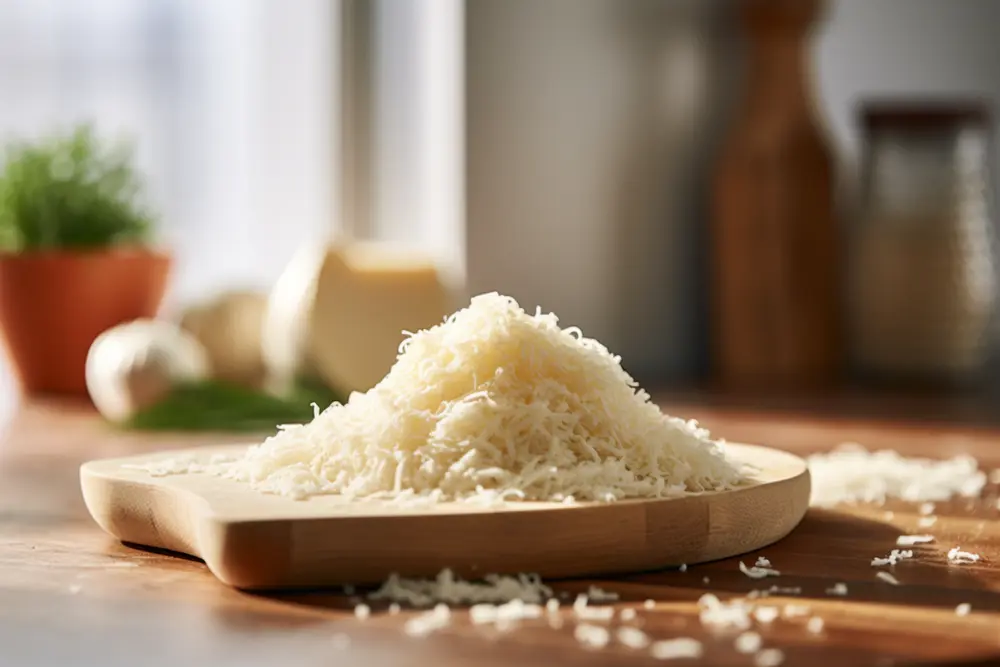
Most of it is grated over pasta, stirred into soups and risottos, or eaten in chunks on its own. It is also shaved over salads. The hardest pieces of crust get simmered in broths and sauces for flavor, broiled as a snack when they carry no wax, infused in olive oil, or dropped into a steamer basket with vegetables.
How Does Parmesan Cheese Compare?
The most relevant cheeses to compare Parmesan against.


