
Puzzone di Moena 
Puzzone di Moena is a semi-hard Italian PDO cheese made from raw cow's milk in Val di Fassa, Val di Fiemme and Valle di Primiero. Its washed rind is brick red and greasy, and the cheese is known for a penetrating odor with hints of ammonia.
Find Puzzone di Moena Cheese
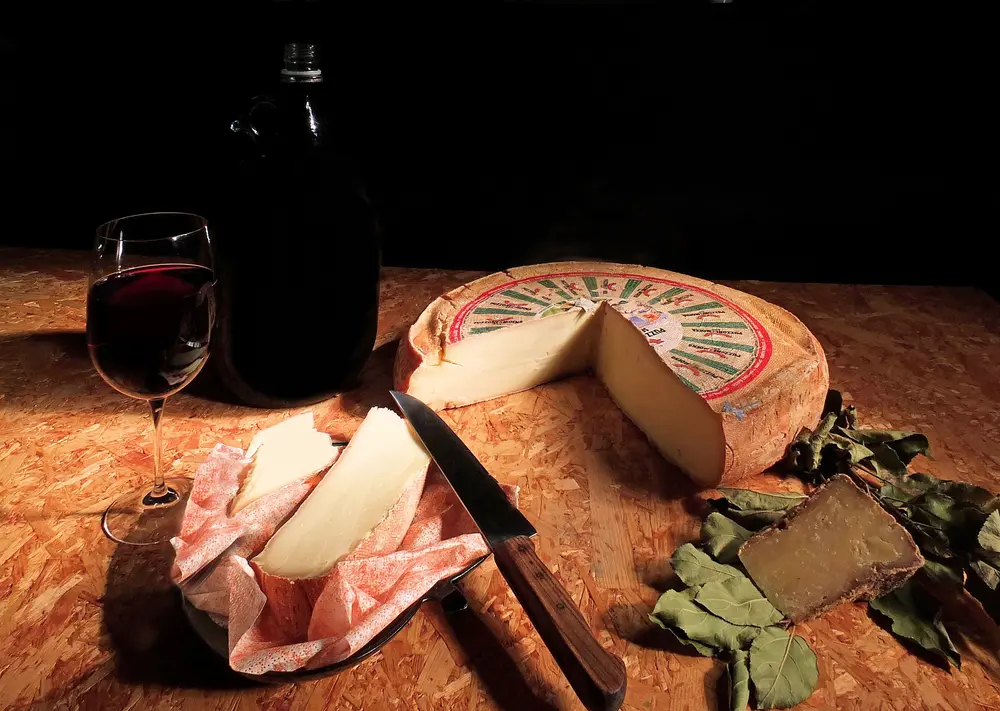
Ferruccio Zanone from Biella, Italia, CC BY-SA 2.0, via Wikimedia Commons
Key Facts
| Country of Origin | Italy |
| Specific Origin | Province of Trento and Province of Bolzano |
| Protection | PDO (2012) |
| Milk Type | Cow |
| Milk Treatment | Raw, partially skimmed by natural surface skimming |
| Fat Content | Not more than 45% of dry matter |
| Moisture Content | 34% to 44% |
| Rind | Smooth or with a few wrinkles, unctuous, yellow ochre to reddish brown |
| Texture | Semi-cooked, medium-hard, elastic |
| Flavor | Strong, intense, slightly salty and/or sharp, with a barely-perceptible bitter aftertaste |
| Aroma | Strong and penetrating, with a slight hint of ammonia |
| Colors | White to light yellow |
| Forms | Cylindrical, 4–5 inches high, 13–17 inches diameter, 20–29 pounds |
| Age | Minimum 90 days, mature after 150 days |
| Rennet Type | Bovine rennet |
| Also Known As | Spretz Tzaorì |
What is Puzzone di Moena Cheese?
Puzzone di Moena is an Italian PDO cheese with a washed rind and a fat, semi-hard pressed paste made from raw cow's milk. It is typical of Moena and, more broadly, of Val di Fassa, Val di Fiemme and Valle di Primiero in Trentino-Alto Adige. It became a PDO product in March 2013, after years as a PAT product, and received PDO recognition from the European Union in 2014.
The cheese goes back many decades, to when mountain pastures, farms and dairies in Val di Fassa made a cheese called Nostrano fassano, with an unctuous rind and a strong-smelling, tasty paste. Neighboring valleys had their own versions, Nostrano della Val di Fiemme and Nostrano di Primiero. After the First World War, Fassa malgarians began washing their nostrani with water and salt once the wheels came back from the dairies. The current name arrived in the summer of 1974, when a Sunday RAI radio broadcast from Trento jokingly called the social dairy of Moena's cheese "Puzzone di Moena," big stinky of Moena. The joke stuck, and in 1984 the cheese took a bronze medal at the Concours International des Fromages de Montagne in Grenoble.
The Ladin name spretz tzaorì means tasty pressed cheese. Spretz comes from the dialect word for spressa, the congealed cheese mass pressed and squeezed free of fat. Mountain cheesemakers once pulled as much butter as possible out of the milk, since butter was worth more, and what was left became a low-fat cheese for the rural table.
Whole raw milk is heated to 44 °C (111 °F) to make this semi-cooked cheese. Through the first weeks the wheels are turned and wetted twice a week with warm, slightly salted water, then once a week until the end of maturing, which runs three to eight months in a cool, humid room. The washing forms a patina that wraps the wheel, helps the paste ferment, and leaves the rind greasy and brick red.
Wheels are cylindrical, with a heel of 9 to 11 cm (3.5 to 4.3 in), a diameter of about 35 cm (14 in), and a weight near 10 kg (22 lb). The paste is semi-hard and light straw colored, with small to medium eyes scattered through it. Flavor is robust and slightly spicy with a faint bitter aftertaste. The odor is penetrating, carrying hints of animals and understory along with ammonia, though in the mouth the aroma can read as less intense than a blue cheese.
The strong, salty, almost spicy taste made the cheese useful to poor mountain farmers. Even a small piece gave flavor to a modest diet built on polenta and potatoes.
How Does Puzzone di Moena Cheese Compare?
The most relevant cheeses to compare Puzzone di Moena against.


.jpg)