Robiola
Robiola is an Italian soft-ripened cheese from the Langhe, made with varying proportions of cow's, goat's and sheep's milk. Its taste and look shift by producer, from the rindless Robiola di Roccaverano to the bloomy-rinded Robiola Lombardia.
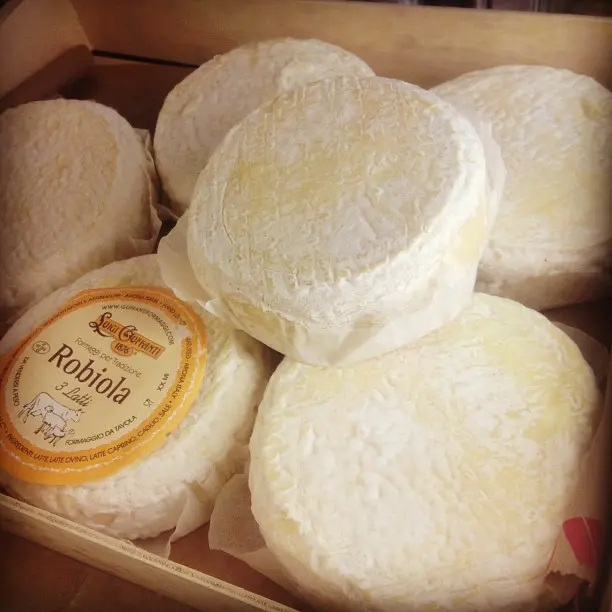
Neil Conway from Oakland, USA, CC BY 2.0, via Wikimedia Commons
Key Facts
| Country of Origin | Italy |
| Specific Origin | Langhe, Piedmont, Italy |
| Milk Type | Cow, goat, sheep |
| Fat Content | 52% |
| Rind | Bloomy, or none depending on variety |
| Texture | Soft-ripened, creamy |
| Flavor | Tangy, mildly sour |
| Aroma | Mild, no ammonia |
| Colors | Cream to straw-yellow paste, milky-white to pink rind |
| Forms | Small rolls |
What is Robiola Cheese?
Robiola is an Italian soft-ripened cheese of the stracchino family, from the Langhe region. One theory holds that the name comes from the comune of Robbio, in the province of Pavia. Another traces it to the word rubeole, meaning ruddy, after the color of the seasoned rind.
The cheese has a long history, sometimes traced to the Celto-Ligurian farmers of the Alta Langa. Pliny the Elder praised cheese from Ceba, today Ceva, in his first-century Natural History, though linking that cheese to modern robiola is speculative. In the fifteenth century, the dairy expert Pantaleone da Confienza described its manufacture and praised its quality in his Summa Lacticiniorum.
It is made with varying proportions of cow's, goat's and sheep's milk. In the Piedmont style, seen in La Tur, the fresh curds are ladled into molds and drained under their own weight before aging, instead of being pressed with weights. Varieties come from the provinces of Cuneo, Asti and Alessandria, on into Lombardy, and robiola counts as one of the specialties of the Aosta Valley.
Taste and appearance depend on where the cheese was made. Robiola di Roccaverano DOC/PDO has no rind, a faint straw-yellow color and a sweet, yielding taste. Robiola Lombardia comes in small rolls with a thin, milky-white to pink rind; the cream-colored paste under the bloomy rind tastes smooth, full, tangy and mildly sour, probably because of its high fat content of 52 percent. That rind can be cut away, but it is mild with no ammonia and adds a subtle crunch. La Tur has a cake-like rind over a tangy-lactic layer of cream.
Robiola from Piedmont is a fresh cheese. It is usually eaten on its own, or with a little honey.
How Does Robiola Cheese Compare?
The most relevant cheeses to compare Robiola against.


.jpg)