Gorgonzola 
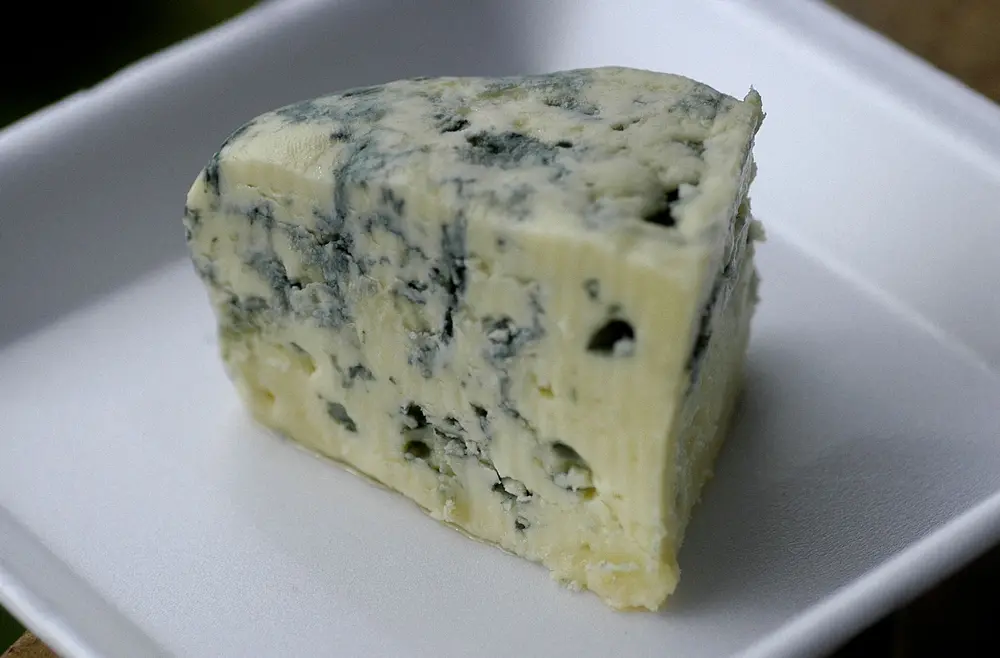
Gorgonzola is an Italian blue cheese made from unskimmed cow's milk, named for a town near Milan. It comes in two styles: dolce, mild and buttery, and piccante, sharper with a firm, crumbly body.
Key Facts
| Country of Origin | Italy |
| Specific Origin | Lombardy, Piedmont |
| Protection | PDO (1996) |
| Milk Type | Cow's milk |
| Milk Treatment | Pasteurized |
| Fat Content | 25-35% |
| Rind | None |
| Texture | Soft to crumbly |
| Flavor | Sweet to savory |
| Aroma | Nutty |
| Colors | Straw-white, blue-green veins |
| Forms | 13 to 26 pounds |
| Age | 2 to 3 months |
| Also Known As | Gorgonzola naturale, Gorgonzola montagna |
What is Gorgonzola Cheese?
Gorgonzola is an Italian blue cheese made from unskimmed cow's milk, believed to date to the 9th century. It takes its name from the Lombardian town of Gorgonzola, near Milan, where the cheese acquired its greenish-blue marbling in the 11th century. Nearby towns dispute that claim. One rival is Pasturo nella Valsassina, where natural caves sit between 6 and 12 degrees Celsius, the right range for ripening it.
Until the early 20th century the cheese went by the name stracchino verde. It was recognized as a DOC in 1955 in both its dolce and piccante forms, and since 1996 it has been registered as a PDO. That status limits production to listed provinces in Piedmont and Lombardy plus several municipalities around Casale Monferrato. Elsewhere the name travels freely, and versions are made in Australia and the United States.
Whey is drawn off during curdling and the cheese is then aged at low temperatures, usually three to four months. Partway through, metal rods are pushed in and pulled straight back out, leaving air channels where mould spores grow into hyphae and create the veining. The longer it ripens, the firmer it gets.
Dolce is the younger of the two. It is buttery, less salty, and finishes slightly sweet. Piccante, also sold as naturale or montagna, ages longer and turns pungent, firm and crumbly. Either one can taste quite salty, and the blue veins add a bite.
Gorgonzola is one of the cheeses in pizza quattro formaggi. It tops steak, sometimes as a sauce with port or another sweet wine, and it can be melted into risotto in the last stage of cooking, added to gnocchi or pasta, or served beside polenta. An ounce has 100 calories, 9 g of fat, 375 mg of sodium, 1 g of carbohydrate and 6 g of protein.
How Does Gorgonzola Cheese Compare?
The most relevant cheeses to compare Gorgonzola against.


