Mozzarella di Bufala Campana 
Loved by 3 people from the United States.
Mozzarella di Bufala Campana is a fresh, soft pasta filata cheese made from the milk of the Italian Mediterranean buffalo, produced in Campania and a few nearby areas under PDO rules. By production value it is Italy's fourth PDO product.
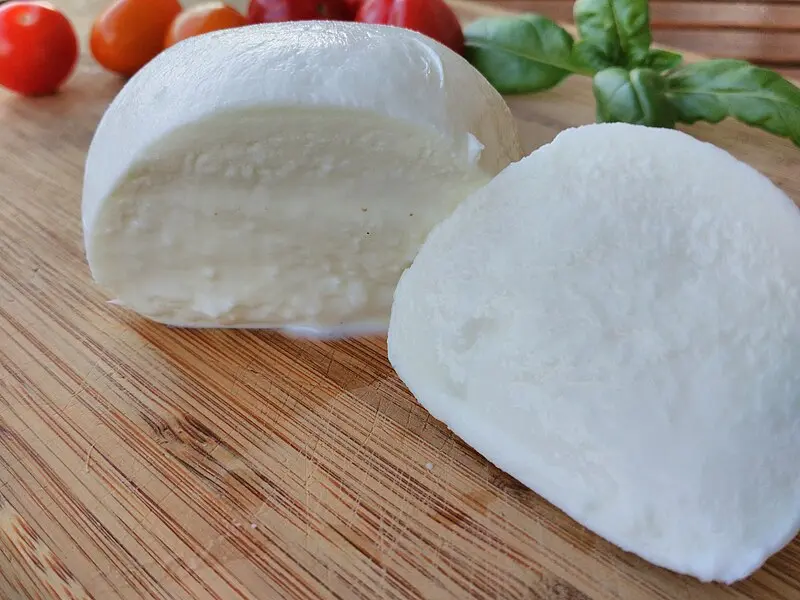
Popo le Chien, CC BY-SA 3.0, via Wikimedia Commons
Key Facts
| Country of Origin | Italy |
| Specific Origin | Campania, Lazio, Puglia, Molise |
| Protection | PDO (1996), DOP (1996) |
| Milk Type | Water buffalo's |
| Milk Treatment | Raw |
| Fat Content | High |
| Moisture Content | High |
| Rind | None |
| Texture | Soft, creamy |
| Flavor | Rich, tangy |
| Aroma | Rich |
| Colors | White, creamy |
| Forms | Balls, sometimes braided or in sheets |
| Age | Eaten fresh |
| Rennet Type | Traditional rennet |
| Also Known As | buffalo mozzarella, mozzarella di bufala, muzzarella 'e vufera |
What is Mozzarella di Bufala Campana Cheese?
Buffalo mozzarella is made from the milk of the Italian Mediterranean buffalo and is traditionally produced in Campania, above all in the provinces of Caserta and Salerno. How the animals reached Italy is still argued over. The producers' consortium calls it most likely that Normans brought them from Sicily around 1000, after Arabs had introduced them there, while a 2020 scientific review traces the Mediterranean buffalo to river buffalo brought from India during the eighth-century Arab occupation of Sicily and southern Italy.
Cheese made from buffalo milk is first recorded at the beginning of the 12th century, and the cheese became widespread across southern Italy from the second half of the 18th century. Before that it was made only in small amounts. Production around Naples stopped briefly during World War II, when retreating German troops slaughtered the local herds, and started again a few years after the armistice.
The name mozzarella di bufala campana was granted denominazione di origine status in 1993, received its trademark registry number in 1996, and was given European protected geographical status and the PDO designation in 2008. The protected area covers all of the provinces of Caserta and Salerno, parts of Benevento and Naples, parts of Frosinone, Latina and Rome in Lazio, part of the comune of Venafro in Molise, and part of the province of Foggia in Puglia. A consortium of roughly 200 producers is responsible for protection, surveillance, promotion and marketing. In 2024 it certified 55,718 tonnes of PDO cheese, worth more than half a billion euros, which puts the cheese fourth among Italian PDO products by production value behind Grana Padano, Parmigiano Reggiano and prosciutto di Parma.
Buffalo milk goes further than cow milk: 5 kg (11 lb) yields 1 kg (2 lb 3 oz) of cheese, against 8 kg (18 lb) of cow milk. Raw milk is stored in steel containers, heated, then curdled with natural whey. The curd rests in tubs until it reaches a pH of about 4.95. Hot water is poured over it so it can be spun into pasta filata, rotating machines shape it, and the pieces are cooled in cold water and pickled in tubs of the original whey before packaging.
The result is a fresh, soft cheese. Per 100 g the consortium lists 17 g protein, 24 g fat, 0.4 g carbohydrate, 245 mg calcium, 320 mg phosphorus and less than 0.4 g lactose. It is eaten on its own with olive oil, with tomatoes, in salads such as Caprese, on grilled bread, with calzone, and on pizza, where a lower moisture version is preferred.
How Does Mozzarella di Bufala Campana Cheese Compare?
The most relevant cheeses to compare Mozzarella di Bufala Campana against.


