Coulommiers Cheese vs Queso de Acehúche
Coulommiers Cheese
Queso de Acehúche
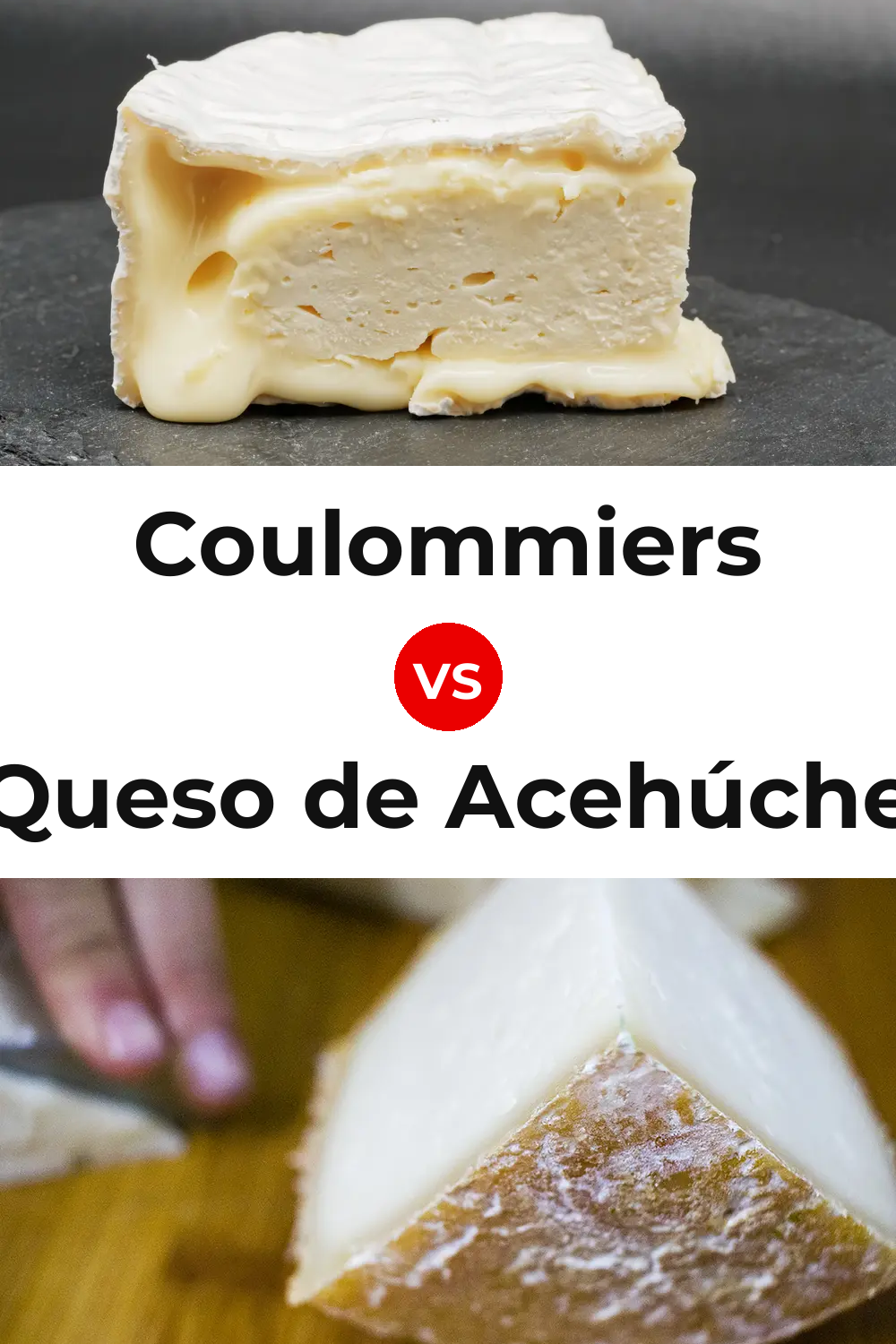
Coulommiers Cheese is a soft cow-milk cheese from France, while Queso de Acehúche is semi-hard, elastic, slightly moist and made from goat milk.
What Is Coulommiers Cheese?
Coulommiers is a soft cheese from the Brie region of France, similar to Brie but smaller in size. It has a creamy texture and a mild, buttery flavor that becomes more earthy and complex as it ripens. The cheese is encased in an edible white mold rind that helps to mature the cheese from the outside in.
What Is Queso de Acehúche?
Queso de Acehúche is a traditional Spanish cheese made exclusively from raw goat’s milk from Murciana-Granadina, Florida, Malagueña, Retinta, and Verata breeds. It is produced in the province of Cáceres, Extremadura, using enzymatic coagulation and matures for at least 40 days. The cheese has a cylindrical shape with flat faces and a semi-hard, elastic texture. Its rind is naturally waxy yellow to dark ochre and may develop a characteristic smear during maturation. The paste is white to ivory, compact, and slightly moist, with small, round holes. It has a lactic, slightly putrid aroma and a mild, balanced flavor with low saltiness, moderate acidity, and increasing pungency as it matures. The cheese may be coated in paprika or oil and is sometimes made using the traditional "sobao" washing technique. Queso de Acehúche is protected under the PDO (Protected Designation of Origin) status.
What's the Difference Between Coulommiers Cheese and Queso de Acehúche?
- Milk type: Coulommiers Cheese (cow's milk), Queso de Acehúche (Goat)
- Milk treatment: Coulommiers Cheese (unpasteurized), Queso de Acehúche (Raw)
- Texture: Coulommiers Cheese (Soft), Queso de Acehúche (Semi-hard, elastic, slightly moist)
- Rind: Coulommiers Cheese (White Penicillium candidum), Queso de Acehúche (Waxy, yellow to dark ochre, may develop a smear; can be coated in paprika or oil)
- Aging: Coulommiers Cheese (4-8 weeks), Queso de Acehúche (Minimum 40 days)
- Taste: Coulommiers Cheese (Fresh, creamy to fine, stronger), Queso de Acehúche (Low saltiness, moderate acidity, low bitterness, low pungency, more pronounced in aged cheeses)
Side-by-Side Comparison
| Coulommiers Cheese | Queso de Acehúche | |
|---|---|---|
| Country of Origin | France | — |
| Specific Origin | Seine-Et-Marne, Brie | Cáceres, Extremadura |
| Milk Type | Cow's milk | Goat |
| Milk Treatment | Unpasteurized | Raw |
| Texture | Soft | Semi-hard, elastic, slightly moist |
| Rind | White Penicillium candidum | Waxy, yellow to dark ochre, may develop a smear; can be coated in paprika or oil |
| Aging | 4-8 weeks | Minimum 40 days |
| Taste | Fresh, creamy to fine, stronger | Low saltiness, moderate acidity, low bitterness, low pungency, more pronounced in aged cheeses |
Taste Comparison: Does Coulommiers Cheese Taste Like Queso de Acehúche?
Coulommiers Cheese reads as fresh, creamy to fine, stronger, while Queso de Acehúche brings low saltiness, moderate acidity, low bitterness, low pungency, more pronounced in aged cheeses character. More specifically, Coulommiers Cheese shows factory-made: fresh, creamy, firm. artisanal: more distinctive, reddish blush on rind, finer flavor, readiness to run, matured 5-8 weeks., while Queso de Acehúche leans toward medium to high persistence. Aging plays into this as well. Coulommiers Cheese at 4-8 weeks develops a different profile than Queso de Acehúche at minimum 40 days.
Can You Substitute Coulommiers Cheese for Queso de Acehúche?
Coulommiers Cheese can stand in for Queso de Acehúche in many dishes, but the switch will shift the overall character of the recipe. Expect soft bite and body where the recipe calls for semi-hard, elastic, slightly moist. Flavor-wise, Coulommiers Cheese reads as fresh, creamy to fine, stronger while Queso de Acehúche brings low saltiness, moderate acidity, low bitterness, low pungency, more pronounced in aged cheeses notes.
Which Is Better, Coulommiers Cheese or Queso de Acehúche?
There's no single winner. It depends on your recipe and the profile you want. If you want a soft cheese, go with Coulommiers Cheese. For a semi-hard, elastic, slightly moist profile, Queso de Acehúche is the better fit. Flavor-wise, Coulommiers Cheese suits recipes that want fresh, creamy to fine, stronger notes, while Queso de Acehúche fits dishes calling for low saltiness, moderate acidity, low bitterness, low pungency, more pronounced in aged cheeses.
Which is your favorite?
One click, anonymous. See what others chose.
Frequently Asked Questions
Is Coulommiers Cheese the same as Queso de Acehúche?
No, they're distinct cheeses. Coulommiers Cheese is made from cow milk; Queso de Acehúche uses goat. Aging also differs: Coulommiers Cheese is typically aged 4-8 weeks, Queso de Acehúche minimum 40 days.
Is Coulommiers Cheese similar to Queso de Acehúche?
Not closely. They use different milk bases and have distinct profiles.
Can I substitute Coulommiers Cheese for Queso de Acehúche?
You can, but expect a shift in richness and milk character.
Does Coulommiers Cheese taste like Queso de Acehúche?
Coulommiers Cheese reads as fresh, creamy to fine, stronger, while Queso de Acehúche is low saltiness, moderate acidity, low bitterness, low pungency, more pronounced in aged cheeses.
What is Coulommiers Cheese made of?
Coulommiers Cheese is made from cow milk (unpasteurized). It's typically aged 4-8 weeks. It originates in France.
What is Queso de Acehúche made of?
Queso de Acehúche is made from goat milk (raw). It's typically aged minimum 40 days.
Which should I choose, Coulommiers Cheese or Queso de Acehúche?
It depends on the dish. The texture difference is the biggest practical tell. Coulommiers Cheese is soft, while Queso de Acehúche is semi-hard, elastic, slightly moist.