Muenster Cheese vs Queso Tetilla
Muenster Cheese
Queso Tetilla
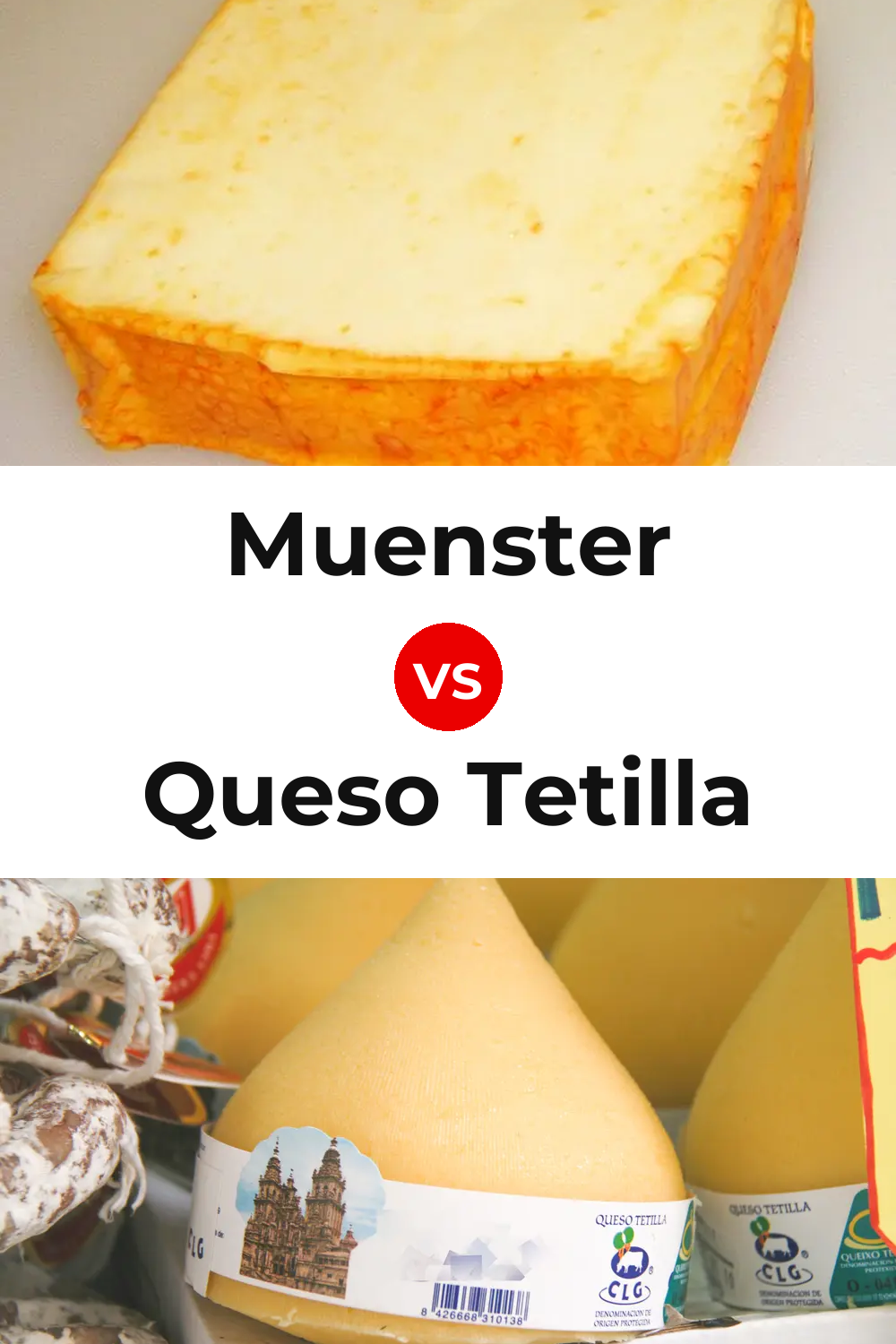
Muenster Cheese is a semi-soft cow-milk cheese from United States, while Queso Tetilla is soft to semi-cured and made from cow milk, originating in Spain.
What Is Muenster Cheese?
Muenster is an American cheese derived from the Alsatian Munster cheese but milder in flavor. It has a smooth, soft texture and a bright orange rind, typically added to enhance its appearance. Muenster is excellent for melting over dishes like burgers and grilled cheese sandwiches.
What Is Queso Tetilla?
Queso Tetilla is a matured cheese from Galicia, Spain, made from the milk of Friesian, Brown Alpine, and Rubia Gallega cows. It has a distinctive conical or convex-conical shape and weighs between 0.5 and 1.5 kg. The cheese has a thin rind and a soft to semi-cured texture. Its flavor is milky, slightly sour, and mildly salty, with a buttery quality influenced by the region’s Atlantic climate and lush pastures. The production process includes rennet coagulation at 28–32°C for 20–40 minutes, brine salting at 17–18° Baumé for up to 24 hours, and a minimum maturation period of seven days. Queso Tetilla is a traditional cheese certified under the Designation of Origin system and regulated to ensure quality and authenticity.
What's the Difference Between Muenster Cheese and Queso Tetilla?
- Origin: Muenster Cheese (United States), Queso Tetilla (Spain)
- Texture: Muenster Cheese (Semi-Soft), Queso Tetilla (Soft to semi-cured)
- Rind: Muenster Cheese (Edible, Orange-Tinted (from annatto)), Queso Tetilla (Thin)
- Aging: Muenster Cheese (Typically 2-6 weeks), Queso Tetilla (Minimum 7 days)
- Taste: Muenster Cheese (Mild, Buttery, Slightly Tangy), Queso Tetilla (Milky, slightly sour, mildly salty)
Side-by-Side Comparison
| Muenster Cheese | Queso Tetilla | |
|---|---|---|
| Country of Origin | United States | Spain |
| Specific Origin | — | Galicia (All Four Provinces) |
| Milk Type | Cow's milk | Cow |
| Milk Treatment | Pasteurized | Pasteurized |
| Texture | Semi-Soft | Soft to semi-cured |
| Rind | Edible, Orange-Tinted (from annatto) | Thin |
| Aging | Typically 2-6 weeks | Minimum 7 days |
| Taste | Mild, Buttery, Slightly Tangy | Milky, slightly sour, mildly salty |
Pairing Comparison
What works with each cheese — wines, foods, breads, and more.
| Muenster Cheese | Queso Tetilla | |
|---|---|---|
| Best Pairings | — | Vinho Verde |
Which would you pick?
One click, anonymous — see what others chose.
Where to buy Muenster Cheese and Queso Tetilla
Muenster Cheese
Queso Tetilla
Taste Comparison: Does Muenster Cheese Taste Like Queso Tetilla?
Muenster Cheese reads as mild, buttery, slightly tangy, while Queso Tetilla brings milky, slightly sour, mildly salty character. More specifically, Muenster Cheese shows buttery, slightly tangy, mildly savory, while Queso Tetilla leans toward buttery. Aging plays into this as well. Muenster Cheese at typically 2-6 weeks develops a different profile than Queso Tetilla at minimum 7 days.
Can You Substitute Muenster Cheese for Queso Tetilla?
In most recipes, Muenster Cheese and Queso Tetilla can be swapped with reasonable results. Both are cow-milk cheeses, so the base character carries over. Expect semi-soft bite and body where the recipe calls for soft to semi-cured. Flavor-wise, Muenster Cheese reads as mild, buttery, slightly tangy while Queso Tetilla brings milky, slightly sour, mildly salty notes.
Which Is Better, Muenster Cheese or Queso Tetilla?
There's no single winner. It depends on your recipe and the profile you want. If you want a semi-soft cheese, go with Muenster Cheese. For a soft to semi-cured profile, Queso Tetilla is the better fit. Flavor-wise, Muenster Cheese suits recipes that want mild, buttery, slightly tangy notes, while Queso Tetilla fits dishes calling for milky, slightly sour, mildly salty.
Frequently Asked Questions
Is Muenster Cheese the same as Queso Tetilla?
No, they're distinct cheeses. Muenster Cheese originates in United States, while Queso Tetilla comes from Spain. Aging also differs: Muenster Cheese is typically aged typically 2-6 weeks, Queso Tetilla minimum 7 days.
Is Muenster Cheese similar to Queso Tetilla?
Somewhat. They share a cow-milk base but diverge in texture and flavor.
Can I substitute Muenster Cheese for Queso Tetilla?
You can, but expect a shift in bite and mouthfeel.
Does Muenster Cheese taste like Queso Tetilla?
Muenster Cheese reads as mild, buttery, slightly tangy, while Queso Tetilla is milky, slightly sour, mildly salty.
What is Muenster Cheese made of?
Muenster Cheese is made from cow milk (pasteurized), using microbial or vegetarian (varies by producer) rennet. It's typically aged typically 2-6 weeks. It originates in United States.
What is Queso Tetilla made of?
Queso Tetilla is made from cow milk (pasteurized), using animal rennet. It's typically aged minimum 7 days. It originates in Spain.
Which should I choose, Muenster Cheese or Queso Tetilla?
It depends on the dish. The texture difference is the biggest practical tell. Muenster Cheese is semi-soft, while Queso Tetilla is soft to semi-cured.
See full profiles: Muenster Cheese and Queso Tetilla.