
Dorset Blue Vinny
Dorset Blue Vinny is a hard, crumbly blue cheese made from cows' milk near Sturminster Newton in Dorset, England. It has a strong taste and smell, and the name is protected, so only cheese made in Dorset can use it.
Find Dorset Blue Vinny Cheese
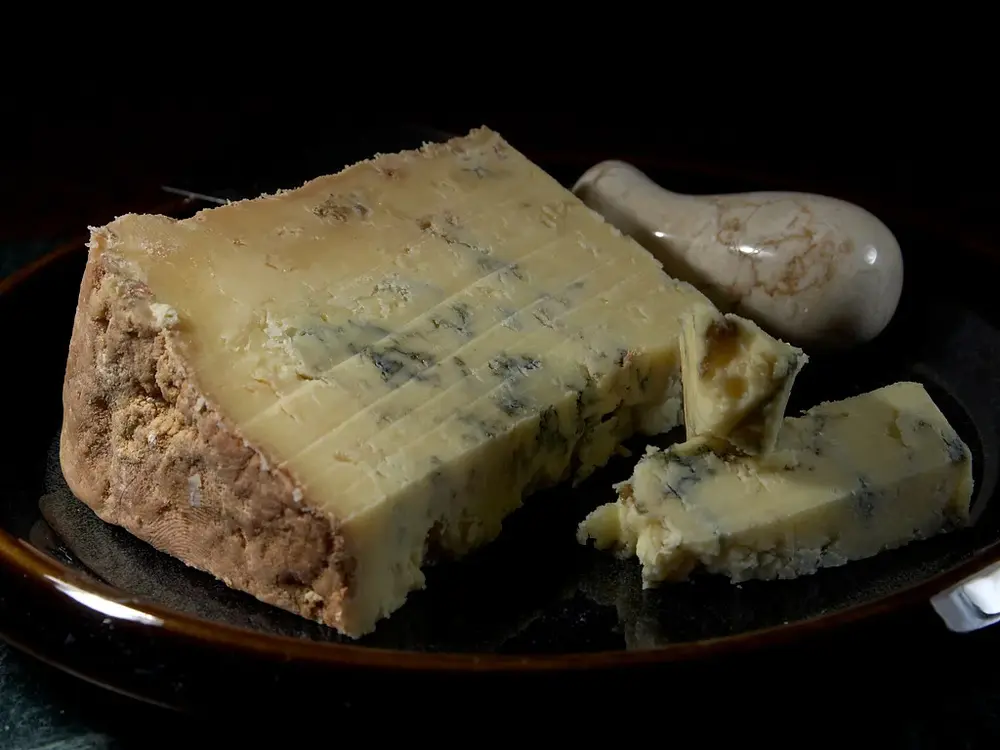
Jon Sullivan, Public domain, via Wikimedia Commons
Key Facts
| Country of Origin | Great Britain |
| Specific Origin | Sturminster Newton, Dorset, England |
| Milk Type | Cow's milk |
| Milk Treatment | Pasteurized |
| Texture | Hard, artisan, blue-veined |
| Flavor | Creamy |
| Aroma | Rich |
| Colors | Blue |
| Alternative Spellings | Dorset Blue Vinney |
| Also Known As | Blue Vinny |
What is Dorset Blue Vinny Cheese?
Dorset Blue Vinny comes from Dorset, England, and is made near Sturminster Newton. For hundreds of years it was a common farmhouse cheese there. Cheese was a side product of a more profitable trade: Dorset butter sold in London at a premium, and churning it left farmers with a lot of skimmed milk. Before the railways, milk itself was worth little, since it spoiled before it could reach market. The skimmed milk went into a hard, crumbly cheese instead.
Local myth has it that Blue Vinny was once treated as illegal and left on the doorstep of anyone who ordered it on the black market. Production almost ended after the Second World War, surviving on only a few farms in very small quantities. In the 1980s Michael Davies of Woodbridge Farm in Dorset brought the old recipe back, and the cheese is still made on the family farm, now with whole milk rather than skimmed.
It is made from cows' milk, often unpasteurised. That choice divides opinion: some consider raw milk healthier, while others point to the risk of tuberculosis passing from infected cows into the milk. The result is a hard, crumbly cheese with blue veining. The word vinny comes from vinew, meaning blue vein. Taste and smell are both strong.
In Dorset it is eaten with Dorset knobs, another local specialty. The Dorset poet William Barnes put it in his poem "Praise O' Do'set", asking whether the reader would like brown bread and some vinny cheese cut for them.
How Does Dorset Blue Vinny Cheese Compare?
The most relevant cheeses to compare Dorset Blue Vinny against.


