Halloumi 
Halloumi is a brined cheese from Cyprus, traditionally made from goat and sheep milk, though most modern halloumi also contains cow's milk. It has a high melting point, so it browns on the grill or in a pan without melting, and it squeaks when you chew it.
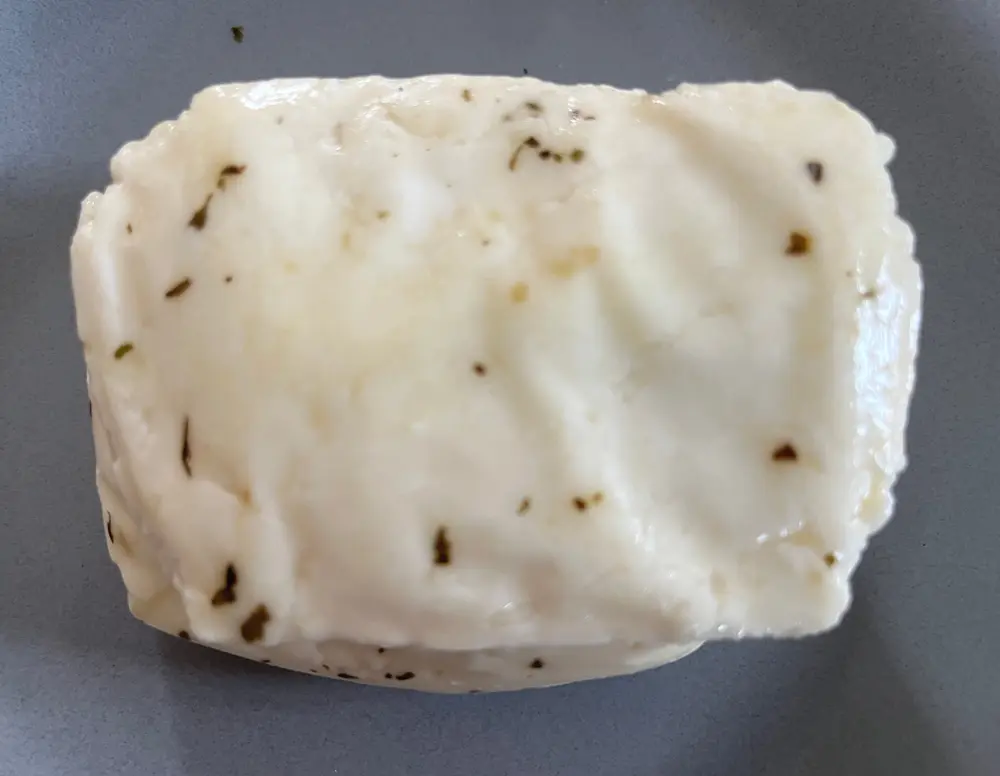
Key Facts
| Country of Origin | Cyprus |
| Specific Origin | Cyprus |
| Protection | PDO (2014) |
| Milk Type | Cow's, goat's and sheep's milk |
| Milk Treatment | Traditionally raw, pasteurized commercially |
| Fat Content | About 25% wet weight, 47% dry weight |
| Rind | No rind |
| Texture | Semihard |
| Flavor | Mild, salty |
| Aroma | Strong |
| Colors | White to light yellow |
| Forms | Hemispherical, 220 to 270 g (7.8 to 9.5 oz) |
| Age | 40 days |
| Rennet Type | Mostly vegetable or microbial |
| Alternative Spellings | Hallomi, Haloumi, Hellim |
| Also Known As | Χαλλούμι, Traditional Halloumi, Traditional Haloumi |
What is Halloumi Cheese?
Halloumi comes from Cyprus and is thought to have been made first by Bedouins, whose nomadic life suited a cheese that kept well. Folklore places its beginnings between AD 395 and 867, when a Cypriot herder mixed sheep and goat milk, heated it over a fire, sifted out the curds and left them to cool. The earliest surviving Cypriot descriptions date to about 1554, recorded by Florios Voustroniou of the Venetian administration, who called it "calumi". Archimandrite Kyprianos mentioned it again in 1788 and noted that it was already being exported.
Goat and sheep milk were the original base, since cows were scarce on the island until the British introduced them in the 20th century. Village cooperatives of ten to fifteen women made it, led by whoever owned the most goats, and licensing began in the early 1940s. Cow's milk took over as demand grew: by 2019, almost all halloumi shipped to the UK was 80% cow's milk. Production passed 450,000 tons in 2023, with the UK importing 18,000 tons, the U.S. 5,000 and Japan 2,500.
Rennet, usually vegetarian or microbial, coagulates the milk at 30 to 34 °C over roughly 30 to 45 minutes. No acid-producing bacteria go in. The curd is cut, reheated, stirred and pressed in molds, then boiled in the reserved whey for at least 30 minutes. This scalding step is what gives the cheese its texture. The pieces are salted, garnished with fresh or dried spearmint, folded, and held in salted whey for one to three days before packing. Mature halloumi stays in brine whey for at least 40 days.
Fresh halloumi is semi-hard and elastic with a mild, lightly salty taste. The mature version is harder, drier and saltier. Both carry a hint of mint from the spearmint added during production. Traditional wheels are hemispherical and weigh 220 to 270 grams (7.8 to 9.5 oz), with about 25% fat by wet weight and 17% protein. Sealed and refrigerated, it keeps up to a year.
You can eat it raw, but cooking is where it shines. Fry or grill it, as in saganaki, and serve it plain, with vegetables, or in salads and sandwiches. Within the EU and the U.S., only cheese made in certain parts of Cyprus may be called halloumi, protection that took years to settle because cattle, sheep and goat farmers disagreed over how much cow's milk to allow.
How Does Halloumi Cheese Compare?
The most relevant cheeses to compare Halloumi against.


