Port Salut
Port Salut is a semi-soft pasteurized cow's milk cheese from Pays de la Loire, France. Trappist monks developed it in the 19th century, and it is known for its orange rind, its smooth sliceable paste and its mild flavor.
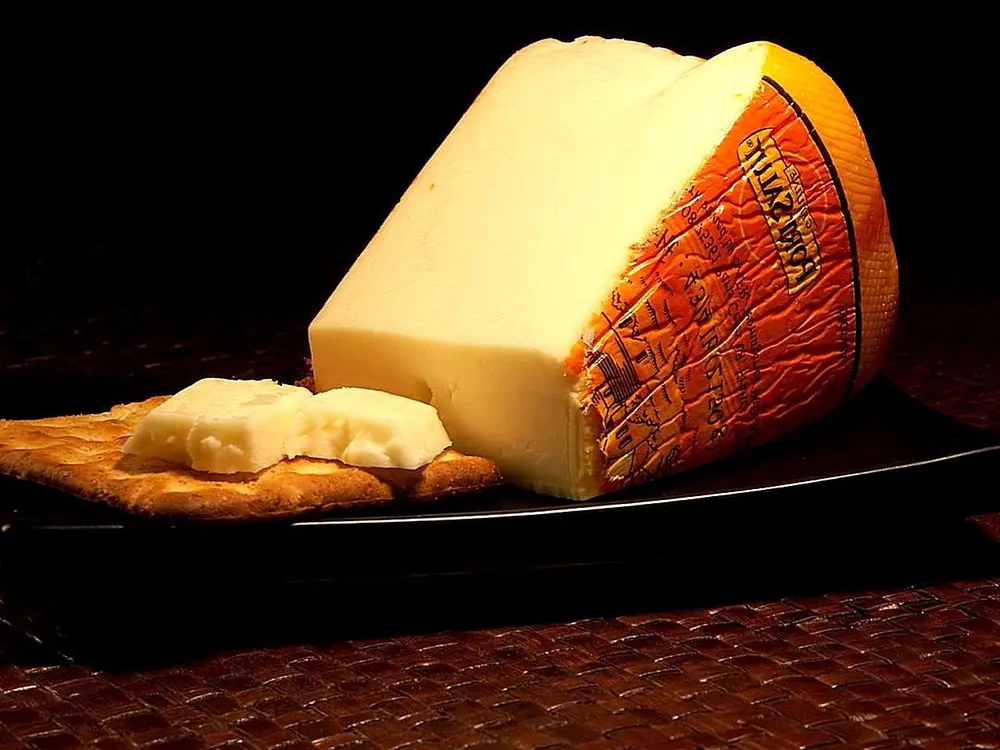
Key Facts
| Country of Origin | France |
| Specific Origin | Pays de la Loire, France |
| Milk Type | Cow's milk |
| Milk Treatment | Pasteurized |
| Fat Content | 72.70% |
| Rind | Washed |
| Texture | Semi-soft |
| Flavor | Acidic, mellow |
| Aroma | Strong, increasing with age |
| Colors | Pale yellow |
| Forms | Wheels about 23 cm (9 inches) across, about 2 kg (4.4 lb) |
| Alternative Spellings | Port du Salut, Port-Salut |
| Also Known As | Entrammes (handmade version) |
What is Port Salut Cheese?
Port Salut comes from Pays de la Loire in France, where Trappist monks developed it during the 19th century at Port-du-Salut Abbey in Entrammes. Many of those monks had left France during the Revolution of 1789 and learned cheese-making abroad to support themselves. They brought the skills home after the Bourbon Restoration. The name of their society, Societe Anonyme des Fermiers Reunis, became a registered trademark and still appears as S.A.F.R. on the wheels.
In 1873 the head of the abbey gave a Parisian cheese-seller exclusive distribution rights, and sales climbed. The abbey looked for trade protection and finally sold the rights to the Bel Group in 1950. Production moved to a factory, where the smooth rind now comes from a plastic-coated wrapper. Handmade Port Salut, sold as Entrammes, is still made at monasteries around the French countryside.
The cheese is pasteurized cow's milk, semi-soft, and sold in wheels of about 23 cm (9 inches) across weighing roughly 2 kg (4.4 lb). The rind is orange. Flavor stays mild, though the smell can turn strong because this is a mature cheese, and it grows stronger the longer the wheel is kept. That has no effect on the taste.
Keep it refrigerated and eat it within two weeks of opening. A wax rind can be eaten, but it takes something away from the cheese itself.
How Does Port Salut Cheese Compare?
The most relevant cheeses to compare Port Salut against.


