Colby-Jack
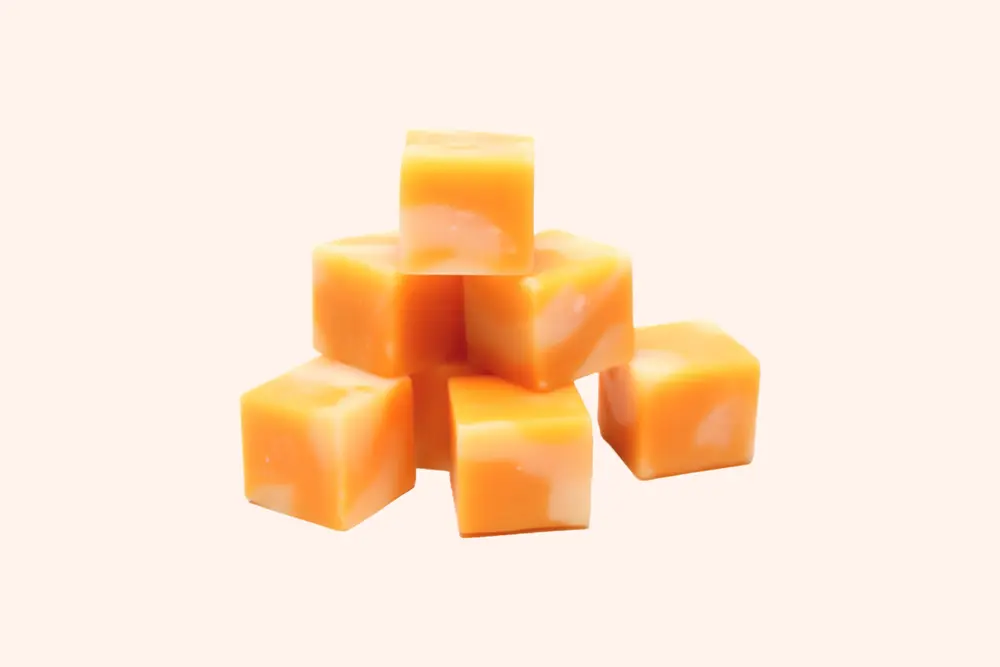
Colby-Jack, also spelled Co-jack or Cojack, is an American marble cheese made by blending curds of Colby and Monterey Jack. It is known for its orange and white marbling, its mild flavor, and how well it melts over burgers and casseroles.
Key Facts
| Country of Origin | United States |
| Specific Origin | Wisconsin and California, United States |
| Milk Type | Cow's milk |
| Milk Treatment | Pasteurized |
| Rind | Sometimes dipped in wax |
| Texture | Semi-hard, processed |
| Flavor | Mild to mellow |
| Colors | Marbled orange and white |
| Forms | Semicircular or rectangular blocks; shredded |
| Age | Up to 14 days |
| Alternative Spellings | Cojack |
| Also Known As | Co-jack, Cojack |
What is Colby-Jack Cheese?
Colby-Jack takes its name from the two cheeses behind it. Colby was created in Colby, Wisconsin, by Joseph F. Steinwand in 1885. Monterey Jack came from Monterey, California, where Mexican Franciscan Friars made it during the 1700s. Marbling the two together stayed a small operation until the 20th century, when the cheese grew popular and moved out of Wisconsin into wider parts of the country. The small wooden building in Wisconsin made 57 kg (126 lb) of cheese a day, pressed into a 5.8 kg (13 lb) long-horn shape and dipped in wax.
Each cheese is made separately by mixing pasteurized milk with bacterial cultures, then adding a coagulant that thickens the mixture and separates curds from whey. Annatto goes into the Colby to give it the orange color. After draining, high-quality curds of both cheeses are blended, which produces the marbling, and the cheese is shaped into blocks or shredded. Aging lasts up to 14 days at 40°F to 45°F (4-7°C).
The finished cheese is marbled orange and white, semi-hard, and mild to mellow in flavor. Young cheese is generally sold in a full-moon or half-moon shape. Packaging varies by maker and includes vacuum packing, paraffin wax, and a latex emulsion coating.
Most production happens in Wisconsin and California. People eat Colby-Jack on its own and melt it over burgers, pasta bakes, macaroni and cheese, and casseroles. The dishes that use it are usually American or Mexican in origin.
How Does Colby-Jack Cheese Compare?
The most relevant cheeses to compare Colby-Jack against.