Swiss
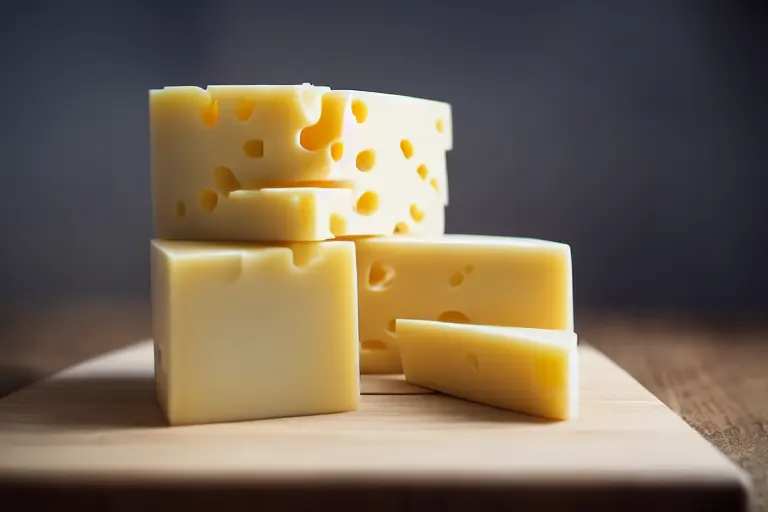
Swiss cheese is the North American name for any cheese made in the style of Emmental, the yellow, medium-hard cheese from the Emmental region of Switzerland. Most versions carry the round holes called eyes and a nutty, slightly sweet flavor.
Key Facts
| Country of Origin | United States |
| Specific Origin | Emmental, Switzerland; now widely made in the U.S. |
| Milk Type | Cow |
| Milk Treatment | Pasteurized |
| Fat Content | ~28-32% |
| Moisture Content | ~37-41% |
| Rind | None |
| Texture | Firm , Semi-Firm , Smooth |
| Flavor | Mild, Nutty, Slightly Sweet |
| Aroma | Mild, Slightly Nutty |
| Colors | Pale Yellow |
| Forms | Block, Sliced, Shredded |
| Age | Typically 1-3 months |
| Rennet Type | Microbial or Vegetarian |
| Also Known As | Emmentaler, Swiss-style cheese |
What is Swiss Cheese?
In North America, Swiss cheese is a generic name rather than a place of origin. It covers any cheese that resembles Emmental, the yellow, medium-hard cheese from the area around Emmental in Switzerland, and it says nothing about where the wheel was made. Cheesemakers in the United States, Finland, Estonia and Ireland all produce it. The USDA treats Swiss and Emmentaler as the same thing, while Australia uses both terms along with Swiss-style cheese, sometimes to tell them apart.
Three bacteria do the work: Streptococcus thermophilus, a Lactobacillus (L. helveticus or L. delbrueckii subsp. bulgaricus), and Propionibacterium freudenreichii subsp. shermani. Late in production the propionibacteria consume the lactic acid the other two leave behind and release acetate, propionic acid and carbon dioxide. The gas slowly collects into bubbles, and those bubbles become the holes. The two acids are what give the cheese its nutty, sweet taste. Unlike the Swiss original, which uses raw milk, the North American version is sometimes made with pasteurized or part-skim milk.
The holes are called eyes, and cheese without them is called blind. Bigger eyes generally mean more pronounced flavor, since a longer fermentation gives the bacteria more time to act. Large eyes also come apart in mechanical slicers, so U.S. industry regulators cut the minimum eye size required for the Grade A stamp. Swiss researchers proposed in 2015 that particulate matter such as hay dust in the milk helps the holes form, and that modern sanitation explains why eyes have shrunk or vanished. Early cheesemakers saw the holes as a defect and pressed the curd to avoid them.
Baby Swiss and Lacy Swiss are the two American variants, both with small holes and a mild flavor. Baby Swiss is made from whole milk, Lacy Swiss from low fat milk. Alfred Guggisberg's Guggisberg Cheese Company developed Baby Swiss in the mid-1960s just outside Charm, Ohio. The United States turns out roughly 330 million pounds (150 kt) of Swiss cheese a year, and Ohio is the largest producing state.
How Does Swiss Cheese Compare?
The most relevant cheeses to compare Swiss against.