Ser koryciński swojski 
Ser koryciński swojski is a rennet cheese from the Korycin area of Poland's Podlaskie province, made from unpasteurised cow's milk. It is shaped into a flattened ball of about 3 kg and sold plain or with herbs, spices and garlic.
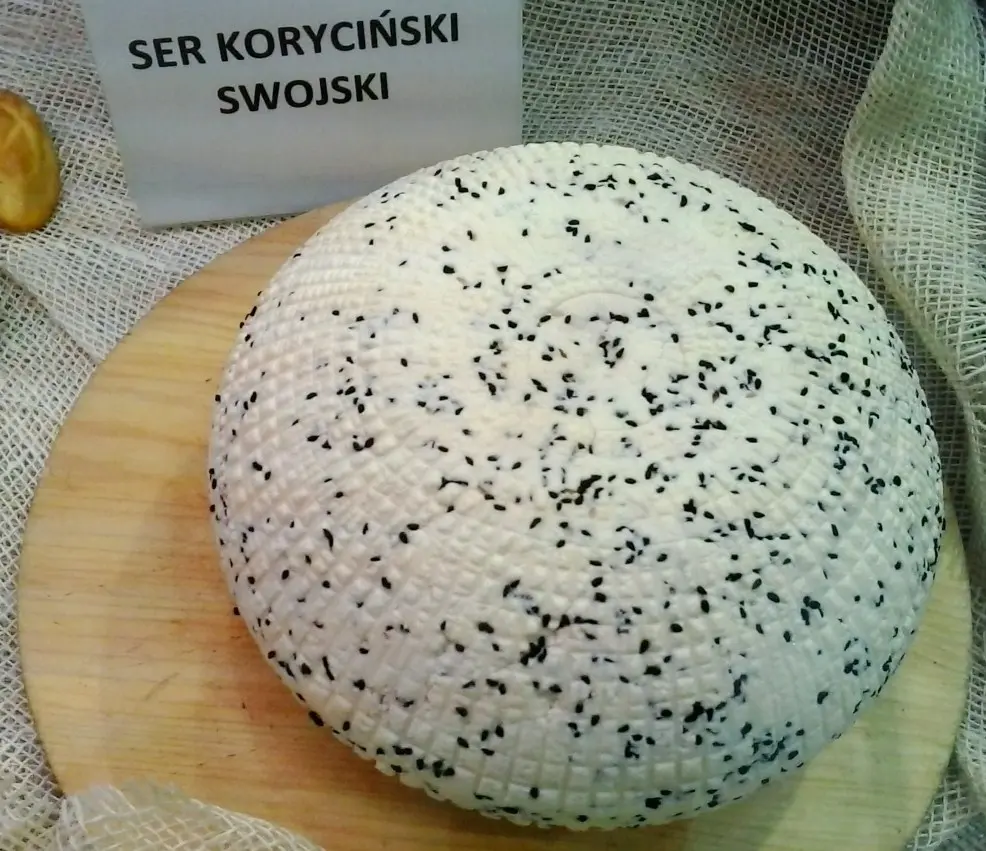
MOs810, CC BY-SA 4.0, via Wikimedia Commons
Key Facts
| Country of Origin | Poland |
| Specific Origin | Korycin, Suchowola, and Janów in Podlaskie province |
| Protection | PGI (2010) |
| Milk Type | Cow's milk |
| Milk Treatment | Raw or pasteurised |
| Fat Content | Fresh: ≤ 20%, Matured: ≤ 22%, Ripe: ≤ 30% |
| Moisture Content | Fresh: ≤ 53%, Matured: ≤ 48%, Ripe: ≤ 43% |
| Rind | Delicate yellow rind with a whitish bloom on the outside (ripe stage) |
| Texture | Fresh: Wet, very elastic; Matured: Moist, elastic; Ripe: Slightly moist, elastic |
| Flavor | Fresh: Mild and creamy; Matured: Slightly salty with a nutty overtone; Ripe: Dry, rather salty with a nutty taste |
| Aroma | Fresh: Dominant aroma of fresh butter; Matured: Slight aroma of dried cheese; Ripe: Aroma of dried cheese |
| Colors | External: Cream to yellow; Internal: Cream to straw-yellowish |
| Forms | Flattened spherical shape with an elliptical cross-section |
| Age | Fresh: 2-4 days; Matured: 5-14 days; Ripe: More than 14 days |
| Rennet Type | Yes |
| Also Known As | Ser koryciński, Swojski |
What is Ser koryciński swojski Cheese?
Ser koryciński is a local rennet cheese made from unpasteurised cow's milk in the municipality of Korycin, in Podlaskie province. Local legend ties it to Swiss mercenaries who fought on the Polish side during the Swedish Deluge of 1655 to 1660 and took part in the battle of Korycin. Wounded soldiers are said to have recovered at the Kumiała manor farm nearby, and some may have settled in Poland for good, passing their cheesemaking methods to the people around them.
The old method used dried calf stomachs, ground to a powder, as the rennet. Today producers use dairy rennet instead. Each cheese is formed into a flattened ball roughly 30 centimetres wide and about 3 kg in weight, and one takes some 25 litres of milk.
Cheeses were once carried in wooden molds and set on rye straw threshed by flail in cellars, where they could ripen for weeks. Aging now is often far shorter. The flavour depends on which herbs and natural flavourings go in, how long the cheese rests, and even the time of year it was made.
The cheese now goes by the simple name Swojski, and versions are made with spices, herbs and garlic. Koryciński ser Swojski was added to the list of traditional products at Poland's Ministry of Agriculture and Rural Development in 2005. The producers' association has about 30 members.
How Does Ser koryciński swojski Cheese Compare?
The most relevant cheeses to compare Ser koryciński swojski against.


