
Vorarlberger Alpkäse 
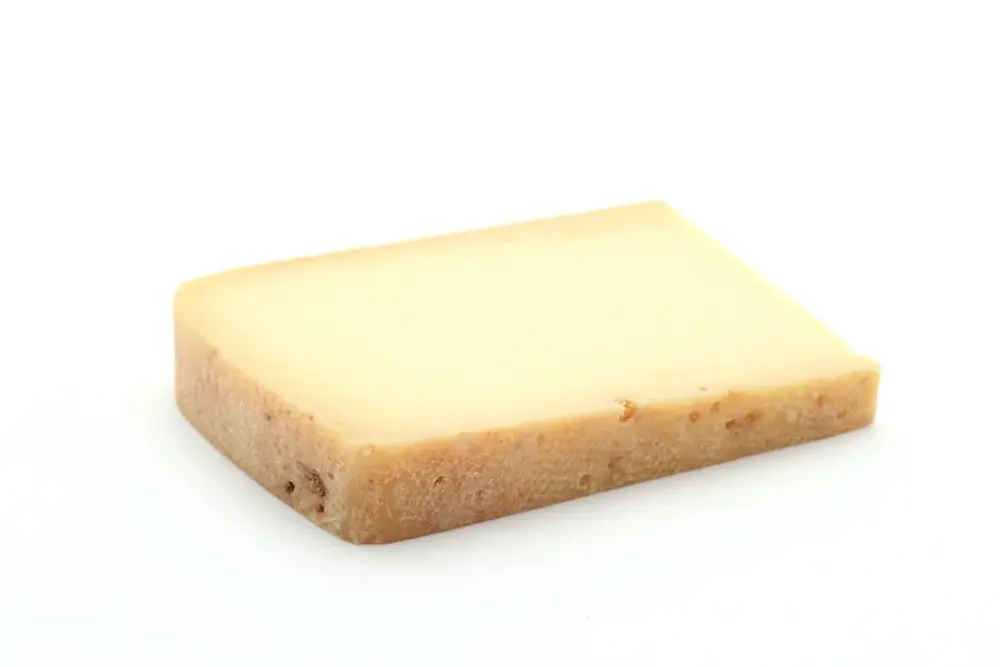
Vorarlberger Alpkäse is an Austrian hard cheese made from raw milk on the alps and Vorsäße of Vorarlberg. It holds a protected designation of origin, weighs up to 40 kilograms, and tastes mild young and piquant with age.
Find Vorarlberger Alpkäse Cheese
Guy Waterval, CC BY-SA 4.0, via Wikimedia Commons
Key Facts
| Country of Origin | Austria |
| Specific Origin | Province of Vorarlberg |
| Protection | PDO (1997) |
| Milk Type | Cow's milk |
| Milk Treatment | Untreated, raw, non-thermised, non-pasteurised, not sterilised by centrifugation |
| Rind | Dried, brownish yellow to brown granular rind |
| Texture | Firm to smooth |
| Flavor | Mild, becomes sharp with increasing age |
| Colors | Ivory-colored |
| Forms | Cheese rounds up to 40 kg |
| Age | At least 3 months |
| Rennet Type | Not genetically engineered |
What is Vorarlberger Alpkäse Cheese?
Vorarlberger Alpkäse is made on the alps and Vorsäße of the province of Vorarlberg, where around 500 square kilometres of land is worked as alpine pasture. Fatty rennet cheeses were already being produced in Vorarlberg during the Thirty Years' War, and by the 18th century most of the milk from the alps went into Alpkäse. The name dates from that period. The cheese has a protected designation of origin.
The work follows the alpine season, May to September. Raw milk has to be produced and processed in the alpine area, and it has to come from cows that graze freely on an alpine pasture. Silage feeding is banned. Beyond raw milk, lactic acid bacteria cultures, rennet, and later salt and water for the brine bath and rind care, nothing else is added.
The cheesemaker stirs in lactic acid bacteria, which do most of the work on flavor, then adds rennet at 32 degrees. The milk sets about half an hour later into liquid whey and firm curd. That curd is cut into grains the size of coffee beans, heated to somewhere between 45 and 54 degrees, and filled into the round molds called Järbe. Several hours under the press drive off the last whey. One or two days in a salt bath follow, building the rind and strengthening the aroma, and during ripening the wheels are brushed with lightly salted smear water.
Wheels reach up to 40 kilograms and the paste holds sparse, pea-sized round holes. At three months the cheese is mild; longer aging turns it piquant. Käsespätzle and Walser Käseknödel are the traditional local dishes made with it. Alpkäse in general is eaten sliced with bread or boiled potatoes, and it also works fried or in a gratin.
How Does Vorarlberger Alpkäse Cheese Compare?
The most relevant cheeses to compare Vorarlberger Alpkäse against.


