
Tiroler Bergkäse 
Tiroler Bergkäse is an Austrian pressed cooked-curd cheese from Tyrol, made with partly skimmed raw cow's milk and held under a protected designation of origin since 1997. Wheels weigh 12 kg or more and carry a smooth brown rind.
Find Tiroler Bergkäse Cheese
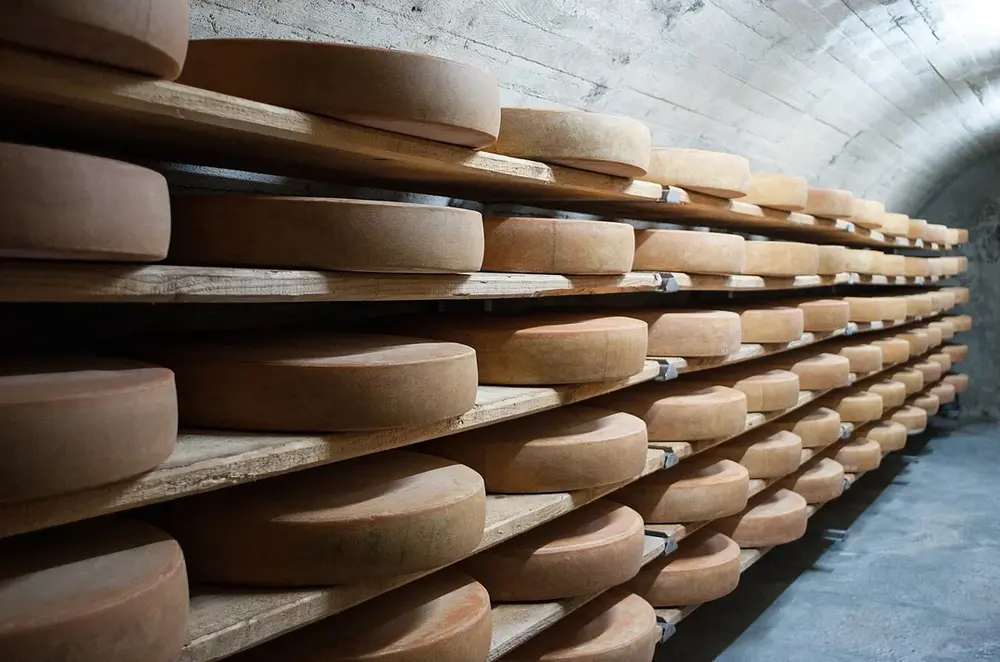
Hermann Hammer (User:Haneburger), CC0, via Wikimedia Commons
Key Facts
| Country of Origin | Austria |
| Specific Origin | North Tyrol and East Tyrol |
| Protection | PDO (1997) |
| Milk Type | Cow's milk |
| Milk Treatment | Raw |
| Fat Content | Minimum 45% fat in the dry matter |
| Moisture Content | Maximum 40% (dry matter at least 60%) |
| Rind | Painted-on and dried-on, yellowish-brown to brown |
| Texture | Firm to more supple |
| Flavor | Mildly aromatic to slightly sharp |
| Colors | Ivory to light yellow |
| Forms | Wheel |
| Rennet Type | Calf rennet (no substitutes or genetically modified rennet) |
What is Tiroler Bergkäse Cheese?
Tiroler Bergkäse, meaning Tyrolean mountain cheese, comes from the Austrian region of Tyrol. It has held a protected designation of origin since 1997. The name covers a pressed cooked-curd cheese made from partly skimmed raw cow's milk.
The milk comes from cows raised in Tyrol, either in the valleys or on the high summer pastures, and fed without silage. It is skimmed down to 3 percent fat, then set with calf rennet and lactic starters. The curd is heated to around 52 C (126 F), pressed, moulded, and sunk in a 20 percent salt bath. During ripening the wheels are rubbed with salt water twice a week so a specific flora can take hold on the rind.
Wheels weigh 12 kg (26 lb) or more. The rind is smooth, dry, and brown to yellow-brown. Inside, the paste is white to pale yellow and can be supple or firm depending on how long it has aged. Scattered holes about the size of a pea are normal. Fat runs to at least 45 percent in the dry matter, and dry matter to at least 60 percent. A 100 g piece holds roughly 27 g protein, 32 g fat, 1.5 g salt, and no carbohydrate, though the numbers shift with the dairy and the age.
It is eaten plain, on a board alongside cured meats. Cooks also use it in Käsespätzle, purées, and soups.
How Does Tiroler Bergkäse Cheese Compare?
The most relevant cheeses to compare Tiroler Bergkäse against.


