Svecia 
Svecia is a Swedish semi-hard cow's milk cheese with a creamy consistency, light yellow colour, small irregular holes and a mildly acidic taste. It is sold in wax-covered cylinders weighing 12 to 15 kg (26 to 33 lb) and aged for at least two months.
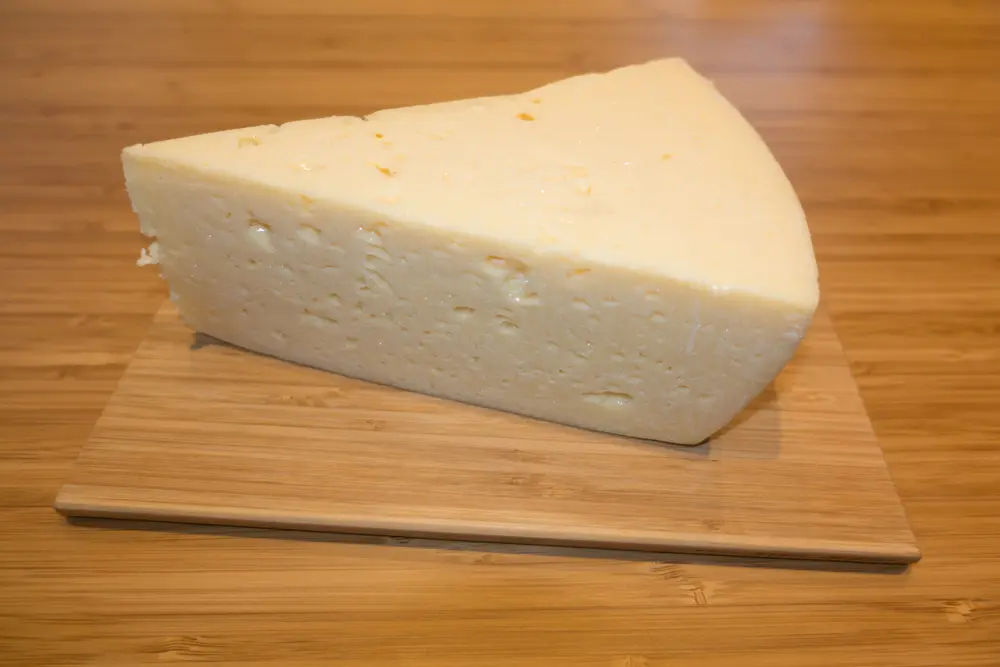
Anna Rydin, CC BY-SA 4.0, via Wikimedia Commons
Key Facts
| Country of Origin | Sweden |
| Specific Origin | Low-lying areas of Sweden |
| Protection | PGI (1997) |
| Milk Type | Cow |
| Milk Treatment | Pasteurized |
| Fat Content | 28% (can vary from 17%-33%) |
| Moisture Content | 53-57% in non-fatty matter |
| Rind | Wax-coated |
| Texture | Semi-hard, creamy soft, firm, somewhat resilient, small irregular holes |
| Flavor | Mildly acidic, full-bodied |
| Colors | Light yellow to yellow |
| Forms | Cylindrical (35 cm diameter, 12-15 kg) |
| Age | Minimum 2 months |
| Rennet Type | Animal |
| Also Known As | Sveciaost |
What is Svecia Cheese?
Svecia, also written Sveciaost, is a Swedish cheese. The name comes from Suecia, the Latin word for Sweden, and it was coined in 1920. The cheese itself is older than its name: it resembles other Swedish hard cheeses whose manufacturing methods may reach back to the 13th century.
Production follows the usual route for a semi-hard cheese. Milk is pasteurized at 72 °C (162 °F), then cooled to around 30 °C (86 °F). Rennet coagulates it into curds, and lactic acid enzymes are added to replace the enzymes and bacteria that pasteurization killed. The curd is cut, stirred and slowly drained, then heated back up to near 40 °C (104 °F) to drive off more moisture.
Salt goes in, then the curds are packed loosely into moulds. Those gaps leave air pockets, which become the tiny holes in the finished wheel. A soak in brine brings the total salt content to 1.0 to 1.5 percent by weight. Ageing takes place in a dry environment for two months at minimum, sometimes more than a year.
The result is semi-hard and creamy in consistency, light yellow, scattered with small irregular holes, and mildly acidic in taste. Each cylinder is covered in wax and weighs 12 to 15 kg (26 to 33 lb).
How Does Svecia Cheese Compare?
The most relevant cheeses to compare Svecia against.


