Tête de Moine
Tête de Moine AOP is a semi-hard cow's milk cheese from the Swiss Jura, first made by the canons of Bellelay abbey in the 12th century. It is not sliced but pared into thin rosettes with a Girolle.
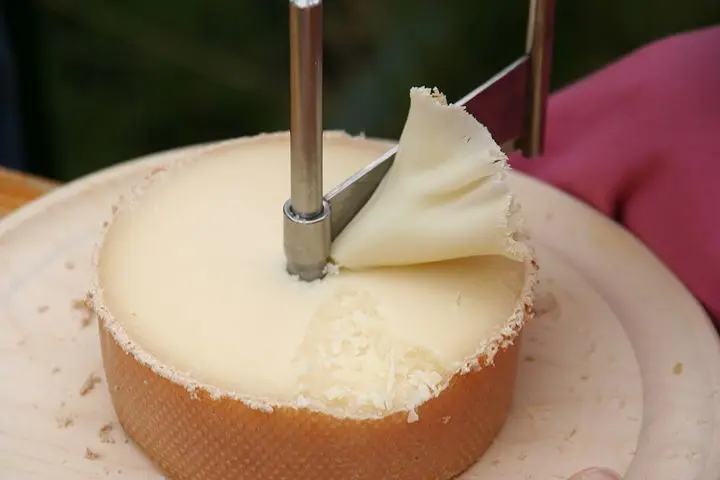
The original uploader was Stucki at French Wikipedia., CC BY-SA 1.0, via Wikimedia Commons
Key Facts
| Country of Origin | Switzerland |
| Specific Origin | Bernese Jura and Canton of Jura, Switzerland |
| Protection | GI (2011) |
| Milk Type | Cow's milk |
| Milk Treatment | Unpasteurized |
| Fat Content | 525 g/kg in dry matter, at least 315 g/kg in the cheese |
| Rind | Firm, grainy natural crust |
| Texture | Semi-hard |
| Flavor | Nutty |
| Aroma | Rich |
| Colors | Reddish-brown rind, yellow to ivory paste |
| Forms | Cylinders 10 to 15 cm in diameter, averaging 850 g, up to 2.5 kg |
| Age | At least 2½ months |
| Alternative Spellings | Tete de Moine |
| Also Known As | Fromage de Bellelay |
What is Tête de Moine Cheese?
Tête de Moine, French for "monk's head," comes from the Bernese Jura and the Canton of Jura in Switzerland. The canons of Bellelay abbey were making it by 1192, a century before the Swiss Confederation. For generations it served as money: tenant farmers paid rent with it, it figured in legal settlements, and it was offered as a gift to the prince-bishops of Basel.
The name is documented from 1790. One account credits French occupation soldiers, who compared the way the cheese is shaved to the tonsure of a monk. Another traces it to Jura tales that counted the cheeses stored at the cloister per tonsure, meaning per resident.
It is made from raw cow's milk by fewer than ten dairies around Porrentruy, the Franches-Montagnes district, Moutier and Courtelary. The rules are strict. Feed must come from the farm's own base or adjoining communal pastures, silage and growth hormones are banned, and the cows stay on pasture at least 120 days during the green feeding period. After a salt-water bath the loaves ripen at least 75 days on spruce boards and are tended regularly, with monthly checks on appearance, hole size, paste and taste.
The wheels measure 10 to 15 cm across and usually weigh about 850 g, though some reach 2.5 kg. The crust is reddish brown, firm and grainy. Inside, the paste is yellow to ivory, slightly moist, sticky and supple. Fat averages 525 g/kg in the dry matter.
The texture is too fine to cut, so the cheese is pared instead. A halved wheel sits on the pin of a Girolle, the tool Nicolas Crevoisier invented in 1982, and a crank shaves off rosettes that resemble chanterelles. A dry white wine is the usual pairing.
How Does Tête de Moine Cheese Compare?
The most relevant cheeses to compare Tête de Moine against.


