Emmental 
Emmental is a yellow, medium-hard Swiss cheese from the Emme Valley, known for the natural holes that run through it. The taste is savoury but mild. It is eaten cold in chunks or slices and melted into dishes such as gratins.
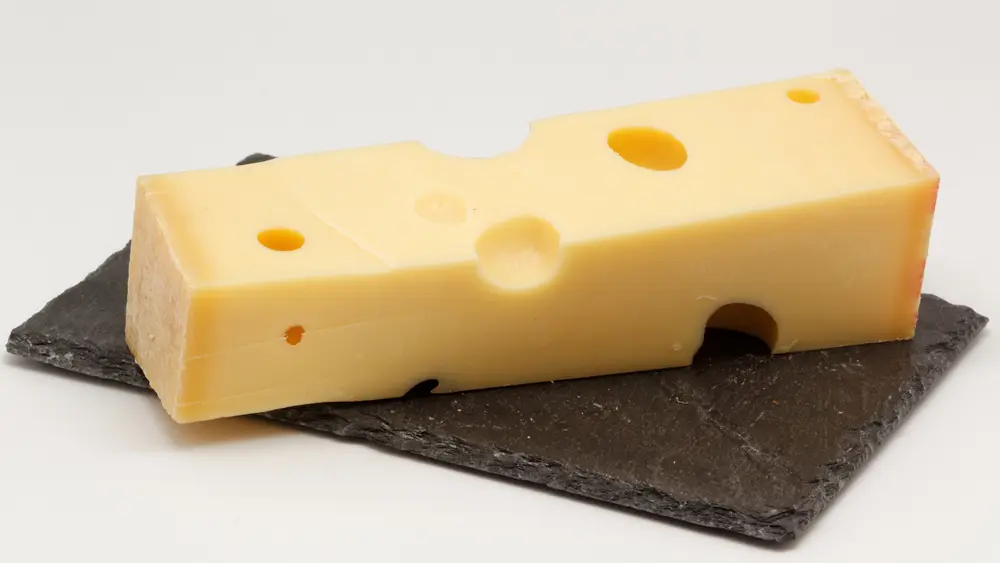
Coyau / Wikimedia Commons
Key Facts
| Country of Origin | Switzerland |
| Specific Origin | Emmental, Canton of Bern |
| Protection | PDO (2004) |
| Milk Type | Cow's milk |
| Milk Treatment | Raw |
| Fat Content | Minimum of 45% (dry matter) |
| Rind | Natural |
| Texture | Hard or medium-hard |
| Flavor | Nutty, sweet |
| Colors | Yellow |
| Forms | Round loaves |
| Age | 4 months to over 1 year |
| Also Known As | Emmentaler, Emmental de Savoie |
What is Emmental Cheese?
Emmental comes from the Emme Valley in Switzerland and belongs to the family of Swiss-type cheeses. The name is protected at home: Emmentaler was registered as an appellation d'origine contrôlée in 2000, and that certification was replaced by an AOP in 2013. The Czech Republic, France, Georgia, Germany, Hungary, Jamaica, Portugal, Russia, Slovakia and Spain also recognise it as a geographical indication.
Under the Swiss rules, the cheese is made in small rural dairies from raw cow's milk, with nothing added beyond water, salt, natural starter cultures and rennet. Preservatives and ingredients from genetically modified organisms are not allowed. Three bacteria do the work: Streptococcus thermophilus, Lactobacillus helveticus and Propionibacterium freudenreichii. The wheels are round, carry a natural rind, and rest in traditional cellars for at least four months.
The holes were long blamed on bacteria in the mass of the cheese. Research in the 21st century traced them to microscopic hay dust that falls into the milk during milking, with bacteria forming around the particles and giving off gas. Modern equipment lets in less dust, so Swiss cheeses now have fewer and smaller eyes. German and French makers add hay flower powder to bring the holes back, which Swiss rules forbid.
Emmental is yellow and medium-hard, with a savoury but mild taste. It is usually eaten cold, as chunks or slices, and it also goes into cooked dishes such as gratins. The whey left over from making it becomes Ziger.
Copies are made all over the world and often sold simply as Swiss cheese. Colonia from Uruguay, Grevé from Sweden, Jarlsberg from Norway, Kars gravyer from Turkey and Maasdam from the Netherlands all follow the Emmental style.
How Does Emmental Cheese Compare?
The most relevant cheeses to compare Emmental against.


