
Boeren-Leidse met sleutels 
Boeren-Leidse met sleutels is a Dutch cow's milk cheese flavored with cumin and caraway seed, made from the semi-skimmed milk left over from butter making. It carries the crossed keys of Leiden and a red annatto-colored rind.
Find Boeren-Leidse met sleutels Cheese
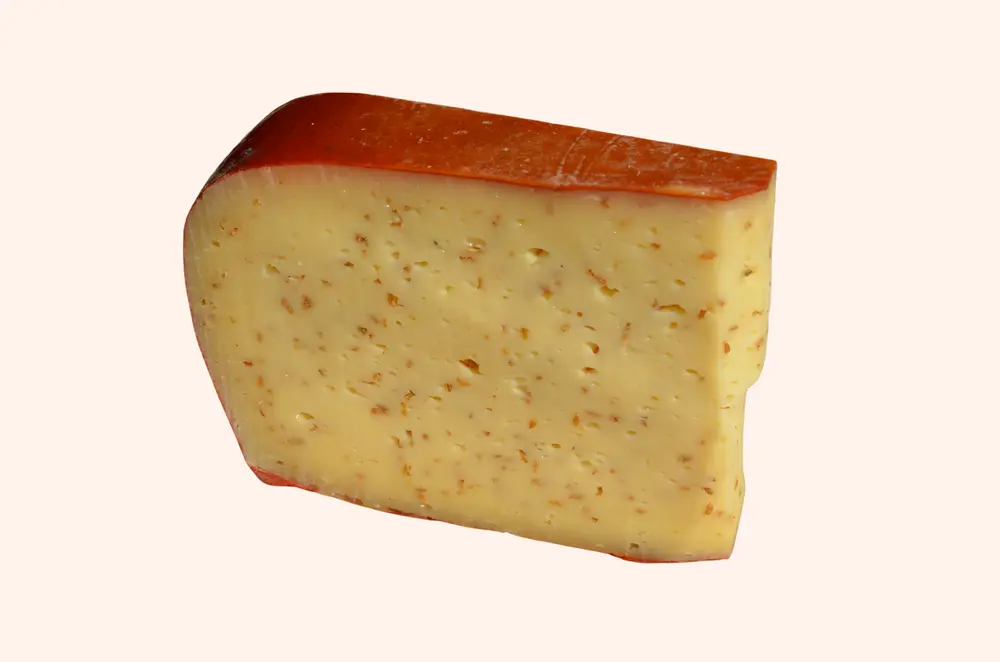
AlexanderVanLoon / CC BY-SA 3.0
Key Facts
| Country of Origin | Netherlands |
| Specific Origin | Area around the Old Rhine River, near the city of Leiden |
| Protection | PDO (1997) |
| Milk Type | Cow's milk |
| Milk Treatment | Pasteurized |
| Fat Content | 30% to 40% |
| Moisture Content | 40.6% |
| Rind | Painted with annatto or colored coatings |
| Texture | Hard and salty |
| Flavor | Sweetness from cumin seeds |
| Aroma | Spicy |
| Colors | Yellow |
| Forms | Pressed in molds with the pattern of keys, embossed into their surface |
| Age | Best aged over six months |
| Rennet Type | Animal rennet |
| Alternative Spellings | Leidse kaas |
| Also Known As | Boeren Leidenkaas |
What is Boeren-Leidse met sleutels Cheese?
Leyden cheese, or Leidse kaas in Dutch, comes from the Netherlands and was historically made in the area around Leiden. It grew out of butter making. Butter had to be produced locally because it spoiled fast, and that left farms with semi-skimmed milk that was usually fed to calves. Turning that milk into a low-fat cheese gave it real value, and low-fat cheese kept better than full-cream wheels like Gouda, especially in heat.
Farmers near Leiden added cumin seeds and colored their cheeses with annatto, which is where the red color comes from. Traditional farm-made Leidse kaas from the west of the Netherlands holds EU and UK Protected Designation of Origin status under the name Boeren-Leidse met sleutels. The phrase met sleutels means with keys, taken from the set of keys on Leiden's coat of arms.
On the farms, around 5% buttermilk may go into the milk, which is then set with rennet at 28 to 30 C (82 to 86 F). After about half an hour the curd is cut with a harp, stirred, and warmed to roughly 33 C (91 F) by pouring in hot whey. The curd is dipped with a cloth and kneaded. Cumin seeds are mixed into part of it, and the curd goes into cloth-lined hoops in three layers with the spiced curd in the middle.
Pressing runs about three hours, then the cheese is redressed, inverted, and pressed again overnight. It is either salted with dry salt or immersed in brine, then cured in a cool, moist cellar. When the rind hardens too much, it gets washed with whey or salty water.
The result is a semi-hard cheese, round and flat like Gouda but with sharp edges on one side and a straighter side wall. Fat runs 30% to 40%, and wheels weigh between 3 kg (6.6 lb) and 9 kg (20 lb). It is the most common komijnekaas in the Netherlands, the local name for cheese made with cumin in it.
How Does Boeren-Leidse met sleutels Cheese Compare?
The most relevant cheeses to compare Boeren-Leidse met sleutels against.


