
Camembert Cheese
Camembert cheese is a soft, creamy cow's milk cheese from Normandy, France, with a white, edible bloomy rind. It tastes buttery and slightly sour, and it is a little stronger than brie.
Buy Camembert Cheese online
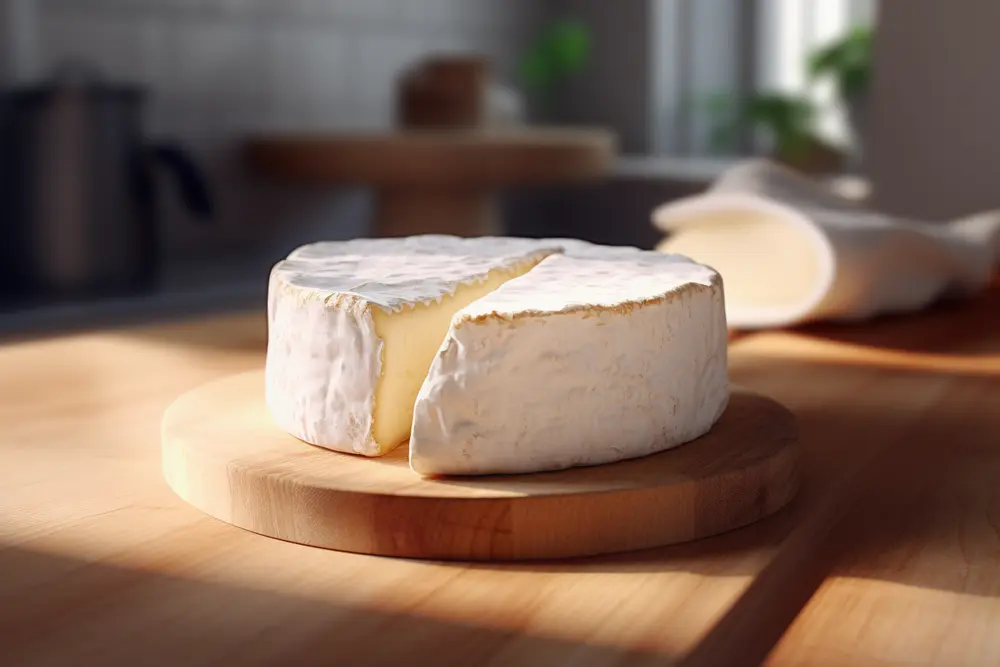
Key Facts
| Country of Origin | France |
| Specific Origin | Camembert, Normandy, northwest France |
| Milk Type | Cow's milk |
| Milk Treatment | Unpasteurized for AOC Camembert de Normandie, pasteurized for most other versions |
| Fat Content | Slightly below brie's typical 20 to 25% butterfat |
| Rind | Bloomy |
| Texture | Soft |
| Flavor | Slightly sour, stronger than brie |
| Aroma | Buttery, rich |
| Colors | Pale yellow |
| Forms | Small round wheel, 10.2 cm (4 in) across by 3.2 cm (1.26 in) thick, about 250 g (9 oz) |
| Age | Minimum 3 weeks |
| Also Known As | Camembert Le Châtelain, Camembert St Loup, Camembert Le Chatelain |
What is Camembert Cheese?
Camembert comes from the village of Camembert in Normandy, northwest France, where it was first made in the late 18th century. Marie Harel, a Normandy farmer, reportedly made it in 1791 after advice from Abbot Charles-Jean Bonvoust, who came from Alençon. She refined a cheese recipe that already existed in the Pays d'Auge. Her daughter's husband, Victor Paynel, presented one of his wife's best cheeses to Napoleon III, who gave it his royal seal of approval.
The cheese sold today owes more to the industrialization of cheesemaking at the end of the 19th century. In 1890 an engineer, M. Ridel, devised the wooden box that carried it over long distances, including to America, and that box is still in use. French troops were issued Camembert during World War I. Camembert de Normandie took the AOC in 1983 and a protected designation of origin in 1992, and it can only be made from raw milk from Normandes cows.
Warmed cow milk is inoculated with mesophilic bacteria, then set with rennet. The curd is cut into cubes of roughly 1 cm (1/2 inch), salted, and transferred to low cylindrical molds. Those molds are turned every six to twelve hours so the whey drains evenly, and after 48 hours each holds a flat cheese of about 250 grams (9 oz) that is still hard, crumbly and bland. The surface is then sprayed with an aqueous suspension of Penicillium camemberti and left to ripen for a legally required minimum of three weeks.
That affinage builds the bloomy edible rind and the creamy interior. A finished round measures 10.2 cm (4 in) across by 3.2 cm (1.26 in) thick and is covered by rind on every side. Rind color was once a matter of chance, most often blue-grey with brown spots; pure white did not become standard until the mid-1970s. The flavor is stronger, slightly sour and sometimes chalky, and the paste is softer than brie. An overripe wheel carries a harsh amount of ammonia, produced by the same microorganisms that ripen it.
Camembert is usually sold whole in a thin round container of poplar wood, with cartons and ring-pull tin cans as modern alternatives; cardboard is reserved for the cheap ones. Warmed, it turns creamier, while brie holds more of its structure. Similar cheeses are made elsewhere: Hungary uses the same name, the Czech Republic calls it Hermelín, Slovakia encián or plesnivec, Cornwall sells Cornish Camembert, and Fonterra in New Zealand makes a 1 kg (2 lb) Camembert Log.
What Does Camembert Cheese Taste Like?
Camembert cheese tastes buttery, slightly sour and sometimes chalky, with a slightly earthy note. It is stronger than brie ripened for the same length of time, and the flavor gets more pronounced as the cheese ages.
Size and shape cause the difference. Camembert ripens as a small round with rind on every side. Brie is traditionally made in much larger wheels, and the cut sides of a brie wedge have no rind.
The aroma is buttery and rich. One of the compounds behind the smell is diacetyl, the buttery flavoring used for popcorn. Once you cut the rind, Camembert usually smells more pungent than brie.
Inside, the cheese is moist, soft and creamy. It is softer than brie.
How Do You Eat Camembert Cheese?
You can eat Camembert with the rind on. The rind covers every side of the round, so each wedge you cut has some rind.
You can also warm it. Warm Camembert turns creamier, while brie keeps more of its shape.
Substitutes for Camembert Cheese
The closest swaps are other soft cow's milk cheeses.
- Brie is milder than Camembert, with a nutty, mushroom flavor. It holds its shape better when warmed.
- Brie de Meaux has a buttery, sweet aroma and tastes of cream, butter and hazelnuts.
- Coulommiers comes from the Brie area. Its flavor starts fresh and creamy and can turn stronger.
- Chaource is soft and creamy, and it tastes and smells of cream and fresh mushrooms.
Can You Eat the Rind of Camembert Cheese?
Yes, the rind of Camembert cheese is edible. It is a white bloomy rind made by the mold Penicillium camemberti.
The rind also adds to the flavor of the cheese.
Where to Buy Camembert Cheese
Buy Camembert Cheese online
Frequently Asked Questions
Is Camembert a strong cheese?
Camembert is a little stronger than brie ripened for the same time. It tastes buttery, slightly sour and sometimes chalky, and the flavor gets more pronounced with age. A cut round smells more pungent than brie. An overripe round contains too much ammonia, which tastes and smells unpleasant.
What milk is Camembert made from?
Camembert is made from cow's milk. The protected Camembert de Normandie uses unpasteurized milk, and most other versions use pasteurized milk. Some countries, especially the US, limit the import and sale of the raw milk cheese because of hygiene rules, so a pasteurized version is sold there instead.
What kind of cheese is Camembert?
Camembert is a soft-ripened cow's milk cheese with a white, edible bloomy rind and a pale yellow interior. It comes as a small round about 10.2 cm (4 in) across, 3.2 cm (1.26 in) thick and about 250 g (9 oz). It has slightly less butterfat than brie, which typically has 20 to 25%.
How Does Camembert Cheese Compare?
The most relevant cheeses to compare Camembert against.


