Queijo da Beira Baixa 
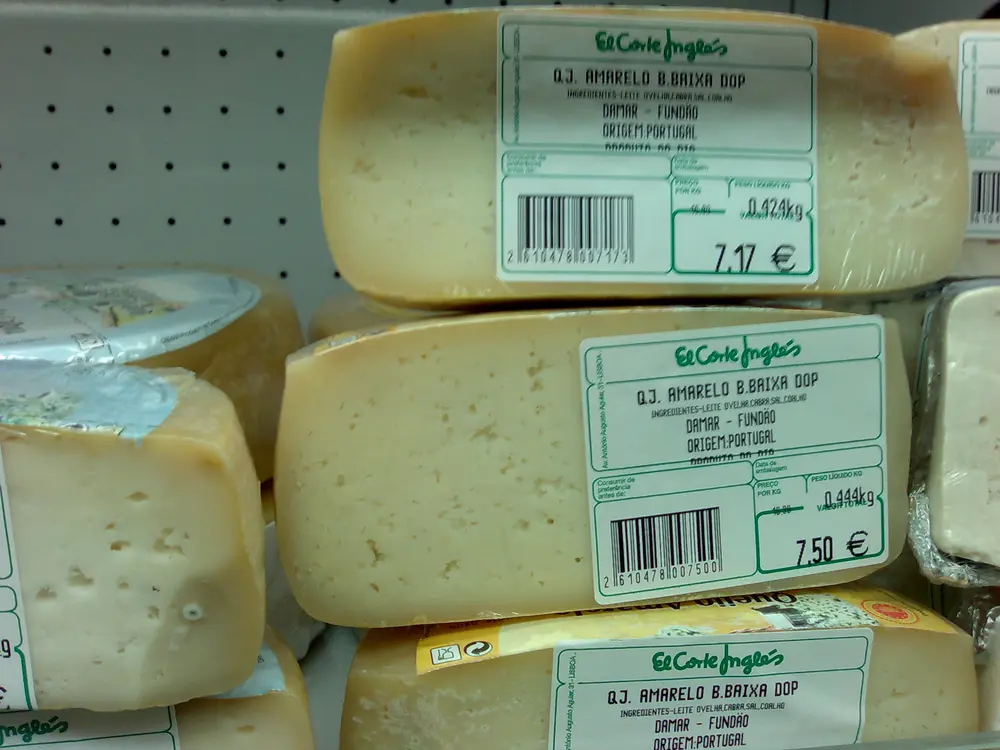
Queijo da Beira Baixa is a Portuguese raw-milk cheese made from sheep milk, goat milk or a blend of both, sold as Amarelo, Castelo Branco or Picante. It has a protected designation of origin and an intense, clean flavor that sharpens with long curing.
Key Facts
| Country of Origin | Portugal |
| Specific Origin | Beira Baixa region |
| Protection | PDO (1996) |
| Milk Type | Sheep and Goat |
| Milk Treatment | Raw |
| Fat Content | 35% - 60% (depending on type) |
| Moisture Content | 49% - 69% (depending on type) |
| Rind | Semi-hard, firm, solid, or rindless (depending on type) |
| Texture | Semi-hard, semi-soft, hard, or very hard (depending on type) |
| Flavor | Intense, clean, slightly acidic, spicy, and salty (depending on type) |
| Aroma | Intense |
| Colors | White, yellowish, dark yellow, orange, reddish, brownish orange, or red (depending on type) |
| Forms | Whole, Portions |
| Age | Minimum 40 days for Amarelo and Castelo Branco types, 120 days for Picante type |
| Rennet Type | Cardoon preparation or animal rennet (depending on type) |
What is Queijo da Beira Baixa?
Queijo da Beira Baixa comes from central Portugal and holds a protected designation of origin. The demarcated area takes in the municipalities of Castelo Branco, Fundao, Belmonte, Penamacor, Idanha-a-Nova, Vila Velha de Rodao, Proenca-a-Nova, Vila de Rei, Serta, Oleiros and Macao, along with some parishes of Covilha. Animal husbandry, milk production, cheesemaking and ripening all take place there.
Only raw milk qualifies: from Merino sheep or other breeds adapted to the region, and from Charnequeiro goats or other adapted breeds. One breed can supply the milk, or several can be mixed in any proportion. The flocks graze in Beira Baixa on pasture species such as Vulpia, Periballia, Trifolium and Ornithopus, and thin ground is improved by sowing subterranean clover and yellow serradella. Feed must come from the area; in times of real shortage, outside feed may not exceed 50 percent of the dry matter fed each year.
Curing runs at least 40 days for Amarelo and Castelo Branco and at least 120 days for Picante. Every type is a flattened cylinder. Amarelo weighs 200 to 500 g in the small format and 600 to 1000 g in the large one, with a semi-hard yellow to dark yellow rind and a compact, pliable paste holding a few irregular holes. Its flavor is intense, clean and slightly acidic. Castelo Branco is taller, 350 to 550 g or 800 to 1300 g, with a smooth rind and a white to yellowish paste, intense in aroma and taste.
The 'Velho' versions change character. Rinds turn wrinkly and orange to reddish, sometimes brownish orange or red, and the paste goes hard to very hard, dry and slightly crumbly, dark yellow to orange and darker toward the middle. Flavor is long, clean, strong, a little sharp and salty. Picante has no rind at all: straight sides, an off-white to greyish paste that is hard or semi-hard, and a lively, very sharp taste.
The cheese reaches buyers whole or in portions. Amarelo 'Velho' and Castelo Branco 'Velho' may also be packed in olive oil or coated with a paste of paprika and olive oil. Labels must state Queijo da Beira Baixa DOP together with the type name, plus 'Velho' where it applies.
How Does Queijo da Beira Baixa Compare?
The most relevant cheeses to compare Queijo da Beira Baixa against.


