Queijo de Cabra Transmontano 
Queijo de Cabra Transmontano is a Portuguese protected designation of origin cheese made from raw milk of Serrana goats in Trás-os-Montes. It has a firm white paste, a strong aroma and a slightly piquant taste, and ages at least 60 days, or 90 days for the Velho version.
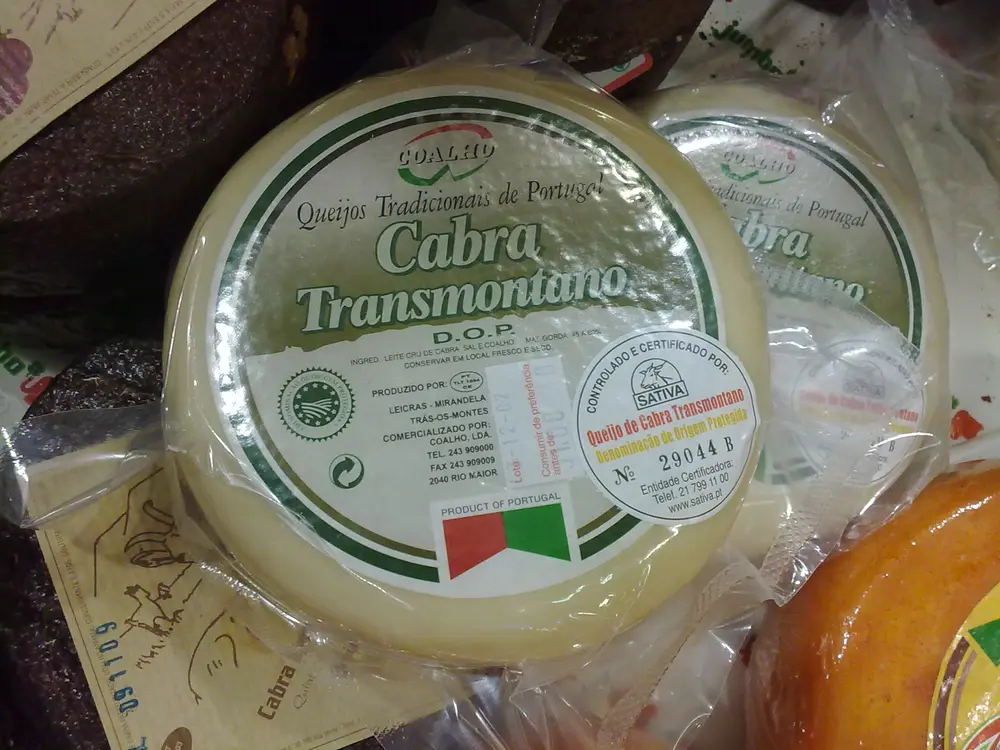
Key Facts
| Country of Origin | Portugal |
| Specific Origin | Trás-os-Montes region, including municipalities in the districts of Bragança and Vila Real |
| Protection | PDO (1996) |
| Milk Type | Goat's milk |
| Milk Treatment | Raw |
| Fat Content | 35% to 55% in dry matter |
| Moisture Content | 25% to 37% |
| Rind | Semi-hard to extra-hard, unbroken, well-formed, smooth, white or paprika-red in color |
| Texture | Closed, semi-hard to extra-hard, not buttery |
| Flavor | Clean taste, usually with a slight tang |
| Aroma | Intense, pleasant |
| Colors | White, uniform |
| Forms | Short (flat) cylinder |
| Age | Minimum ripening time of 60 to 90 days |
| Rennet Type | Animal rennet |
What is Queijo de Cabra Transmontano?
Queijo de Cabra Transmontano comes from Trás-os-Montes in northern Portugal. The defined area takes in the municipalities of Mirandela, Macedo de Cavaleiros, Alfândega da Fé, Carrazeda de Ansiães, Vila Flor, Torre de Moncorvo, Freixo de Espada à Cinta, Mogadouro, Vimioso and parts of Bragança in the Bragança district, plus Alijó, Valpaços and Murça in the Vila Real district. Milk production, cheesemaking and ripening all have to happen inside that area.
Goat farming there is mostly for meat, and the herding follows the weather and the isolated life of the breeders, which keeps the system extensive. Depending on the season, the condition of the animals and what is growing, the herd walks to a new feeding place each day and lives on wild plants from uncultivated and fallow land. Serrana goats go for young shoots and leaves: about 60 percent of their intake while out grazing comes from trees, 30 percent from shrubs and 10 percent from grasses. With enough growth available, that covers up to 90 percent of what they need.
Only raw Serrana goat milk with 3.8 to 7.0 percent fat is used, along with salt and animal rennet, plus oil and paprika powder where those apply. The rennet is added slowly to set the milk. Ripening runs at 5 to 12 °C with 70 to 85 percent relative humidity. Sixty days is the minimum; after 90 days the cheese can be labelled Velho, and Velho wheels may be rubbed with oil and paprika powder.
The wheel is a flat disc 3 to 6 cm high, even in shape but without a firm edge. One size runs 6 to 12 cm across at 300 to 600 g, or 250 to 500 g for Velho; the larger runs 12 to 19 cm across at 600 to 900 g, or 500 to 900 g for Velho. The rind is smooth and white, and red on some Velho, semi-hard in the young cheese and hard to extra-hard in Velho. Inside, the paste is white, firm and shows few holes. Fat in dry matter is 35 to 55 percent, water content 27 to 37 percent, or 25 to 35 percent for Velho.
It is sold as a whole wheel or in pieces, and pieces must be prepacked. Packing normally happens at the producer so each piece can be traced, though other controlled facilities may do it in individual cases. Labels carry the name with the DOP mark, the certification mark and the European Union symbol for protected designations of origin.
How Does Queijo de Cabra Transmontano Compare?
The most relevant cheeses to compare Queijo de Cabra Transmontano against.


