Queijo de Évora 
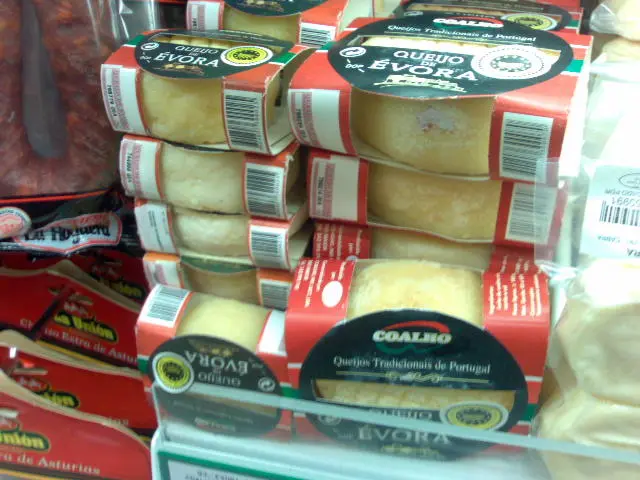
Queijo de Évora is a PDO ewe's milk cheese from Évora, in Portugal's Alentejo. It is cured, hard or semi-hard, yellowish in color, and known for a slightly acidic flavor with a light peppery bite.
Adriao, CC BY-SA 4.0, via Wikimedia Commons
Key Facts
| Country of Origin | Portugal |
| Specific Origin | Évora, Alentejo, Portugal |
| Protection | PDO (1996) |
| Milk Type | Ewe's milk |
| Milk Treatment | Raw |
| Rind | Sealed |
| Texture | Semi-hard |
| Colors | White-yellow |
| Forms | Cured cheese, semi-hard consistency, with small holes |
| Rennet Type | Cardoon (Cynara cardunculus) |
What is Queijo de Évora?
Queijo de Évora comes from the city of Évora, in the Alentejo region of Portugal, and holds a protected designation of origin under European Union rules. Besides the Évora municipality, it is made in Alandroal, Arraiolos, Avis, Borba, Estremoz, Fronteira, Montemor-o-Novo, Mora, Mourão, Portel, Redondo, Reguengos de Monsaraz, Sousel, Vendas Novas, Viana do Alentejo and Vila Viçosa.
The cheese belongs to the old cheesemaking tradition of the Alentejo. It was stored submerged in olive oil in clay vessels called talhas, which kept it edible through the whole year. It mattered in daily eating, above all for the poorer classes, whose wages were often paid in cheese and other foodstuffs.
Production starts with raw ewe's milk. Once the milk coagulates, the curd is drained using the action of cardoon.
It is a cured cheese, hard or semi-hard, yellowish and darkening where air touches it. The rind can be smooth or a little rough. Small hard-paste cheeses run 60 to 90 g, normal hard-paste ones 120 to 200 g, and semi-hard ones 200 to 300 g.
It is eaten with bread and a glass of red wine. Around 71,630 kg were produced in 2019, about 3.7 percent of national output, making it the sixth most produced PDO cheese in Portugal. The 2020 figures count 6 milk-supplying farms and 3 certified dairies.
How Does Queijo de Évora Compare?
The most relevant cheeses to compare Queijo de Évora against.


