Roncal 
Roncal is a hard cheese made from raw sheep's milk in the Roncal Valley of the Navarrese Pyrenees. In 1981 it became the first Spanish cheese granted a denomination of origin, and it is known for its intense, slightly spicy sheep's milk flavor.
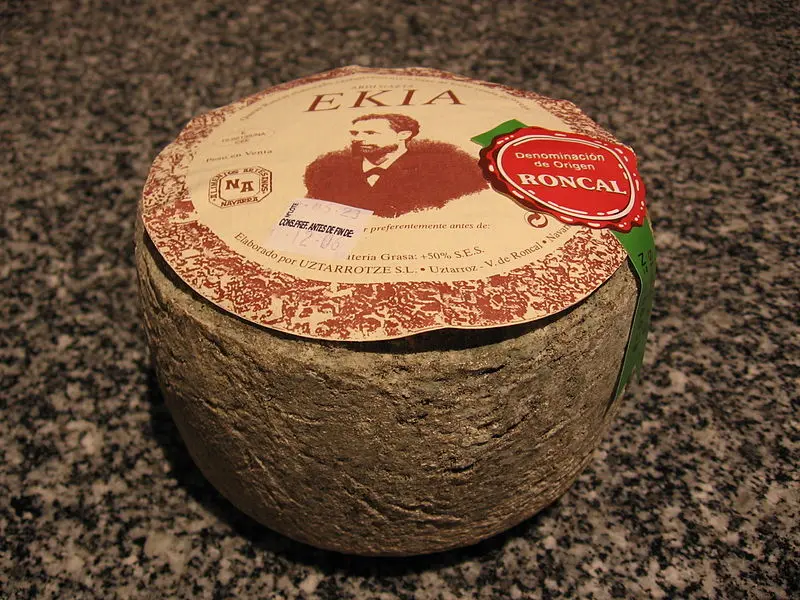
No machine-readable author provided. Ardo Beltz assumed (based on copyright claims)., CC BY-SA 3.0, via Wikimedia Commons
Key Facts
| Country of Origin | Spain |
| Specific Origin | Roncal Valley, Navarra |
| Protection | PDO (1981), PDO (1996) |
| Milk Type | Sheep's milk |
| Milk Treatment | Unpasteurized |
| Fat Content | More than 45% fat in dry matter |
| Rind | Natural hard brown |
| Texture | Hard or semihard |
| Flavor | Well developed, pronounced |
| Aroma | Straw, mushrooms, dried fruits |
| Colors | Yellowish-white to straw |
| Forms | Cylindrical, 2–7 pounds (1–3 kilograms) weight |
| Age | More than 120 days |
| Rennet Type | Animal |
| Also Known As | Roncal DOP |
What is Roncal Cheese?
Roncal comes from the valley of the same name, the last Navarrese valley in the Pyrenees, along the river Esca. Seven villages share the production area: Burgui, Garde, Isaba, Roncal, Urzainqui, Uztarroz and Vidangoz. Flocks of Lacha sheep graze the high pastures and clearings between pine and beech woods, some of them above 1,000 metres. Shepherding and forestry were the economy of the valley, with customs traced back to at least the thirteenth century. In 882 King Sancho Garcia granted the people of the valley the right to bring their flocks down in winter to the Bardenas Reales, and the Canada Real de los Roncaleses is still walked by more than 10,000 head of livestock.
In 1981 Roncal became the first Spanish cheese to receive a denomination of origin, a move meant to protect it from commercial cheeses borrowing the name. It is protected at European level under Regulation (CE) 1107/96 of 12 June. A regulatory council approves dairies and farms, and an official tasting committee gives each batch a sensory rating. Both the making and the ripening must happen in the municipalities of the valley.
Cheesemaking runs from December to July, using raw milk of Lacha and Rasa sheep, low in acidity and high in fat and dry extract. Milk from the F1 cross of Lacha and Milchschaf is also allowed. The milk is coagulated at 30 to 37 degrees Celsius (86 to 99 degrees Fahrenheit) with animal rennet in no more than an hour, where kid rennet was once used. The curd is cut, packed into beech wood molds and pressed, then held for 30 hours in dense cold brine. Drying and rind forming take 40 days at 12 degrees Celsius (54 degrees Fahrenheit), followed by at least four months of ripening.
The finished cheese is cylindrical with a hard paste, ivory to pale yellow, and carries more than 45 percent fat on dry extract. Its rind is hard and moldy, yellowish brown. Inside, the paste is compact and almost free of eyes but carries the small pores the denomination requires. Nothing goes into it but milk, rennet, ferment and salt, so it keeps the taste and smell of the raw material. The flavor is intense and sturdy, a little spicy, unmistakably sheep's milk, and buttery on the palate.
There is a set way to serve it. Cut the whole cheese in half, take a wedge of roughly an eighth from that half and trim the side rinds, then slice thin triangles and lay them on a flat plate with the sharp point facing inward. Red wine goes with it, aged or young, ideally from Navarra.
How Does Roncal Cheese Compare?
The most relevant cheeses to compare Roncal against.


