Afuega'l Pitu 
Afuega'l pitu is an unpasteurized cow's milk cheese from Asturias in northern Spain, sold plain white or paprika red. Its name translates as "strangle the chicken," and it holds Protected Designation of Origin status from Spain and the EU.
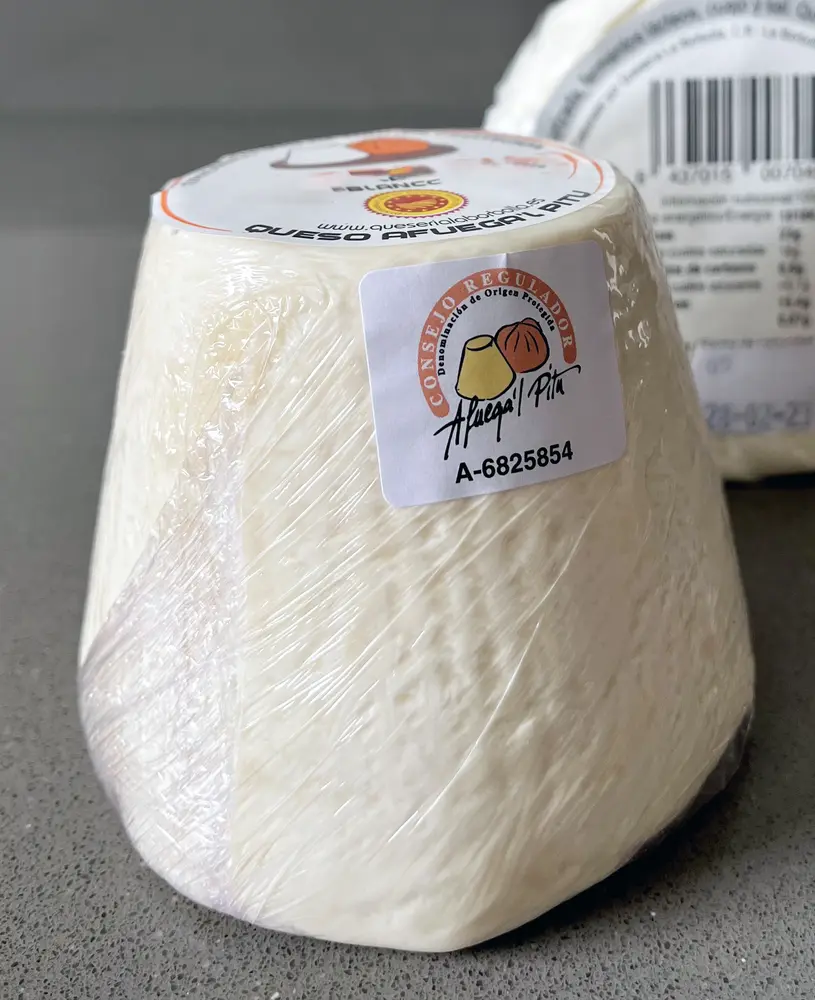
Key Facts
| Country of Origin | Spain |
| Specific Origin | Asturias |
| Protection | PDO (2004), PDO (2003) |
| Milk Type | Cow's milk |
| Milk Treatment | Unpasteurized |
| Rind | White soft and rough in briefly ripened cheeses; moist, yellowish brown with moldy blue or white areas in ripened cheeses |
| Texture | Soft |
| Flavor | Lactic, slightly sour, salted in fresh or hardly ripened cheeses; strong and spicy as ripening progresses |
| Colors | White, or red where paprika is added |
| Forms | De trapu or "de trapo" (piriform, ~1 pound), "atroncau" or "atroncado" (inverted flowerpot shape, ~half a pound), "roxu" or "rojo" (with paprika), "blancu" or "blanco" (plain) |
| Age | Fresh to mid-ripened |
| Rennet Type | Very small amounts of calf rennet |
What is Afuega'l Pitu Cheese?
Afuega'l pitu comes from Asturias in northern Spain. It is one of four Asturian cheeses with Protected Designation of Origin status, alongside Cabrales, Gamonéu and Casín, and the European Union has recognized it as a PDO since 2008. The name translates from Asturian as "strangle the chicken," and the legend behind it says the cheese is ready when the chicken is dead. Production centers on the municipalities of Grau, Les Regueres, Morcín, Pravia, Riosa, Salas, and Yernes y Tameza. Grau makes the most of it and hosts the council of the Denomination of Origin.
Cheesemakers use milk from cows milked in the afternoon or evening. The milk is heated to between 25 and 30 C (77 and 86 F) and a coagulant is added to form curds. After midday the next day the curds are cut and put into a mold to drain. From there the curd either goes into a sack called a fardela, which gives the trapu form, or stays in the mold for the troncado form. Salt goes in, and Spanish paprika if the maker wants it. Curing follows a few days later, on wooden planks, for anywhere from a week to several months. The cheese is made all year, mostly in spring and winter, when milk fat runs higher.
Two shapes define it. The troncado, or atroncáu, is cone shaped like a bishop's mitre or an inverted flowerpot, taking its form from the draining mold. The trapu is rounded like a chestnut, shaped by the draining cloth. Paprika sets the other main division: blancu is plain white, while roxu is made with sweet or hot smoked Spanish paprika added before molding, according to each artisan's recipe. Curing time puts a given cheese in the soft, semi-cured or cured class.
How Does Afuega'l Pitu Cheese Compare?
The most relevant cheeses to compare Afuega'l Pitu against.


