Queso Casín 
Queso Casín is a hard to semi-hard cheese from southern Asturias, made with full-fat unpasteurized milk from Casina, Asturian Valley and Friesian cows. It is known for a firm, friable body, a sharp peppery bite, and a rind stamped with flowers or geometric figures.
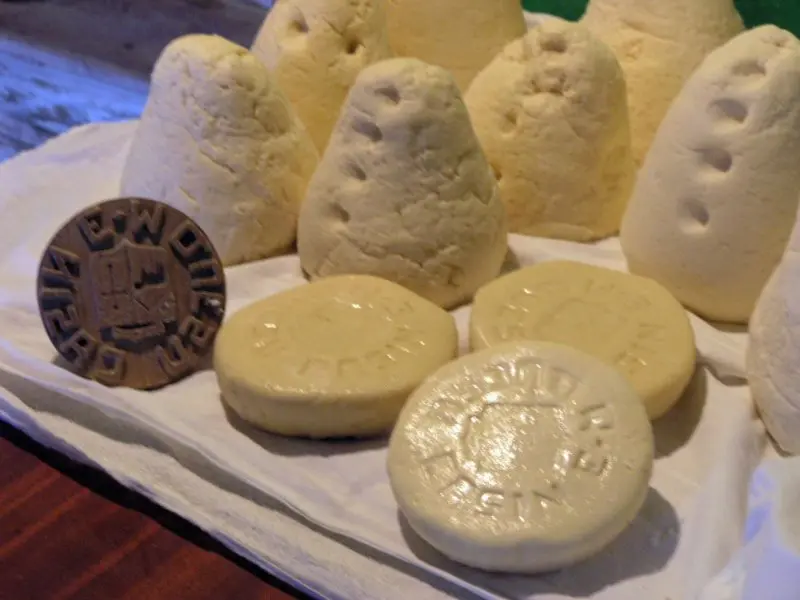
Monchu Calvo, CC BY-SA 4.0, via Wikimedia Commons
Key Facts
| Country of Origin | Spain |
| Specific Origin | Asturias (Municipalities of Caso, Sobrescobio, and Piloña) |
| Protection | PDO (2008) |
| Milk Type | Cow |
| Milk Treatment | Unpasteurized |
| Fat Content | Minimum 45% (dry matter) |
| Moisture Content | Minimum 57% (dry matter) |
| Rind | Smooth, fine, and almost non-existent |
| Texture | Hard to semi-hard, firm, crumbly, and buttery on the palate |
| Flavor | Strong, tangy, slightly bitter, and persistent |
| Aroma | Strong and potent |
| Colors | Dark creamy-yellow with shades of white |
| Forms | Irregular discoid cylinder |
| Age | Minimum 60 days |
| Rennet Type | Animal |
| Also Known As | Casín cheese |
What is Queso Casín?
Queso Casín is made in the southern part of Asturias, in an area taking in the Redes Natural Park and the municipalities of Caso, Sobrescobio and Piloña. Its name holds a protected designation of origin. The cheese is named after one of the cattle breeds behind it, the Casina, which in turn takes its name from the town of Caso.
The milk is full fat and unpasteurized, from Asturian Mountain, Asturian Valley and Friesian cows or crosses between those breeds. Suppliers have to be registered with the regulating council, and the cows must have fed on local, natural foodstuffs.
Animal coagulant works alongside fermenting products and calcium chloride, setting the milk at 30 to 35 °C (86 to 95 °F) over about 45 minutes. The curd is cut with lyres, warmed by 2 °C and stirred for at least 10 minutes until the grains reach the size of a hazelnut, then rested and drained in sacking bags or perforated plastic containers. Three days or more follow in ventilated rooms at 15 to 20 °C (59 to 68 °F), with daily turning, before the cheese is moulded by hand or machine and lightly salted. Another 5 days to 2 weeks of daily turning, then a last pressing tidies the shape and adds the decoration and the maker's mark. Final maturing happens at 8 to 10 °C (46 to 50 °F) and 80 percent humidity, and two months must pass between coagulation and maturity.
Each cheese is a thick disc, sometimes closer to a cone, 10 to 20 cm across and 4 to 7 cm high, weighing 250 to 1,000 g (8.8 to 35.3 oz). The rind is smooth and thin, a yellowy cream colour with occasional whitish patches, clean and dry but slightly greasy. The paste is firm and friable, a little rubbery, with no cavities inside, though tiny cracks can run through the body.
The flavour is strongly dairy, turning acid and peppery in well matured pieces and staying milder in younger ones, and it lasts a long time in the mouth. Cheeses are wrapped in paper, cardboard, wood or culinary grade plastic before sale, because the whole cheese is meant to be eaten.
How Does Queso Casín Compare?
The most relevant cheeses to compare Queso Casín against.


