Queso de Guía 
Queso de Guía is a Spanish cheese from Gran Canaria, made mostly from sheep's milk with some cow and goat milk added. It carries a protected designation of origin granted in 2006 and is sold either soft and creamy or hard and sharp.
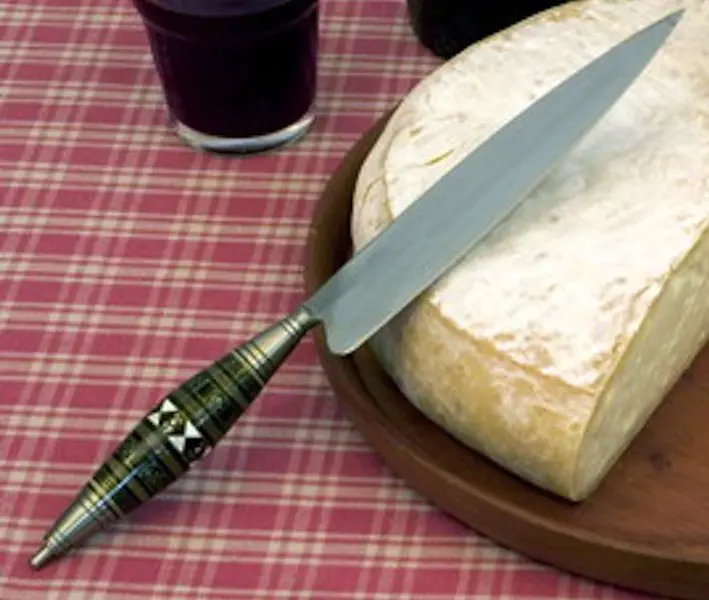
FEDAC, CC BY-SA 3.0, via Wikimedia Commons
Key Facts
| Country of Origin | Spain |
| Specific Origin | Gran Canaria, Canary Islands, Spain |
| Protection | PDO (2007) |
| Milk Type | Sheep (Canary Island breed), with up to 40% cow and 10% goat milk |
| Milk Treatment | Raw, for the artesano designation |
| Fat Content | 27.50% (in dry matter) |
| Rind | Ivory when young, thick and dark brown when mature |
| Texture | Dense, compact, sometimes creamy |
| Flavor | Salty and acidic, with occasional bitterness and sharpness |
| Aroma | Medium intensity, mainly lactic |
| Colors | Ivory-white to yellow |
| Forms | Cylindrical wheels (0.5 to 5 kg) |
| Age | 15+ days (semi-mature), 60+ days (mature) |
| Rennet Type | Animal rennet and/or vegetable rennet (Cynara cardunculus var. ferocissima, Cynara scolymus) and/or starter cultures |
| Also Known As | guía |
What is Queso de Guía?
Queso de Guía comes from the island of Gran Canaria in the Canaries. Three municipalities make it: Gáldar, Moya and Santa María de Guía. The name points to the Altos de Guía area, where the cheese is produced. It won a protected designation of origin in 2006.
All the milk has to come from those same three municipalities, from sheep, cows and goats of Canary Island breeds, with crossbreeding allowed for the cows. The blend is at least 60 percent sheep's milk, no more than 40 percent cow's milk and no more than 10 percent goat's milk, so it still counts as a sheep's cheese. Queso de Guía itself is set with ordinary animal rennet. The two related variants, flor de Guía and media flor de Guía, use vegetable rennet drawn from the flower heads of two local thistles, Cynara cardunculus var. ferocissima and Cynara scolymus, with media flor allowed up to 50 percent animal rennet in the mix. Cheese sold under the designation of origin can only be made between January and July, while the sheep graze in the three approved municipalities. When a producer works with raw milk from their own animals, the cheese can carry the artesano mark.
The wheels are cylinders 4 to 6 cm high and 15 to 30 cm across, weighing 500 g to 1 kg. The underside keeps the marks of the mould. Cheeses aged 15 to 60 days are labelled semi-curado: soft, creamy, cream-coloured paste, bitter and slightly acidic, under a thin elastic white rind. Past 60 days the cheese becomes curado, with a hard brownish yellow paste, a bitter and sharp taste, and a rind that is thicker, harder and dark brown.
Every version of the cheese holds at least 55.5 percent dry matter, at least 27.5 percent fat on dry matter and at least 22.5 percent protein on dry matter.
How Does Queso de Guía Compare?
The most relevant cheeses to compare Queso de Guía against.


.jpg)