Cabrales 
Cabrales is a blue cheese made by rural dairy farmers in the Asturias mountains of Spain, from raw cow's milk alone or blended with goat and sheep milk. It is known for its strong, sometimes sharply acidic flavor and for ripening in limestone caves.
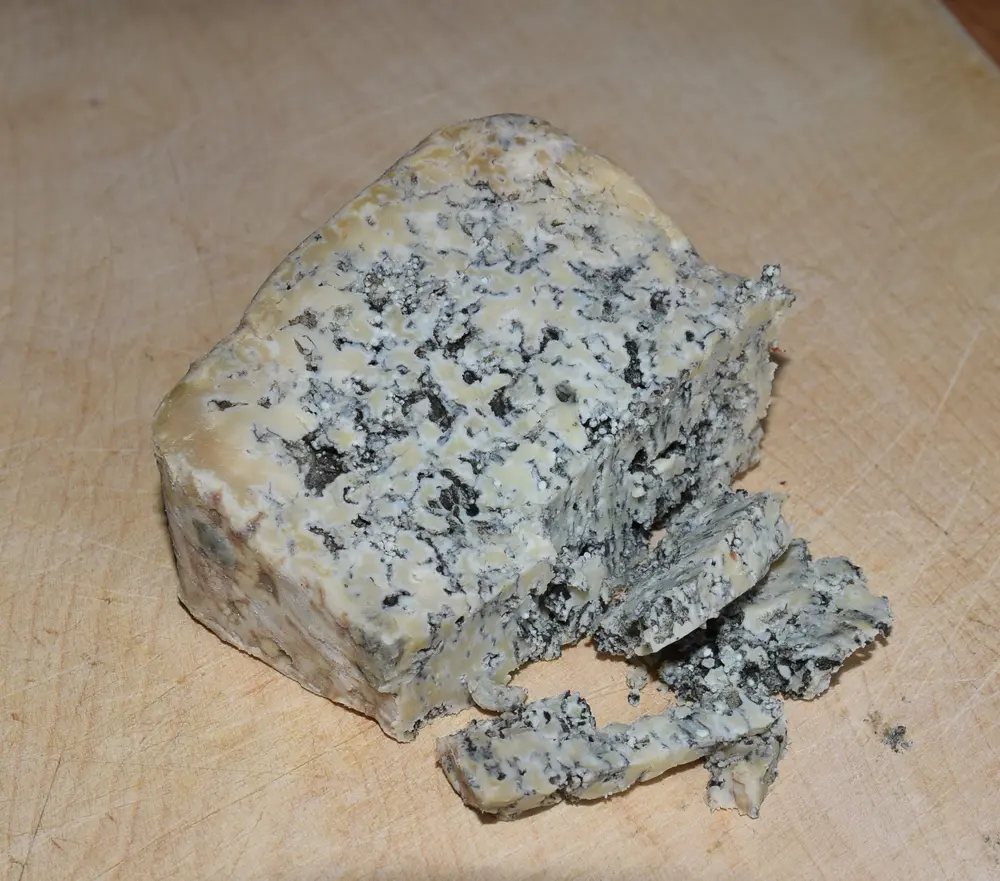
Helge Høifødt, CC BY-SA 3.0, via Wikimedia Commons
Key Facts
| Country of Origin | Spain |
| Specific Origin | Asturias |
| Protection | PDO (1981), PDO (1996) |
| Milk Type | Cow's milk |
| Milk Treatment | Unpasteurized |
| Fat Content | At least 45% of dry matter |
| Moisture Content | Minimum 30% |
| Rind | Natural |
| Texture | Unctuous, compact, no eyes |
| Flavor | Intense, piquant |
| Aroma | Strong |
| Colors | Gray rind with yellow-reddish areas, blue-green veined paste |
| Forms | Cylindrical |
| Age | 2 to 3 months |
| Rennet Type | Kid rennet |
| Alternative Spellings | Queso de Cabrales |
| Also Known As | Cabrales DOP, Cabrales PDO |
What is Cabrales Cheese?
Cabrales comes from Asturias, Spain, where rural dairy farmers make it in the artisan tradition. Every drop of milk has to come from herds kept in a small production zone in the mountains of the Picos de Europa. The name carries the same kind of legal protection in Europe as Gorgonzola and Roquefort.
The milk is heated and set with rennet. Cheesemakers drain off the whey, pack the curds into cylindrical molds called arnios, salt them, and let them harden for about two weeks. After that the wheels move into natural caves in the limestone mountains for another two to five months, resting on wooden shelves called talameras where they are turned and cleaned by hand. Humidity in the caves runs near 90% and the temperature holds at 7 to 13 C (45 to 55 F), which is exactly what penicillium molds want. Blue-green veins spread through the paste as a result.
A finished wheel stands 7 to 15 cm (roughly 3 to 6 in) high, with diameter and weight varying from maker to maker. The rind is thin, soft and creamy, gray with yellow-reddish patches. Inside, the paste is unctuous and compact with no eyes, and fat accounts for at least 45% of the dry matter. The flavor is strong and can turn quite acidic. Wheels made with mixed milks taste spicier and more complex than those made with cow's milk alone.
Cabrales used to be sold wrapped in damp sycamore maple leaves. Regulations now require commercial wheels to go out in dark green aluminum foil stamped with the PDO Queso de Cabrales mark, so the leaf-wrapped cheese survives only in small batches inside the production zone and never leaves it. Demand is serious: a 2.62 kg (5.78 lb) wheel from the Valfriu dairy took a Guinness World Record at auction in 2018 at 14,300 euros, and the same cheese sold for 20,500 euros in 2020. Producers made 433,000 kg in 2019.
How Does Cabrales Cheese Compare?
The most relevant cheeses to compare Cabrales against.


