Queso Los Beyos 
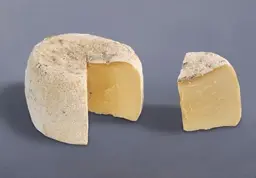
Queso de Los Beyos is a protected geographical indication cheese from the Los Beyos gorge, shared by Ponga and Amieva in Asturias and Oseja de Sajambre in Leon, Spain. It is a small smoked cheese of cow, goat, or sheep milk, semi-hard to hard, with a mild acidic tang.
Benitoypepe, CC BY-SA 4.0, via Wikimedia Commons
Key Facts
| Country of Origin | Spain |
| Specific Origin | Oseja de Sajambre (Castile-Leon), Ponga, and Amieva (Asturias) |
| Protection | PGI (2010) |
| Milk Type | Cow’s, sheep’s, or goat’s milk (never mixed) |
| Milk Treatment | Raw or pasteurized |
| Fat Content | Minimum 45% (of dry matter) |
| Moisture Content | Minimum 50% (dry matter) |
| Rind | Thin, coarse, creamy yellow to light brown |
| Texture | Hard to semi-hard, closed, friable, crumbly, minimal elasticity |
| Flavor | Mild (cow’s milk), more intense (sheep’s and goat’s milk) |
| Aroma | Mild in cow’s milk cheese, stronger in sheep’s and goat’s cheese |
| Colors | White (goat’s milk), marble or pale yellow (cow’s and sheep’s milk) |
| Forms | Cylindrical with flat or slightly concave faces |
| Age | Minimum 15 days, or 60 days if made from raw milk |
| Rennet Type | Animal |
| Alternative Spellings | Queso de Los Beyos |
What is Queso Los Beyos?
Queso de Los Beyos takes its name from a gorge cut by the river Sella that belongs to the Asturian councils of Amieva and Ponga and to the Leonese municipality of Oseja de Sajambre. Specialists still argue over the place name. Most of them trace beyo to bedus, a Celtic word that passed into Latin. The cheese carries a protected geographical indication covering all three areas.
Production sits in a short list of villages: El Arenal, San Ignacio, Bores, Canisqueso, Rubiellos, Vidosa and Viego in Ponga, scattered spots in Amieva, and the five villages of the Sajambre valley. Amieva and Oseja de Sajambre are currently waiting on a court ruling in a suit they filed after Ponga registered the Los Beyos name as its own trademark.
Milk can be cow, goat, or sheep, but never a mixture, and today almost every wheel is made from cow milk. The morning milking is combined with the evening milking, rennet goes in to set the curd, and the whey drains off naturally. Once the curd is in the molds, the cheeses go onto shelves in a room where they are smoked. After that they rest somewhere dry and airy for 15 days up to three months.
The finished cheese is semi-hard to hard and weighs no more than 500 grams (about 1.1 lb). Its rind is dry and rough, a creamy yellow. The smell is gentle and the taste runs slightly acidic, still mild. A paste full of eyes means something went wrong in the make.
The cheese anchors several local events. San Juan de Beleño holds a major competition on the last Sunday in May, Amieva follows on the first Saturday in June, and Los Beyos shows up strongly at the Picos de Europa cheese fair in Cangas de Onis. There is also a display of it at the Oseja de Sajambre fair each October.
How Does Queso Los Beyos Compare?
The most relevant cheeses to compare Queso Los Beyos against.


