Queso de Burgos 
Queso de Burgos is a fresh white cheese from the province of Burgos, Spain, eaten within days of being made. Once a sheep's milk cheese sold at the Burgos market, it received EU Protected Geographical Indication status in September 2025.
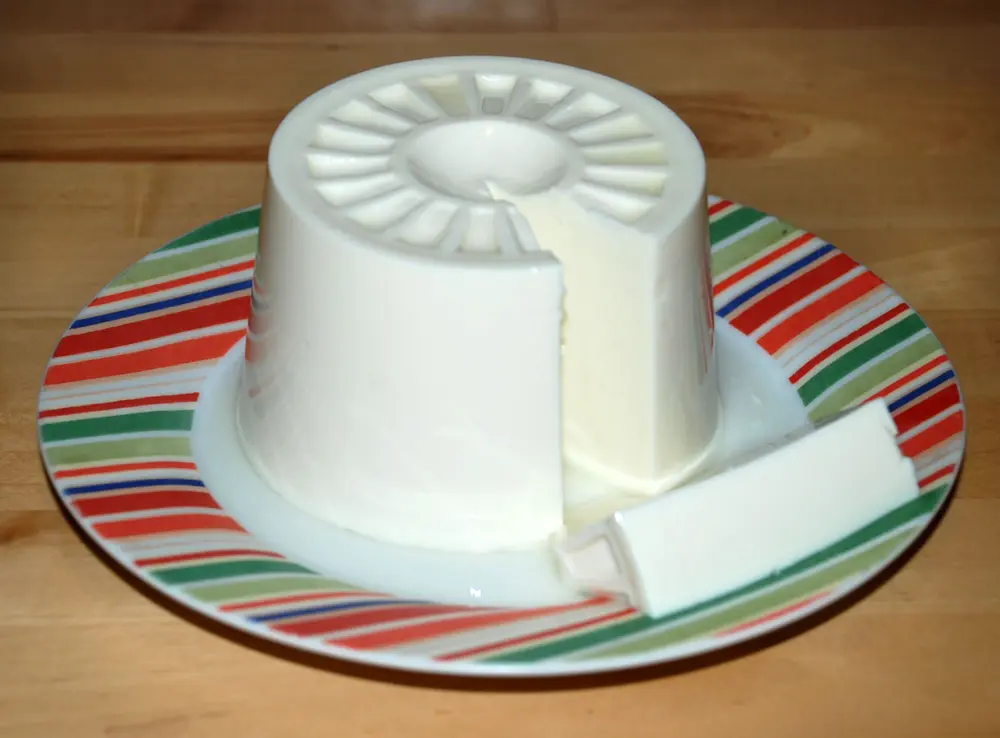
Valdavia, CC BY-SA 3.0, via Wikimedia Commons
Key Facts
| Country of Origin | Spain |
| Specific Origin | Province of Burgos |
| Protection | PGI (2023) |
| Milk Type | Cow’s and sheep’s milk |
| Milk Treatment | Pasteurized |
| Fat Content | Minimum 40% of dry matter |
| Moisture Content | More than 20% and less than 36% |
| Rind | None |
| Texture | Fresh, slightly grainy or buttery, elastic, slightly fatty |
| Flavor | Mild, milky, and slightly sweet |
| Aroma | Smells of fresh milk; varies in intensity based on sheep’s milk content |
| Colors | White to slightly yellowish |
| Forms | Cylindrical or cylindrical-conical |
| Age | Fresh, not matured |
| Also Known As | Burgos, Fromage Burgos, Burgos käse |
What is Queso de Burgos?
Queso de Burgos comes from the province of Burgos in Spain and is one of the cheeses most associated with Castilla y León. The name traces back to the city of Burgos and its weekly market, where farmers from the surrounding countryside came in winter and spring to sell cheeses made from sheep's milk. On 10 September 2025 the European Union published the registration of the name as a Protected Geographical Indication.
The cheese was originally made with sheep's milk alone, which is now almost impossible to find. Cow's milk is used instead because it costs far less, or a blend with a small share of sheep's milk. That shift allows much cheaper industrial production, but the result has little in common with the original, which was softer and less harsh on the palate. Output today reaches around 35,000 tonnes a year.
Climate explains why it stays fresh. In the south of Spain, hard-paste cheeses turned milk into something that would keep, since milk lasted barely a day before microbes took hold. Burgos sits high enough to be cold, so the cheese kept without any curing. Shelf life used to top out at ten days; ultrafiltration before coagulation and cleaner production have pushed it to roughly 30 days.
It is white, soft and watery, and ready to eat a few hours after it is made. It should not be confused with requesón, which is made from the whey left after the milk is curdled. Sizes on sale include 250 g and 500 g tubs, 2 kg cheeses, and packs of individual portions.
The usual way to eat it is with honey, quince paste or walnuts, a dessert known as "del abuelo", or chopped into a salad. Consumption has grown in recent years because it is a natural product, high in protein.
How Does Queso de Burgos Compare?
The most relevant cheeses to compare Queso de Burgos against.


