Queso Ibores 
Queso Ibores is a raw goat's milk cheese from southeast Cáceres, Spain, with a protected designation of origin. It is known for its paprika-rubbed or oil-rubbed rind and a tangy, moderately piquant paste made from Serrana, Verata and Retinta goat milk.
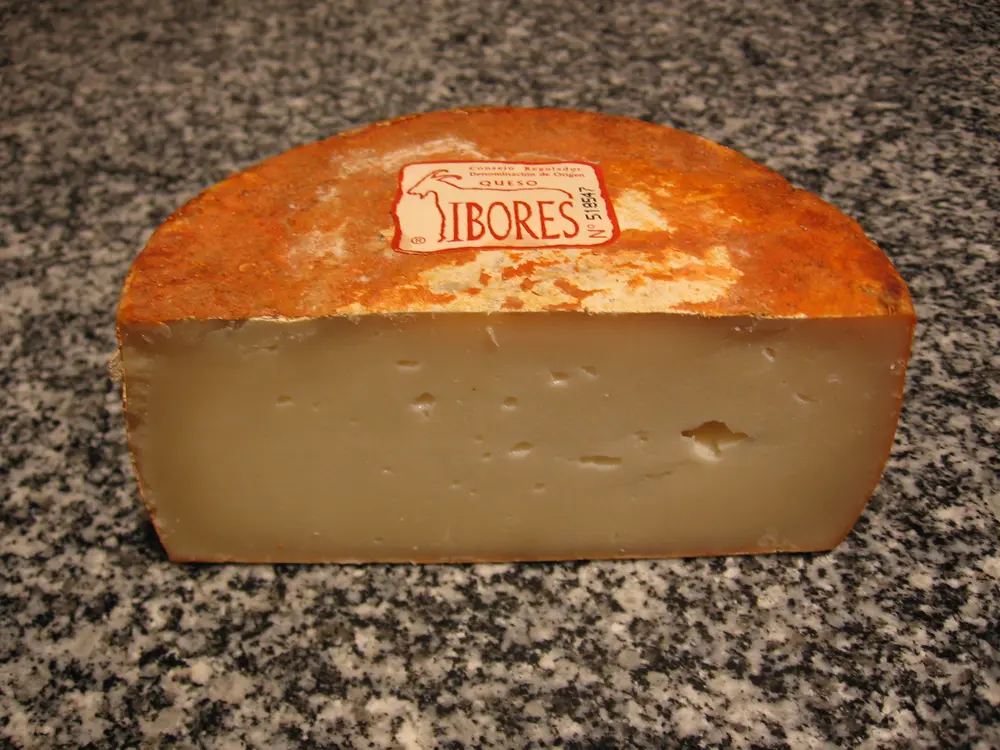
No machine-readable author provided. Ardo Beltz assumed (based on copyright claims)., CC BY-SA 3.0, via Wikimedia Commons
Key Facts
| Country of Origin | Spain |
| Specific Origin | Ibores, Villuercas, La Jara, and Trujillo, Cáceres |
| Protection | PDO (2004) |
| Milk Type | Goat |
| Milk Treatment | Raw |
| Fat Content | Minimum 45% (of dry matter) |
| Moisture Content | Minimum 50% (dry matter) |
| Rind | Smooth, medium-hard, coated in pepper or oil |
| Texture | Slightly hard, moist, creamy, crumbly to spongy |
| Flavor | Strong, slightly tart, tangy, and salty |
| Aroma | Sweet to mild, characteristic of raw goat’s milk cheese |
| Colors | Ivory interior; rind varies from greyish (natural) to orange-red (pepper-coated) or ochre yellow (oil-coated) |
| Forms | Cylindrical, slightly convex on top |
| Age | Minimum 60 days (100 days for "Artesano" variety) |
| Rennet Type | Animal |
What is Queso Ibores?
Queso Ibores comes from the natural districts of Los Ibores, Villuercas, La Jara and Trujillo, in the southeast of the province of Cáceres, Spain. Thirty-something municipalities fall inside the production zone, among them Trujillo, Guadalupe, Logrosán and Castañar de Ibor. Records of the cheese being sold there go back to 14 July 1465, when Enrique IV of Castile granted Trujillo the right to hold a tax-free Thursday market covering livestock and its products. One Trujillo street is still called the calle de los Cabreros, after the goatherds who drove their animals along it to market.
Herding and cheesemaking remain a main source of income locally, and both the flocks and the dairies are small family operations. The designation of origin was granted provisionally in April 1994 by the regional agriculture department, its regulations ratified in April 1997, national protection followed in 2004, and European Union recognition came in February 2005. Trujillo has hosted the annual Feria Nacional del Queso since 1986, where Ibores has collected prizes regularly.
Only raw milk from Serrana, Verata and Retinta goats and their crosses is used. These breeds are hardy enough for the rough terrain and extensive grazing of the area, which other breeds cannot handle. The milk is set with natural rennet or another authorized coagulant at 28 to 32 C for 60 to 90 minutes, then cut down to curd grains of 5 to 10 mm. The curd goes into cylindrical molds and is pressed for 3 to 8 hours at 1 to 2 kg per square centimeter. Salting is dry or in brine, up to 24 hours in a solution of no more than 20 Bé. Minimum ripening is 60 days, or 100 days for wheels labeled Artesano.
A wheel stands 5 to 9 cm tall, measures 11 to 15 cm across and weighs 650 to 1200 g. The rind is smooth and semi-hard, naturally waxy yellow to dark ochre, though it is traditional to rub it with paprika or oil. Molds shift the color from greyish on a natural rind to orange-red on paprika-rubbed wheels and yellow ochre on oiled ones. Inside, the paste is ivory white and semi-hard with a buttery, moist texture between friable and springy, dotted with small holes that are few and scattered unevenly.
The aroma runs from mild to moderate, clearly that of a raw goat's milk cheese. The flavor is clean and characteristic: slightly acidic, moderately piquant, a little salty, with a soft goaty note in the aftertaste. Minimum fat is 45 percent of dry matter, dry matter at least 50 percent, pH between 5.0 and 5.5, total protein 30 percent of dry matter and salt no more than 4 percent.
How Does Queso Ibores Compare?
The most relevant cheeses to compare Queso Ibores against.


