Mahón-Menorca 
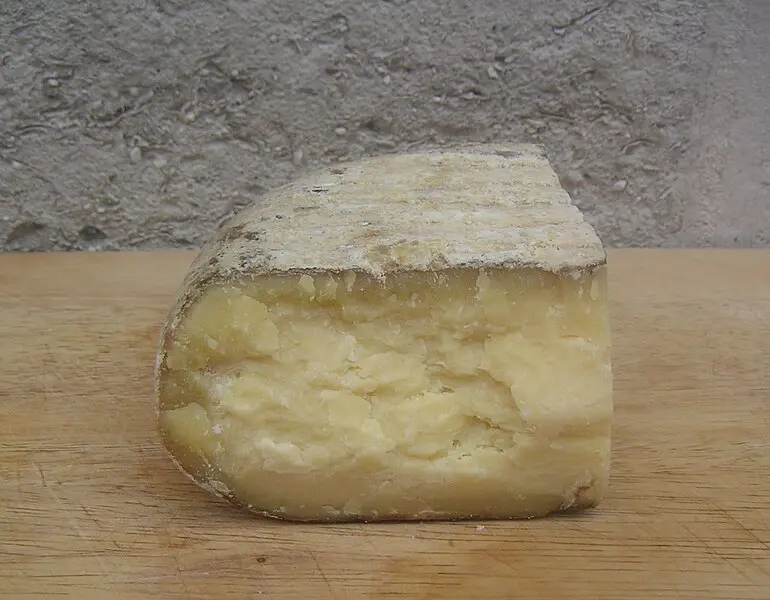
Mahón-Menorca is a white cow's milk cheese from the island of Menorca, named after the town and port of Mahón. It runs soft to hard depending on age, with an orange rind rubbed with butter or oil and paprika and a buttery, sharp, slightly salty taste.
Key Facts
| Country of Origin | Spain |
| Specific Origin | Menorca, Balearic Islands |
| Protection | PDO (1996), PDO (1985) |
| Milk Type | Friesian, Menorcan, Brown Alpine cow’s milk, some ewe’s milk (max 5%) |
| Milk Treatment | Raw or any authorized preservation technology |
| Rind | Characteristic orangish |
| Texture | Firm |
| Flavor | Salty and spicy |
| Aroma | Lactic, buttery |
| Colors | Ivory-yellow to orangey or brownish gray |
| Forms | Parallelepiped shape |
| Age | Tender: 21-60 days, Semi-cured: 2-5 months, Vintage: >5 months |
| Rennet Type | Vegetable (Cynara cardunculus) |
| Alternative Spellings | Maó |
| Also Known As | formatge de Maó, queso de Mahón |
What is Mahón-Menorca Cheese?
Mahón cheese comes from Menorca, an island off the Mediterranean coast of Spain, and takes its name from the town and natural port of Mahón. Cheesemaking there is very old. Ceramic pieces dated to around 2000 BC, or 3000 BC by other accounts, seem to have been farmers' cheesemaking utensils, and a letter written by Bishop Sever around the year 417 records that Menorcans ate milk and cow's cheese.
The Denominación de Origen was granted in 1985 and its regulatory council was set up that same year. In 1997 the protected name changed to Mahón-Menorca Cheese.
The milk is cow's milk, curdled at low temperature, salted by immersion and matured according to the customs of the island. Roughly a century ago a class of gatherer-ripeners appeared on Menorca. They traded farm goods, seeds and food with the farmers, took fresh cheeses in exchange, and aged them in caves while watching the wind and the temperature. Their handling made the cheese a sought-after export. Milk from the island's 600 or so farms all goes into dairy products, and Menorca's cattle are among the highest milk producers in Spain.
The cheese is white, soft when young and hard with age. The rind usually looks orange because it is rubbed with butter, or oil, and paprika. The taste is buttery and sharp, slightly salty, with sweet and nutty aromas that come in part from the sea salt in the grasses the cows eat.
Young Mahón, sold as Maó artesà or Mahón artesano, is aged no longer than three months and stays softer. Keep it in the vegetable compartment of a refrigerator in airtight plastic wrapping. Harder, more aged wheels do better wrapped in foil or waxed paper.
The traditional way to eat it is sliced, sprinkled with olive oil, black pepper and tarragon. The creamy texture also suits pasta, potato, rice and vegetable dishes. Most of the island's production goes into processed cheese.
How Does Mahón-Menorca Cheese Compare?
The most relevant cheeses to compare Mahón-Menorca against.


