Kasseri 
Kasseri is a pale yellow, medium-hard to hard Greek cheese made from sheep milk with at most 20% goat's milk. It belongs to the pasta filata family and is best known as the cheese in saganaki and kasseropita.
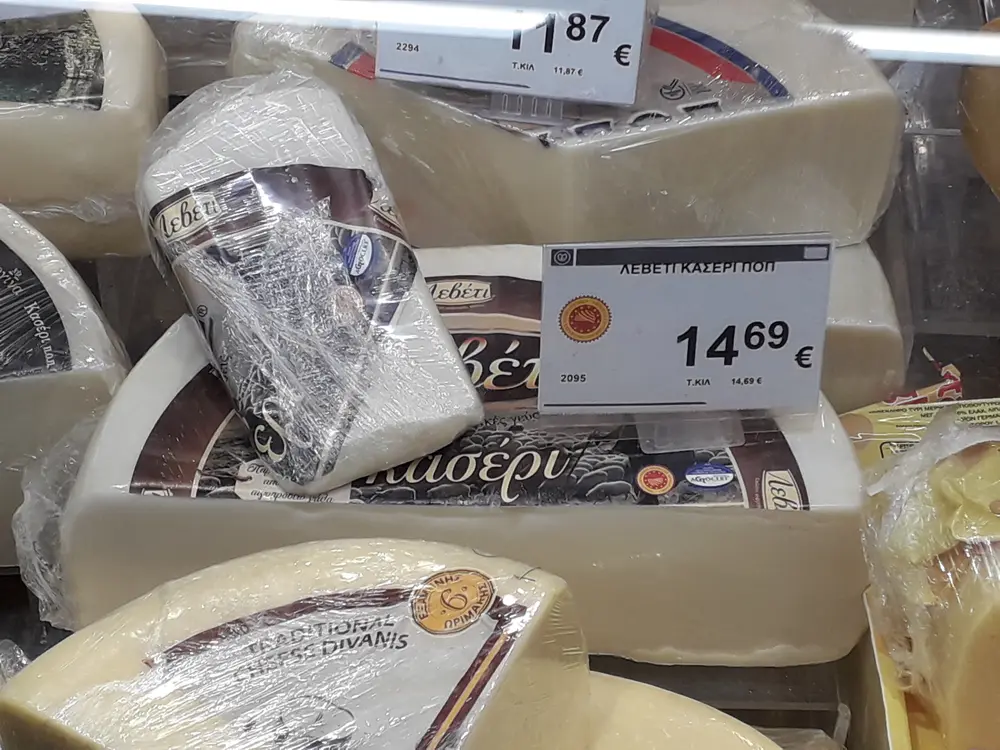
Key Facts
| Country of Origin | Greece |
| Specific Origin | Thrace, Macedonia, Thessaly, Lesbos |
| Protection | PDO (1996) |
| Milk Type | Goat's and sheep's milk |
| Milk Treatment | Traditionally raw, increasingly pasteurized |
| Rind | Develops as ages |
| Texture | Firm to hard |
| Flavor | Rich |
| Aroma | Flowery |
| Colors | Pale yellow |
| Forms | Wheels |
| Age | At least 3 months |
| Rennet Type | Natural rennet |
| Alternative Spellings | Kaser, Kasar, Kaşar |
| Also Known As | Kasseri PDO, Κασέρι |
What is Kasseri Cheese?
Kasseri is Greek, and its protected designation of origin limits production to the provinces of Thessaly, Macedonia, Lesbos, or Xanthi. It is made from pasteurised or unpasteurised sheep milk with at most 20% goat's milk. A close relative called kashkaval is made in Turkey, Romania, and the Balkans. Cow's milk versions exist too, but EU rules bar them from the kasseri name, so each producer sells them under its own label.
The name is usually traced to Turkish kaşer, from the Hebrew word kosher. The story goes that Jewish cheesemakers in Kirkkilise, now Kirklareli in Turkey, made it without rennet, which would have made it fit under Jewish law. Rennet is in fact used, so that account looks like folk etymology. A second explanation points to caseus, the Latin word for cheese.
Production starts with milk heated to 36 °C (97 °F) and enough rennet to set a curd in 45 minutes. The curd is cut into pieces roughly the size of a maize cob and cooked at 38 to 40 °C (100 to 104 °F) with stirring. On the draining tables it is ground by hand, bound tightly in cheesecloth under a small weight, and left to ferment until the pH reaches about 5.2. Thin slices then go into water at 70 to 80 °C (158 to 176 °F) and are kneaded until the mass can be spun into a smooth thread at least 1 meter (3 feet 3 inches) long. After salting and two or three days in molds, the cheese ages at least three months at 18 °C (64 °F).
What comes out is pale yellow, semi-hard to hard, smooth rather than crumbly, chewy, with a hard rind.
It goes into sandwiches, and it is the main ingredient in kasseropita and saganaki. Assyrians use it for gupta tomirta, or buried cheese, which is topped with cumin and sometimes other seasonings.
How Does Kasseri Cheese Compare?
The most relevant cheeses to compare Kasseri against.


