Chaource 
Chaource is a soft cow's milk cheese from the village of Chaource in the Champagne-Ardenne region of France. It has a white Penicillium candidum rind and a slightly crumbly center with a melt-in-the-mouth texture, and it is usually eaten young.
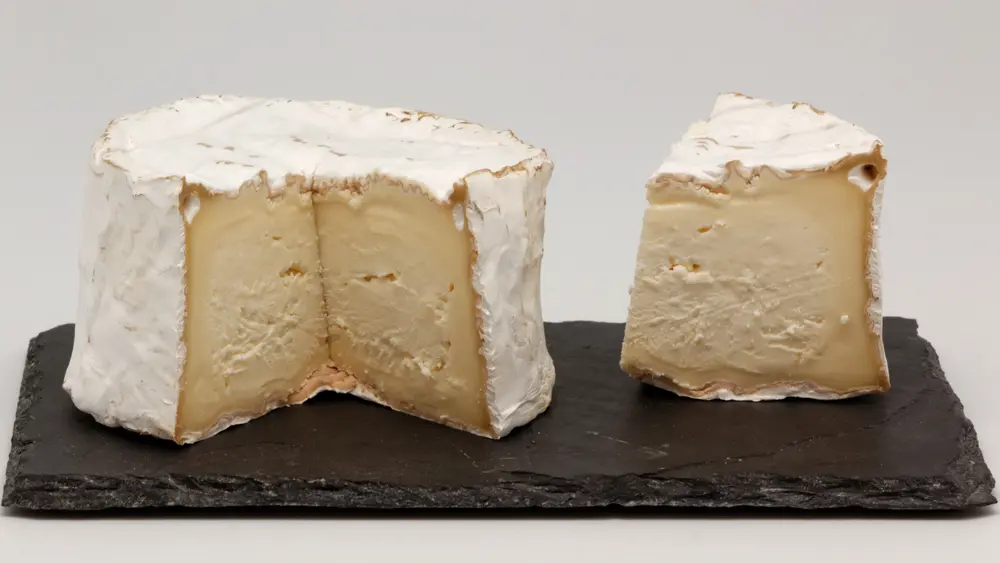
Coyau / Wikimedia Commons
Key Facts
| Country of Origin | France |
| Specific Origin | Aube, Champagne |
| Protection | PDO (1996), AOC (1970) |
| Milk Type | Cow's milk |
| Milk Treatment | Pasteurized or unpasteurized |
| Fat Content | 48% fat on dry matter |
| Rind | Smooth rind |
| Texture | Soft and creamy |
| Flavor | Cream, fresh mushrooms |
| Aroma | Cream and fresh mushrooms |
| Colors | White |
| Forms | Big: 16–25 oz, Small: 9–11 oz |
| Age | At least 14 days |
What is Chaource Cheese?
Chaource takes its name from the village of Chaource in Champagne-Ardenne, where it has been made since at least the Middle Ages. Cheese is still produced there today, from small makers up to industrial-scale operations further away. Production is limited to a tightly controlled area in the departements of Aube and Yonne.
The cheese became an Appellation d'Origine Controlee in 1970 and has been fully regulated since 1977. Under the AOC rules, coagulation must be principally lactic and run for at least twelve hours, and drainage must be slow and spontaneous. The recipe is close to that of Brie. Fat content is a minimum of 50 percent, and both pasteurised and unpasteurised milk are allowed.
Each cheese is cylindrical, roughly 10 cm (3.9 in) in diameter and 6 cm (2.4 in) high, weighing either 250 g (8.8 oz) or 450 g (16 oz). Inside, the pate is soft, creamy in colour and slightly crumbly, wrapped in a white Penicillium candidum rind. It is gently salted, with a light taste and the melt-in-the-mouth quality the cheese is known for.
Affinage usually runs two to four weeks, and Chaource is generally eaten young. In her 2010 book Cheese: Exploring Taste and Tradition, Patricia Michelson describes a bitter nutshell-like flavour with an earthiness that recalls the local wine, and warns that the cheese sits on the salty side, so pairings need care.
How Does Chaource Cheese Compare?
The most relevant cheeses to compare Chaource against.


