
Brie de Meaux 
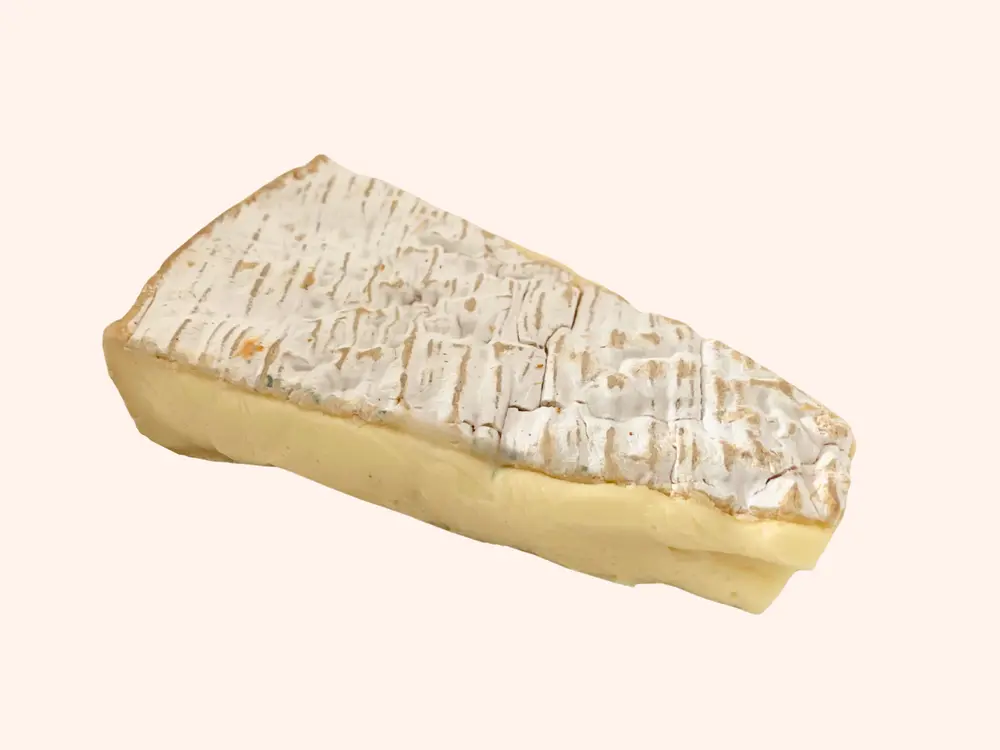
Brie de Meaux is a soft cheese made from raw cow's milk in the Brie region of France, an AOC product since 1980. Wheels run 36 to 37 cm (14 to 14+1/2 in) across, with a delicate white rind and a straw-yellow, creamy interior.
Find Brie de Meaux Cheese
Key Facts
| Country of Origin | France |
| Specific Origin | Meaux |
| Protection | AOC (1980), AOP (1996), PDO (1996) |
| Milk Type | Cow's milk |
| Milk Treatment | Unpasteurized |
| Rind | White mold |
| Texture | Soft |
| Flavor | Cream, butter, hazelnuts |
| Aroma | Buttery, sweet |
| Colors | Ivory to yellow |
| Forms | Wheels 36 to 37 cm (14 to 14+1/2 in) in diameter, about 1 cm tall, average 2.8 kg (6 lb 3 oz) |
| Age | Minimum of 4 weeks |
| Rennet Type | Bovine rennet |
What is Brie de Meaux Cheese?
Brie de Meaux takes its name from the town of Meaux, in the Brie region of France. It has held AOC status since 1980. Output reached 6,774 tonnes in 2003, a decline of 13.4% since 1998.
A modern legend links it to a rich, creamy seventh-century cheese with an edible white rind that the Frankish Emperor Charlemagne tasted and approved in 774 AD, in the company of a bishop, after which two cartloads were sent to Aachen each year. The site came to be associated with the monastery traditionally founded by Rado in Reuil-en-Brie. Talleyrand named the cheese the king of cheeses in 1815 at the Congress of Vienna.
Production starts with raw cow's milk, about 25 litres (6+1/2 US gal) for one wheel 35 cm across and 1 cm tall. The fermented milk sits in a tank for 16 hours, then curdles in a bowl for an hour. It is cut into small cubes with a slice-curd and moulded by hand in thin layers with a brie shovel. The casting room is held at 33 °C (91 °F) for four hours to evacuate the whey, then 24 °C (75 °F) for six hours, then 19 °C (66 °F).
The cheese drains on reed mats, is salted the following day, and stays two days in the curing room. Next comes a room at 12 °C (54 °F), where the white rind begins to appear, then after a week a colder one at 7 °C (45 °F). Three weeks is the minimum, six to eight weeks typical for full maturity, with the wheels turned by hand throughout. Total manufacture runs two months.
A finished wheel measures 36 to 37 cm (14 to 14+1/2 in) in diameter and weighs 2.8 kg (6 lb 3 oz) on average. The rind is soft, delicate and white. The interior is straw-yellow, creamy and soft.
Production is confined to Seine-et-Marne, Loiret, Meuse, Aube, Marne, Haute-Marne and the Yonne. None of it takes place near Meaux, and the town itself does little to celebrate the cheese.
How Does Brie de Meaux Cheese Compare?
The most relevant cheeses to compare Brie de Meaux against.


