Chabichou du Poitou 
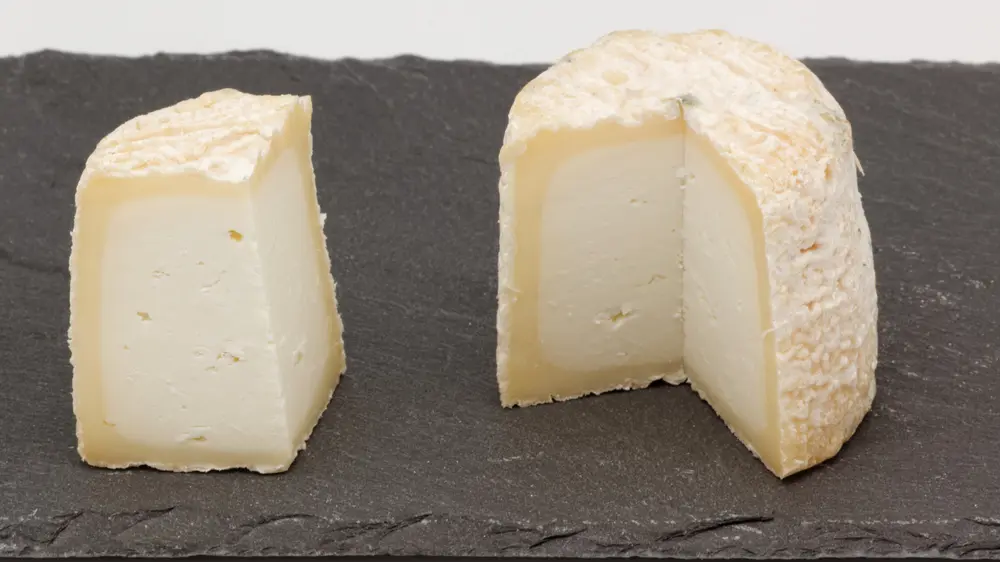
Chabichou du Poitou is a goat cheese from the north of Nouvelle-Aquitaine in France, shaped like a small cylinder called a bonde. It is aged 10 to 20 days and is the only soft-ripened goat cheese that PDO rules allow to be made with pasteurized milk.
Coyau / Wikimedia Commons
Key Facts
| Country of Origin | France |
| Specific Origin | Haut Poitou |
| Protection | AOC (1990), PDO (1996) |
| Milk Type | Goat's milk |
| Milk Treatment | Unpasteurized or whole |
| Rind | White with blue-gray patches |
| Texture | Soft, creamy to brittle |
| Flavor | Slightly salty |
| Aroma | Goaty |
| Colors | White |
| Forms | Truncated cylinder (bonde) |
| Age | At least 10 days |
| Also Known As | Chabichou du Poitou AOP, Chabichou du Poitou AOC |
What is Chabichou du Poitou Cheese?
Chabichou, also known as Chabichou du Poitou, is a goat cheese made only in the north of France's Nouvelle-Aquitaine region. The AOC zone covers the south of Haut-Poitou: the south of Vienne, the Deux-Sèvres and the north of the Charente. The cheese got AOC status in 1990, with help from the efforts of Ségolène Royal, and output reached 555 tons in 2003.
Legend dates it to 732, after the Battle of Poitiers. Some of the defeated Arabs stayed in the area with their families and goat herds, and the pastures suited the "poor man's cow" well. The name is traced to cheblis, Arabic for goat. Goats were likely domesticated here far earlier, under Roman colonization. The cheese appears in print in 1782, in the Guide du voyageur à Poitiers et aux environs, and production climbed twice: once when phylloxera slowed regional wine in the late 1800s, then again as cooperative dairies spread, beginning at Bougon in 1906.
It is made from fresh, whole goat's milk, pressurized only slightly, less than 100 microliters per liter. The milk coagulates over 24 hours at 20 to 22 °C. The curd is moulded by hand with a ladle or mixer into perforated, truncated moulds and drained for 18 to 24 hours at 22 °C, turned over two or three times. After unmoulding it is salted with dry salt or sometimes in a brine bath, drained in drying rooms for 24 to 48 hours, then matured in cellars at 10 to 12 °C with 80 to 90 percent humidity.
Maturing runs at least 10 days and usually two or three weeks. Some wheels are held for months, which gives a more vigorous flavor.
The form is a cylinder called a bonde, after the bunghole of a wine barrel. The rind is natural. Chabichou is very white and smooth, flexible on the palate, semi-soft with a firm, creamy texture and a fine caprine odor.
How Does Chabichou du Poitou Cheese Compare?
The most relevant cheeses to compare Chabichou du Poitou against.


