
Camembert de Normandie 
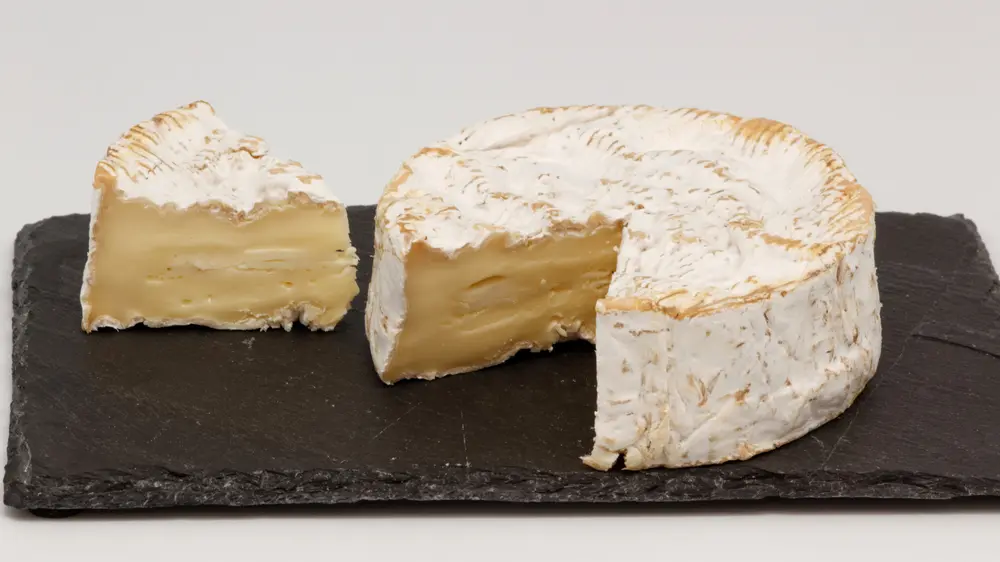
Camembert de Normandie is the AOC version of Camembert, a soft, surface-ripened cow's milk cheese from Normandy in northwest France. The rules require raw milk from Normande cows, and each small round is covered by a bloomy white rind.
Find Camembert de Normandie Cheese
Key Facts
| Country of Origin | France |
| Specific Origin | Normandy |
| Protection | PDO (1983), PDO (1996) |
| Milk Type | Cow's milk |
| Milk Treatment | Unpasteurized |
| Rind | Bloomy, white |
| Texture | Young: Narrow unripe core; Aged: Homogeneous, sticky |
| Flavor | Young: Lactic, tangy, sweet; Aged: Pungent, mushroom, garlic |
| Aroma | Lactic to pungent with notes of mushroom and garlic |
| Colors | Ivory to light yellow |
| Forms | Disk |
| Age | ~30 days |
| Also Known As | Camembert de Normandie AOC, Camembert de Normandie PDO |
What is Camembert de Normandie Cheese?
Camembert was reportedly first made in 1791 by Marie Harel, a farmer in Normandy who followed advice from Abbot Charles-Jean Bonvoust of Alençon. She refined an existing recipe from the Pays d'Auge and passed her secrets to her daughter, whose husband Victor Paynel presented one of his wife's best cheeses to Napoleon III. The cheese sold today owes more to the industrialization of cheesemaking at the end of the 19th century, when the engineer M. Ridel built the wooden box in 1890 that carried it as far as America.
The variety named Camembert de Normandie got its AOC in 1983 and a protected designation of origin in 1992. It makes up roughly 10 percent of Camembert production, and the rules allow only raw, unpasteurized milk from Normande cows. Hygiene regulations have restricted imports and sales in some countries, notably the US, where a pasteurized version is sold instead.
Warmed cow milk is inoculated with mesophilic bacteria, then set with rennet. The curd is cut into cubes of about 1 cm (1/2 inch), salted and filled into low cylindrical molds, which are turned every six to twelve hours so the whey drains evenly. After 48 hours each mold holds a flat cheese of about 250 grams (9 oz), still hard, crumbly and bland. The surface is sprayed with a suspension of Penicillium camemberti, and the cheese ripens for a legal minimum of three weeks.
Affinage builds the bloomy, edible rind and the creamy inside. Camembert tastes stronger than Brie, slightly sour and sometimes chalky, and the paste is softer. Cutting the rind lets out a pungent aroma. Overripe cheese turns sharply ammoniac.
It is eaten whole or in wedges, rind included, and it turns creamier when warmed, while Brie holds its shape under heat. Ripe cheeses are wrapped in paper and packed in thin round poplar boxes, sometimes cartons for cheaper versions, with no brine or oil.
How Does Camembert de Normandie Cheese Compare?
The most relevant cheeses to compare Camembert de Normandie against.


