Époisses 
Époisses is a pungent soft-paste cow's milk cheese from the village of Époisses in Burgundy, France. Washed in brine and Marc de Bourgogne as it ripens, it has a soft red-orange rind that is edible and a strong smell.
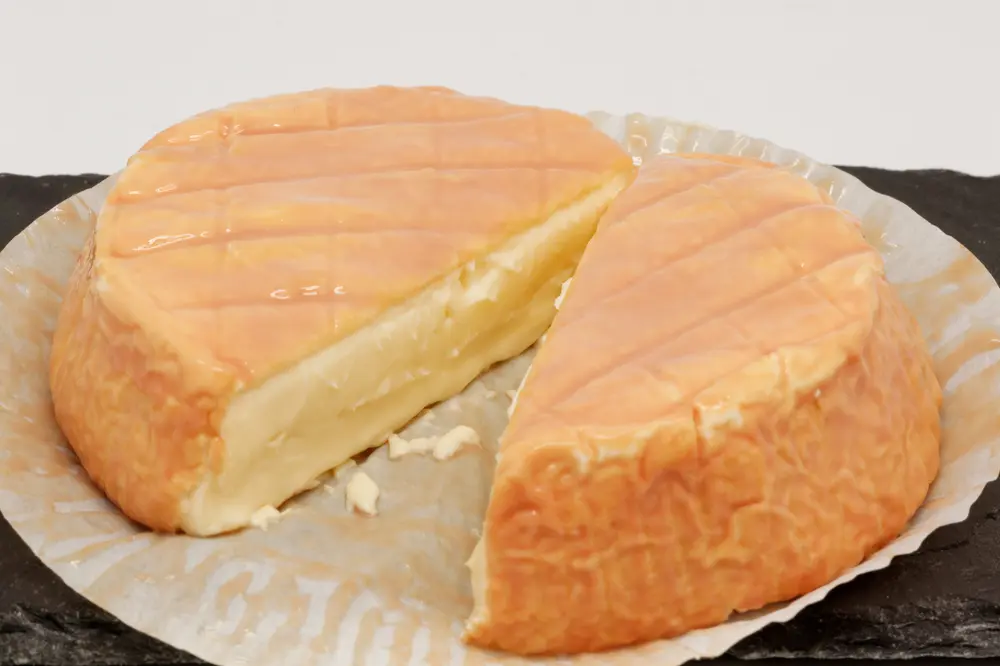
Coyau / Wikimedia Commons
Key Facts
| Country of Origin | France |
| Specific Origin | Auxois and Terre Plaine, Burgundy |
| Protection | PDO (1996), AOC (1991) |
| Milk Type | Cow's Milk |
| Milk Treatment | Raw or pasteurized |
| Rind | Washed-rind |
| Texture | Soft and creamy |
| Flavor | Subtle, fruity, distinctive, balanced |
| Aroma | Undergrowth |
| Colors | Orange ivory to brick red |
| Forms | Small and large sizes |
| Age | Minimum of 28 days |
| Also Known As | Époisses de Bourgogne |
What is Époisses Cheese?
Époisses comes from the village of Époisses in the département of Côte-d'Or, about halfway between Dijon and Auxerre, in the former duchy of Burgundy. Oral legend credits the Cistercians of Cîteaux Abbey with starting production at the beginning of the sixteenth century. When that community left some two hundred years later, local farmers inherited the recipe and worked on it over the following century. Napoleon was particularly fond of it.
Production began to decline after the First World War and had virtually stopped by the 1950s. In 1956 a small farming couple, Robert and Simone Berthaut, relaunched it by gathering the few people who still knew how the cheese was made. Their son Jean now runs the business. Fromagerie Berthaut makes all fermier Époisses, and several artisanal fromageries produce it as well.
Whole milk is heated to around 30 °C (86 °F) and left to coagulate for at least 16 hours. The fragile curds drain in moulds while the whey runs off. About 48 hours later the cheese is removed, salted, and set on racks to dry, then moved to cellars to mature. There it is rinsed up to three times a week in a mixture of water and marc and brushed by hand so the bacteria spread evenly across the surface. Yeast and fermenting agents build the orange-red exterior over roughly six weeks.
The cheese is circular, around 10 cm (4 in) or 18 cm (7 in) in diameter, with a soft red-orange color. The paste is soft, the smell is pungent, and the rind can be eaten. Milk may be raw or pasteurized, and every cheese is sold in a circular wooden box.
Époisses was awarded appellation d'origine contrôlée status in 1991. The rules require coagulation by lactic acid lasting 16 hours, curd cut roughly rather than broken, and dry salt only after drainage. Only cheese made in listed communes of the Côte-d'Or, Haute-Marne and Yonne may bear the appellation.
How Does Époisses Cheese Compare?
The most relevant cheeses to compare Époisses against.


