Comté 
Comté is a hard cheese from eastern France, made daily from raw cow's milk in village dairies called fruitières. It holds PDO status, has the largest production of any French PDO cheese, and tastes mild, nutty, salty and slightly sweet.
Key Facts
| Country of Origin | France |
| Specific Origin | Massif du Jura |
| Protection | PDO (1996), AOC (1958) |
| Milk Type | Cow's Milk |
| Milk Treatment | Raw |
| Fat Content | Around 45% fat in dry matter |
| Rind | Natural |
| Texture | Smooth; Semi-hard |
| Flavor | Nutty, creamy, sweet to meaty, roasted |
| Colors | Pale yellow |
| Forms | Wide, flat wheels |
| Age | 4 months to 3 years |
| Also Known As | Gruyère de Comté |
What is Comté Cheese?
Comté comes from the Jura Mountains of eastern France, built on artisanal methods worked out there about 1,000 years ago. Farmers made it seasonally and kept the wheels for months so the household had food through the cold season. Milk was collected from farms and turned into cheese at co-operative dairies called fruitières, of which there were eventually about 150 in the area. Comté was awarded AOC status in 1958 and PDO status in 1996, and in 2026 it is one of 46 French PDO cheeses.
Fresh milk goes into large copper vats and is warmed gently. Each wheel takes up to 600 litres (160 US gal) of milk. Rennet is added to coagulate the milk, the curds are cut into grains the size of rice or wheat, stirred, then heated again for around 30 minutes. The contents are pressed into moulds to force out the whey, and the wheels mature first for a few weeks at the dairy, then for several months elsewhere. AOC rules allow only milk from Montbéliarde or French Simmental cows or crosses of the two, ban silage in the feed, require the milk be used raw with a single heating during renneting, and set a minimum of four months of maturing.
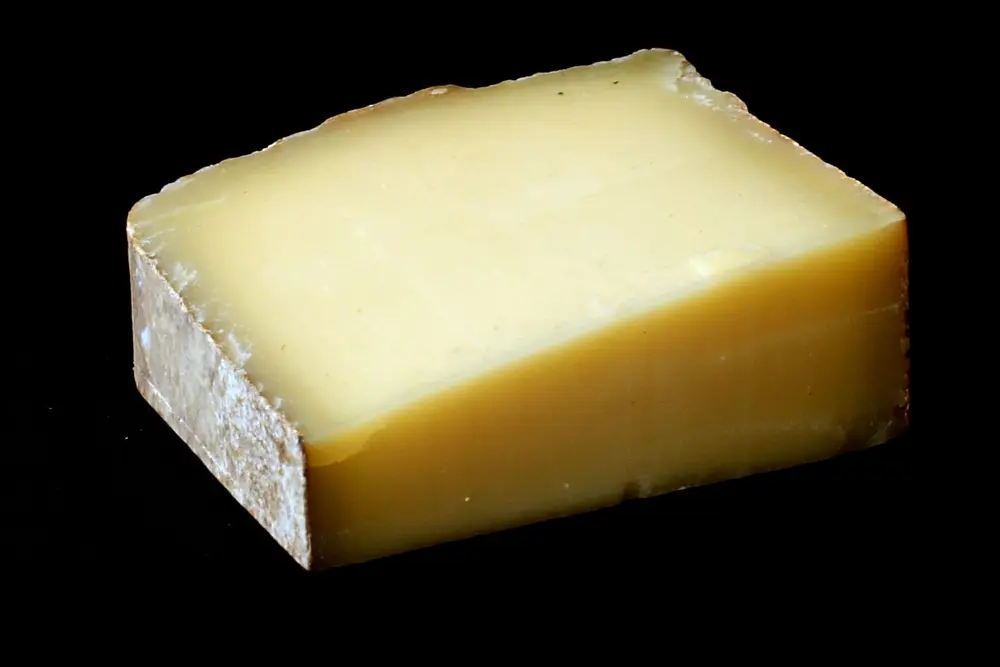
The wheels measure 40 to 70 cm (16 to 28 inches) across and 9 to 13 cm (4 to 5 inches) thick, and weigh up to 55 kg (121 lb). Fat in dry matter sits around 45%. The rind is usually a dusty brown, while the paste inside is a pale creamy yellow. Texture is fairly hard but flexible. The taste is mild, nutty, salty and slightly sweet.
Forty per cent of the French population eats it. Between 1979 and 2007, no grated cheese could be sold under the Comté name. Inspectors score every wheel out of 20; above 14 points it becomes Comté Extra with a green casein label, 12 to 14 points earns a brown label and the plain name Comté, and anything below 12 loses the right to the name and is sold for other purposes.
Flavour varies from dairy to dairy. The cheese is made in 160 village fruitières owned by the farmers who bring milk from their own cows, and panels of trained volunteer tasters meet as a jury terroir to discuss what they find, publishing results every two months in the newsletter Les Nouvelles de Comté. Pierre Androuët wrote in 1983 that there is a world of difference between lowland Comté and mountain Comté.
How Does Comté Cheese Compare?
The most relevant cheeses to compare Comté against.


.jpg)