Bleu de Gex
Bleu de Gex is a creamy, semi-soft blue cheese from the Jura region of France, made with unpasteurized Montbéliard cow's milk and aged at least three weeks. It is milder and younger than most French blues, and every wheel is stamped with the word Gex.
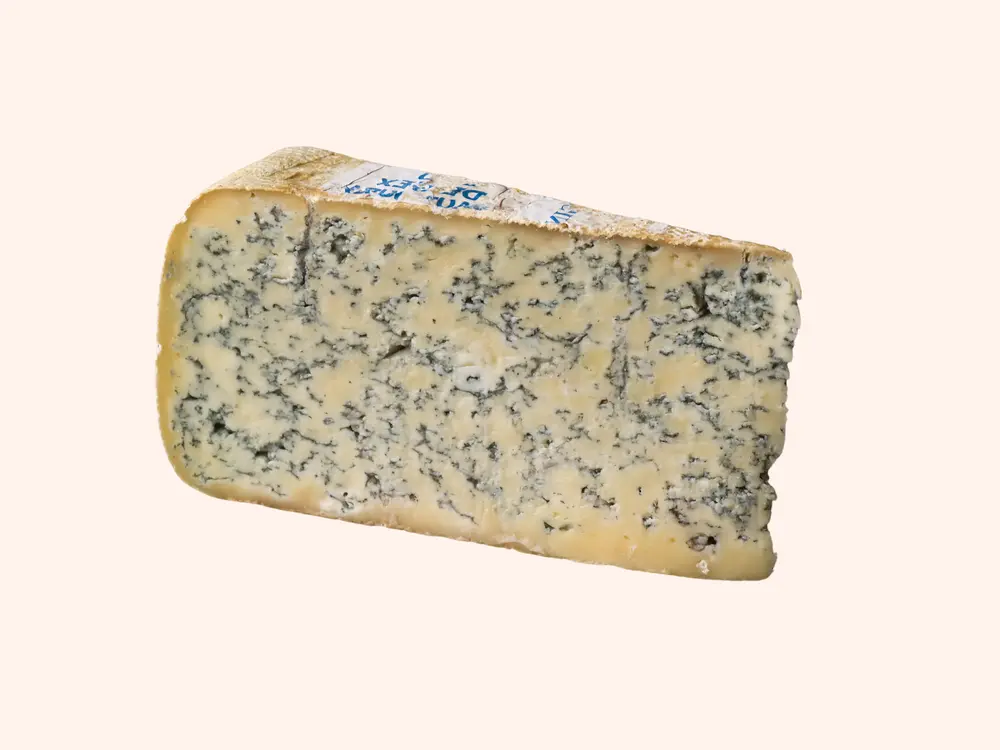
Myrabella / CC BY-SA 3.0 & GFDL
Key Facts
| Country of Origin | France |
| Specific Origin | Haut-Jura, France |
| Protection | AOC (1977), AOP (1996) |
| Milk Type | Cow |
| Milk Treatment | Unpasteurized |
| Fat Content | 29% (50% in dry matter) |
| Rind | Natural, brushed |
| Texture | Creamy |
| Flavor | Mild, with a hint of mushroom |
| Colors | Ivory with blue-green veins |
| Forms | Wheels |
| Age | 3 weeks minimum |
| Rennet Type | Animal |
| Also Known As | Bleu du Haut-Jura, Bleu de Septmoncel |
What is Bleu de Gex Cheese?
Bleu de Gex, also called Bleu du Haut-Jura or Bleu de Septmoncel, comes from the Jura region of France. The name points to the Pays de Gex, a historical area that now sits partly in France and partly in Switzerland. A ruling of the Tribunal of Nantua on 26 July 1935 set the exclusive production zone, which runs from Le Grand-Abergement in Ain to Saint-Laurent-en-Grandvaux in Jura. A decree confirmed that zone on 20 September 1977, and the cheese has held PDO status since 21 June 1996.
Production starts with unpasteurized milk, and Appellation d'Origine Contrôlée rules allow only milk from Montbéliard cows. Penicillium roqueforti is introduced, the unwashed curds are packed loosely, and the wheels age for at least three weeks. Forty-eight dairy farmers, two cooperative dairies and two artisanal cheesemakers in Chézery-Forens, Lajoux, Les Moussières and Villard-Saint-Sauveur turn out roughly 558 tonnes a year. Output has sat near that level for decades: 518 tonnes in 1996, 520 in 2000, 558 in 2010.
The wheels have flat faces with rounded angles between the sides and the heel. They run 31 to 35 cm in diameter and 10 cm thick, and weigh 6 to 9 kg, averaging 7.5 kg. The cheese is uncooked and unpressed, creamy and semi-soft, with 29% fat in the finished product and 50% in the dry matter. Each wheel is stamped with the word Gex. Flavor stays mild, younger and gentler than most French blues.
The best window for eating it falls between May and July, and more broadly from April to November, after about two months of aging. Aged wines such as port make a good match. A version held back longer is known as pérassu. Changes to the U.S. definition of soft cheese in November 2004 mean Bleu de Gex cannot be sold legally in the United States. Two groups promote it: the Syndicat Interprofessionnel de Défense du Bleu de Gex Haut-Jura in Poligny, and the Confrérie des amateurs du Bleu de Gex in Gex, active since 1995.
How Does Bleu de Gex Cheese Compare?
The most relevant cheeses to compare Bleu de Gex against.


