Bleu d'Auvergne 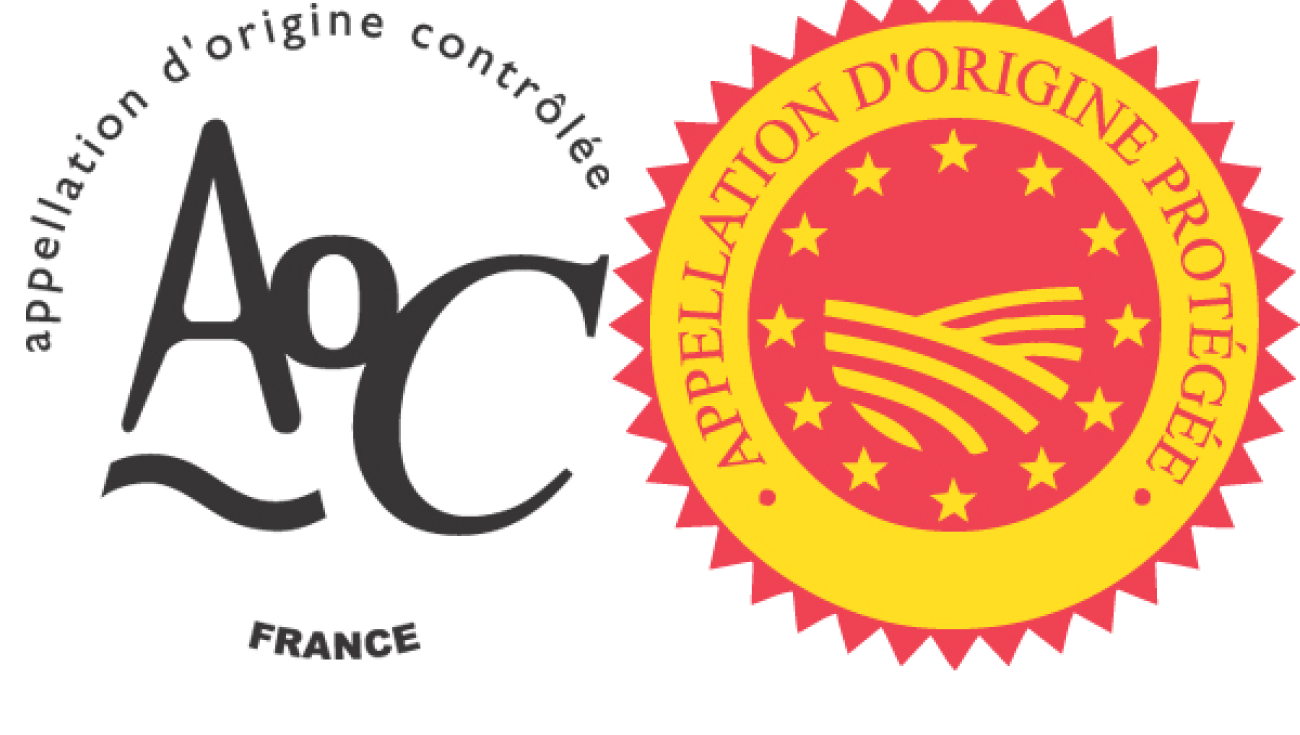
Bleu d'Auvergne is a French blue cheese made from cow's milk in the Auvergne region, with AOC protection. It is less salty and creamier than most blues, and ages only about four weeks.

Key Facts
| Country of Origin | France |
| Specific Origin | Cantal and Puy de Dôme départements, and parts of Lot, Corrèze, Aveyron, Lozère, and Haute Loire |
| Protection | PDO (2009), PDO (1996), AOC (1975) |
| Milk Type | Cow's milk |
| Milk Treatment | Raw or pasteurized |
| Rind | Clean, slightly gray |
| Texture | Firm and creamy |
| Flavor | Intense and distinctive blue |
| Aroma | Strong |
| Colors | White to ivory, marbled with blue to green mold |
| Forms | Cylinder, about 8 inches in diameter and 3–4 inches high, weighing 4–7 pounds |
| Age | Minimum of four weeks |
| Alternative Spellings | Blau d'Auvèrnhe (Occitan) |
| Also Known As | Bleu d'Auvergne AOC |
What is Bleu d'Auvergne Cheese?
Bleu d'Auvergne is a blue cheese made from cow's milk in the Auvergne region of south-central France. It holds the Appellation d'origine contrôlée granted by the French government.
A cheesemaker named Antoine Roussel developed it in the mid-1850s. He saw that blue molds appearing on his curd gave an agreeable taste, so he ran experiments to find out how to bring on the veining deliberately. Several attempts failed. Rye bread mold turned out to produce the veins, and pricking the curd with a needle let oxygen reach the air pockets where the mold could grow. His techniques spread through the region.
Most production now happens in industrial dairies. As of 2018, only one original farm-based producer remained. The refrigerated raw milk the dairies buy is often pasteurized first. Raw or pasteurized, it is mixed with Penicillium roqueforti or Penicillium glaucum, then rennet is added; pasteurized milk is re-inoculated with a limited set of cultured microorganisms to replace the native microbiota it lost. The curd is cut, drained, stirred gently to coat the grain, and placed in molds. Salt goes on the flat faces, then the sides, working slowly into the paste. Mechanical needling pierces each cheese as it enters the cellar. One cheese takes roughly 20 to 25 liters of milk.
Aging runs a minimum of four weeks in cool, humid cellars, a short stretch for a blue cheese. The taste is strong and pungent but gentler than other blues, less salted, buttery, with a moister texture.
It turns up in salad dressings and pasta seasonings, and it holds its own as a snacking cheese. Sweet wines such as dessert-style riesling and sauvignon blanc suit it, as do robust red wines and dark beers like English barley wine or American porter. A peated Islay Scotch works against the salt and cream too.
How Does Bleu d'Auvergne Cheese Compare?
The most relevant cheeses to compare Bleu d'Auvergne against.


